Plato’s tale of Atlantis, told in Timaeus and Critias, has fascinated readers for over two millennia. Yet Plato was not writing in a vacuum. Across the world, from India to Mesopotamia, from Egypt to Tamil traditions, we find stories that sound strangely familiar. These are not “proofs” of Atlantis, but parallels—echoes of catastrophe, paradise, or vanished lands.
Kumari Kandam (Tamil Memory of a Sunken Land)
The Tamil tradition speaks of Kumari Kandam, a lost landmass once ruled by the Pandyan kings. Ancient Tamil texts like Silappatikaram and Kaliththokai describe Sangam academies—gatherings of poets—some of which were said to have been drowned by the sea. Later Puranic texts placed Kumari Kandam in the deep south, now swallowed by the ocean.
It was imagined as a vast territory divided into 49 regions, crossed by mountains with 48 peaks, irrigated by channels from four great rivers. Mining of gems and gold was central. Eventually, the land was said to have been “swallowed by the sea” (Katalkol).
In modern times, revivalists fused this myth with the Victorian hypothesis of Lemuria, a now-abandoned scientific theory about a sunken Indian Ocean continent. Tamil nationalists embraced it as ancestral memory. In my earlier article on Lemuria, I showed how Kumari Kandam became conflated with Lemuria and even Mu, giving the myth a global spin.
Atlantis echo: A golden civilization, irrigated plains, gem mines, destroyed by rising seas.
Kangdez (Iranian Fortress-Paradise)
Iranian epic literature preserves the memory of Kangdez (Fortress of Kang). In the Shāhnāmeh and Bundahishn, Kangdez appears as a miraculous walled city in the Far East. Slides highlight its placement: “at the far eastern ocean, about six months to a year’s voyage from Iran, near the equator, outside China, east of India.”
Descriptions of Kangdez include concentric rings of walls layered with metals and precious stones, plentiful waters, eternal springs, and places of play, silver and gold towers, and a great plain influenced by the sea’s tides with rivers flowing south from volcano-studded mountains.
Atlantis echo: Both traditions emphasize concentric fortifications, gleaming metals, abundance of water, and a paradisal yet precarious geography.
Neserser (Egypt’s Island of Osiris)
In the Book of the Dead (Papyrus of Nu), we encounter Neserser—“the Island of Fire” in the far East, where the sun rises. It is the dwelling place of Osiris (Ausares, Asar) and Thoth. The imagery is vivid: Osiris enthroned in the center of six or seven concentric circles on a sacred lake, a volcanic-like “island and lake of fire” dedicated to Ra, floods that reshape the landscape, and Thoth residing nearby, keeper of divine knowledge.
Later Egyptologists described these circles as “hidden after the flood.”
Atlantis echo: Here again are concentric circles, a sacred island, a great flood, and divine kingship.
Mount Nisir (Mesopotamian Flood Memory)
The Epic of Gilgamesh recounts a great flood, where Utnapishtim builds an ark. After seven days, the boat grounds on Mount Nisir. Slides add color: the land in the Far East was like paradise, with forested mountains, rivers, vast plains, noisy birds, cicadas, and monkeys screaming in the trees.
This imagery is tropical—not the dry Mesopotamian steppe, but a lush, equatorial realm. Some scholars note that “Nisir” is phonetically close to “Neserser” and even “Nusasura.”
Atlantis echo: The flood, the grounding of survivors on a mountain, the paradise-like tropical plain.
The Asuras and the Ahuras
In early Vedic India, the Asuras were not evil—Varuna, guardian of cosmic law and the waters, was chief among them. Later texts, however, cast the Asuras as enemies of the Devas, while Varuna retained dignity as a god of oceans.
In Iranian religion, the cognate term Ahura (as in Ahura Mazda) was elevated as the supreme god, while the Daevas (same root as Devas) became demons.
India (early Vedas): Asuras = powerful lords, led by Varuna
India (later): Asuras = demons
Iran: Ahuras = good, Daevas = bad
Assyria: Ashur = supreme deity
Egypt: Osiris (Asar, Asari) = supreme deity with concentric-circle symbolism
Atlantis echo: The Atlantean kings were “Poseidon’s sons.” Poseidon parallels Varuna/Baruna, lord of seas and boundaries. The name “Atlas” recalls “Asura/Ashur/Osiris.” We glimpse a very old naming web that Solon may have repurposed.
“Atlas” and “Poseidon” as Borrowed Names
Plato openly said he borrowed names “to make the tale intelligible to his audience.” Thus Atlas and Poseidon may be Greek masks for older gods.
Atlas: The mountain-bearing Titan in Greek myth; but also linked to the root “Asura/Asar.”
Poseidon: God of seas and quakes, mirroring Varuna/Baruna/Vouruna—Indo-Iranian lords of waters and oaths.
These echoes suggest that Solon translated Near Eastern deities into Greek equivalents. The concentric rings, sacred kingship, and sea-lord all survive the translation.
The Garden of Eden
Finally, the Garden of Eden—a paradise watered by a river dividing into four: Tigris, Euphrates, Gihon, and Pishon. Genesis places Eden in the East, yet beyond ordinary geography. Some scholars argue Eden reflects older Mesopotamian “Dilmun” traditions—a far-off, pristine land. My 2015 article even suggested Kalimantan as Eden’s real-world counterpart.
Atlantis echo: Eden shares the archetype of a paradise lost—an ordered, fertile place destroyed or closed off after human transgression.
Gosong Gia and Nusantara Echoes
Slides mention Nusasura—possibly the “original name of Atlantis.” It combines nusa (island) and Asura. Old maps show names like Nusasira or Nisaira, perhaps distorted echoes. The Gosong Gia reef in the Java Sea is suggested as a drowned remnant. Even the people of Bawean Island hold myths of a sunken land.
Atlantis echo: If Atlantis lay in the Java Sea, Nusantara traditions like Nusasura may be its local survival in name.
Neserser, Punt, and Southeast Asia: The Egyptian Connection
Plato insists that his Atlantis story came from Egyptian priests at Sais, who told Solon the tale. If so, then the Egyptian worldview—their maps of trade, geography, and sacred memory—shaped what Plato inherited.
The Egyptians had firsthand knowledge of Southeast Asia, preserved in their accounts of the Land of Punt. Punt, described as the Ta Netjer or “land of the gods,” was not a vague myth but a real destination of repeated voyages, from Khufu to Rameses III. The great expedition of Hatshepsut (c. 1493 BCE) is famously carved on her temple walls, showing Egyptian ships sailing to Punt’s harbors.
Products: Gold, camphor (kapur barus), benzoin (kemenyan), cinnamon, ebony, nutmeg, short-horned cows, elephants, and macaques—all endemic to Sumatra and neighboring islands.
Architecture: Puntite houses on stilts match Sumatran and Enggano traditions.
People: Puntites depicted with lighter skin, straight noses, and Malay-style dress, jewelry, and weapons.
Names: Chief Parehu resembles Enggano names (Paraúha, Puríhio). His wife Ati recalls common Indonesian nicknames.
This is not coincidence—it is a cultural fingerprint.
Now let’s place this beside Neserser. The Book of the Dead speaks of Osiris enthroned at the center of six or seven concentric circles, on an island-lake in the far East. The imagery of circles, water, divine enthronement, and flood resonates directly with Plato’s Atlantis.
If the Egyptians already connected their cosmology to the far East—to Sumatra, the “land of origin”—then the parallels between Neserser and Atlantis may not be abstract at all. They may reflect Egypt’s sacred geography projected upon Southeast Asia.
The Thread of Transmission:
Egypt knew Sumatra as Punt—the source of incense, gold, and sacred products.
Neserser represented a circular, island-paradise of Osiris in the East.
Atlantis, as told by priests to Solon, may have drawn on this same Eastern sacred memory.
In this light, Atlantis is not a purely Mediterranean invention. It may encode Egypt’s knowledge of Southeast Asia, filtered through myth, memory, and Plato’s philosophy.
In the Book of the Dead (Papyrus of Nu), we encounter Neserser—“the Island of Fire” in the far East, where the sun rises. It is the dwelling place of Osiris (Ausares, Asar) and Thoth. The imagery is vivid: Osiris enthroned in the center of six or seven concentric circles on a sacred lake, a volcanic-like “island and lake of fire” dedicated to Ra, floods that reshape the landscape, and Thoth residing nearby, keeper of divine knowledge.
Later Egyptologists described these circles as “hidden after the flood.”
Atlantis echo: Here again are concentric circles, a sacred island, a great flood, and divine kingship.
Connecting the Dots: A Discussion
The parallels between Plato’s Atlantis and global myths—from Tamil Kumari Kandam to Mesopotamian Nisir, from Iranian Kangdez to Biblical Eden—show a striking pattern of shared motifs: floods, lost paradises, concentric sacred cities, and divine kingship.
Among these, the Egyptian contribution is the most critical. Plato himself acknowledged that the story came from Egyptian priests. Their sacred geography included Neserser, the concentric island of Osiris in the far East, and their historical voyages reached as far as Punt—identified with Sumatra, the ‘Land of Origin.’
When we combine Neserser’s sacred concentric circles with Punt’s real-world geography and resources, a powerful connection emerges: Egypt not only imagined an eastern paradise, but had knowledge of one. Atlantis may be the philosophical echo of Egypt’s long memory of Southeast Asia.
Thus, the Atlantis story can be seen as a tapestry woven from many threads—myths of lost lands, religious cosmologies, and Egypt’s own encounters with Southeast Asia. Connecting these dots allows us to glimpse Atlantis not as an isolated legend, but as part of a wider human memory of catastrophe, paradise, and rebirth.
Conclusion: When Myths Rhyme Across Oceans
Kumari Kandam, Kangdez, Neserser, Nisir, Asuras, Atlas, Eden—each speaks in its own voice, yet the chorus is familiar. Lost lands, floods, circular cities, divine kings, and paradise destroyed.
Plato may have woven a Greek philosophical tale. But the motifs he used—perhaps borrowed, perhaps remembered—echo far older and wider. Atlantis may not be alone; it may be part of a global pattern of mythic memory of catastrophe and rebirth.
Comparative Snapshot: Parallels at a Glance
A concise table to visualize recurring motifs and where Southeast Asia fits in the Egyptian knowledge frame.
Tradition/Source
Core Setting
Key Motifs
Flood/Collapse
Concentric/Sacred Center
Sea-Lord/Lawgiver
SE Asia Link
Kumari Kandam (Tamil)
Southern drowned land
Golden age, irrigated plains, gem mining, lost coasts
Yes – land swallowed by sea
No explicit circles (ordered realms)
Implied righteous kingship
Indirect (Indian Ocean south)
Kangdez (Iranian)
Fortress in the Far East, near equator
Concentric walls, metals, springs, tidal plain, volcanoes
Implied peril at sea’s edge
Yes – concentric fortifications
Sovereign order (Iranian epic)
Points East; equatorial hints
Neserser (Egypt)
Island-lake in the Far East
Osiris enthroned; 6–7 circles; ‘lake of fire’
Yes – flood imagery; ‘hidden’ after
Yes – canonical concentric circles
Osiris/Ra as sacral law & kingship
Conceptual East (sunrise); bridge to Punt
Mount Nisir (Gilgamesh)
Mountain of grounding
Paradise-like East; forests, birds, monkeys; great flood
Yes – global flood narrative
No (mountain refuge)
Divine warning & survival order
Tropical imagery resonates with SE Asia
Asuras/Ahuras (Indo-Iranian)
Cosmic moral order
Waters, oaths, boundaries (Varuna/Ahura Mazda)
Not central
Symbolic circles (order)
Yes – sea-lord/lawgiver archetype
Cultural substrate across Indo-Iran
Atlas/Poseidon (Greek)
Atlantean kingship; sea-quake god
Names tied to sea power, metals, concentric city
Yes – sudden destruction
Yes – Atlantis capital rings
Poseidon (cf. Varuna/Baruna)
By proxy via Indo-Iran → Egypt
Garden of Eden (Genesis)
Eastern paradise, 4 rivers
Pristine garden, moral test, exile
Yes – loss/expulsion (not flood)
No circles; central river hub
Implied divine law
ANE roots; not specific to SE Asia
Nusasura/Gosong Gia (Java Sea)
Shoal/reef & island lore
Name echoes (nusa + asura); local sunken-land myths
This article reviews Plato’s Critias 113a-b, where the text explicitly states that Solon adapted the Atlantis story to suit a Greek audience. All names of places, figures, and entities were “borrowed” from Classical vocabulary rather than preserved in their Egyptian form. Supporting passages in Timaeus and Critias reinforce this narrative strategy: the exaggerated chronology of Athens, the symbolic geography of the “embodied” Athens, and the reshaping of genealogies such as Atlas as the son of Poseidon. These examples illustrate how audience accommodation shaped the entire narrative. Recognizing this adaptation helps distinguish literary construction from historical geography and prevents confusion between Classical references and their supposed archaic origins.
Among Plato’s dialogues, the story of Atlantis is framed through the figure of Solon, who in turn is said to have received the tale from Egyptian priests. Yet Plato is not merely reporting; he is constructing a narrative that his Athenian audience could understand. This becomes especially clear in Critias 113a-b, where the text acknowledges that Solon “accommodated” the foreign story to Greek ears. This passage provides one of the clearest statements that the names of places, figures, and entities in the Atlantis story are not Egyptian at all, but deliberately rendered into familiar Greek equivalents.
2. Critias 113a-b: The Key Clause
In this passage, Critias explains that Solon translated and borrowed names so that the story would be intelligible to his audience. As a result, every toponym, ethnonym, or personal name is given in Classical Greek form. The implication is sweeping: the geography, characters, and divine figures in the Atlantis account appear clothed in Greek cultural terms, regardless of their supposed original context.
3. Supporting Clauses Across Timaeus and Critias
Other sections of Plato’s narrative reinforce this conclusion:
Timaeus 24e: The priests describe a landmark “which you Greeks call the Pillars of Heracles.” This shows direct acknowledgment that the Greek name is a translation, not the original, and underscores the principle of audience accommodation.
Timaeus 24e: The reference to a distance point in the “Atlantic Ocean” situates the narrative outside the Mediterranean, but still uses a term recognizable to the Greeks.
Timaeus 23e: The claim that “the Athens” existed a thousand years before Egypt is archaeologically unsubstantiated, pointing again to narrative accommodation rather than literal history.
Critias 110d–112e: The description of “the Athens” does not match the real Classical Athens, but rather an idealized embodiment of the city.
Critias 114a: Atlas is called the son of Poseidon—contradicting established Greek mythology—another sign of adaptation for a Hellenic audience.
Taken together, these passages underline that Plato’s text consistently operates within the bounds of Greek cultural imagination, even when claiming foreign origin.
4. A Catalogue of “Borrowed” Names
From Critias 113a-b, we must recognize that the names are not “originals” but Greek renderings:
Places: Atlantic Ocean, the Athens, Cithaeron, Parnes, Oropus, Asopus, Attica, Acropolis, Eridanus, Ilissus, Pnyx, Lycabettus, Pillars of Heracles, Gades, Gadeirus, and others.
This list illustrates how comprehensively the narrative relies on Greek vocabulary. It is not a literal record of Egyptian transmission but a cultural translation.
5. Discussion
5.1 Solon’s Strategy of Audience Accommodation
The priests in Sais may have spoken of cities, rulers, and landscapes unfamiliar to a Greek audience. Plato underscores that Solon, faced with this barrier, chose to “translate” and borrow names into familiar Greek terms. Timaeus 24e makes this explicit, when the priests remark that the landmark was “which you Greeks call the Pillars of Heracles.” The story thus admits openly that names were reshaped to ensure recognition. This was not a distortion, but a narrative strategy: the story had to be intelligible and memorable to Athenians. Without such adaptation, the foreign account would have remained alien and unpersuasive.
5.2 The Chronology of “the Athens”
The assertion in Timaeus 23e that Athens existed a thousand years before Egypt immediately strains credibility. Archaeology shows no such reality. Rather, the chronological claim functions as part of the same accommodation strategy. It elevates Athens into a primeval status, allowing the audience to view their city not only as ancient but as surpassing even the Egyptian civilization. In this way, Solon’s narrative serves the ideological purpose of Greek cultural pride.
5.3 The Embodied Athens
The description of “the Athens” (Critias 110d–112e) diverges strikingly from the Classical city. Plato presents an earlier Athens as vast, fertile, and forested, later reduced to bare rocky soil — the “bones of the wasted body.” The land’s decline from abundance to sterility reinforces a theme of civilizational loss. As argued in my previous article (Plato Embodied Athens as Part of the Atlantis Story), this Athens is not historical but symbolic, embodying the moral contrast Plato wished to draw against Atlantis.
5.4 Atlas as Son of Poseidon
In Critias 114a, Atlas is described as Poseidon’s son, a genealogy foreign to traditional Greek myth. Here again, we see Solon’s accommodation at work. Rather than preserving Egyptian mythic figures or lineages, the story reframes them into recognizable Greek divine structures. Atlas becomes assimilated into the Olympian framework, ensuring that the tale speaks the language of its intended audience.
5.5 Are the Earlier Clauses Affected by Critias 113a-b?
Yes. Although the explicit statement of accommodation appears at 113a-b, the principle operates throughout the narrative from the beginning. The description of Athens’ geography, the mythical genealogy of Atlas, and the exaggerated chronology all reveal the same underlying process: unfamiliar foreign elements reshaped into Greek cultural forms. Critias 113a-b merely articulates openly what had already been practiced in the narrative’s construction.
6. Conclusion
Critias 113a-b makes explicit what is implicit throughout Plato’s Atlantis narrative: the story has been thoroughly filtered through Greek cultural lenses. All names are “borrowed” from Classical vocabulary to ensure audience comprehension. This does not necessarily undermine the possibility of deeper historical kernels but reminds us that the text is a literary construction. To confuse these accommodated names with real-world Classical referents risks a failure of consilience—blurring the distinction between narrative adaptation and historical geography.
This paper reinterprets Plato’s Timaeus and Critias as a structured reservoir of signs and reframes the Atlantis account through a semiotic–linguistic method tested by consilience.
We distinguish two narrative timelines—Timeline I, a flourishing polity and its collapse ca. 9,600 BCE; and Timeline II, the Sonchis–Solon vantage ca. 600 BCE—and two catastrophic phases: Phase I (instant devastation) and Phase II (long-term subsidence and shoaling).
Treating the dialogues’ descriptions as Order-2 properties (connotative features), we reconstruct an Order-3 spatial model constrained by five thalassa domains (ringed harbour waters, Inner Sea, Outer Sea, Ocean 1 facing a mountainous margin, Ocean 2 as the true ocean with an opposite continent) and by a compass-orientation logic that yields three mouth-placement scenarios (east, south, west).
The tropical constraint at ~11,600 BP narrows candidates to the low latitudes; global filtering of macro-properties (larger than Libya and Asia [Minor], facing other islands, adjacency to an opposite continent, coconut/elephant/rice distributions) coheres uniquely in Southeast Asia (Pleistocene–early Holocene Sundaland). Among the three orientation scenarios, the East Mouth Model preserves all constraints at envelope and site scales. Within the southern semi-enclosed sea (ancient Java Sea), the model interlocks a level plain in South Kalimantan, ~100-stadia canal spacing with southward discharge, a capital-port at the reef-mantled high of Gosong Gia (ringed basins), and an eastward entrance through the Kangean Mouth. Bathymetry at Gosong Gia exhibits three benchmarks—concentric circular formations, a small hill near the center, and ~55 m surrounding depths—that anchor secondary urban-harbour properties. Consilience is operationalized as fitness: the degree to which each property improves the puzzle-like interlock across scales.
The result is a testable, Java-Sea–centric reconstruction that articulates concrete predictions for bathymetry, sub-bottom stratigraphy, remote sensing of canal regularities, and navigational corridors.
The foundation of this research is the proposition that Atlantis was a real, physical place, rather than a purely allegorical or mythical construct. The primary source for the Atlantis account is found in the works of the ancient Greek philosopher Plato—specifically, in his dialogues Timaeus and Critias. These texts offer a detailed description of Atlantis, including its location, structure, culture, and its sudden destruction. Unlike many past interpretations that confine their search to the Atlantic Ocean or the Mediterranean, this study reads Plato’s narrative literally and geographically, treating it as a precise account of a real place. This approach avoids bending the text to fit modern assumptions and instead examines it in its own historical and linguistic context.
1.2 Egyptian Origins of the Narrative
The origins of the Atlantis story lie not in Greece but in Ancient Egypt, in the sacred district of Sais (modern-day San Al-Hajar) in the Nile Delta. Around 600 BCE, the Athenian statesman, poet, and lawmaker Solon visited Sais, where he met Sonchis, a senior priest of the temple of Neith. Drawing upon inscriptions and registers preserved in the temple, Sonchis recounted the history of Atlantis as part of Egypt’s recorded past. The Egyptian origin confers a deep historical context to the Atlantis account, situating it within a long-standing written tradition.
1.3 Transmission and Transformation in Greek Tradition
After receiving the account from Sonchis, Solon intended to adapt it into an epic poem but never completed the task. Nevertheless, the story entered Greek oral tradition, where it was recited for roughly two centuries, especially during the Apaturia festivals. Over this period, the narrative underwent several transformations: localization to familiar Greek geographies, characterization of figures to fit Hellenic ideals, personalization to reflect Greek identity, and metaphorization of events. By the time Plato wrote Timaeus and Critias around 360 BCE, he had access both to Solon’s preserved account and to the semi-legendary version shaped by oral tradition. Plato’s composition merges these strands, preserving core historical elements while integrating evolved legendary layers.
1.4 Philosophical Embedding in Plato’s Dialogues
Plato presents the Atlantis story as a dialogue among Socrates, Critias the Younger, Timaeus, and Hermocrates. Critias traces the account to his grandfather, Critias the Elder, who heard it from Solon, who in turn learned it from Sonchis in Egypt. This chain of custody—Egyptian priesthood → Solon → Critias the Elder → Critias the Younger → Plato—demonstrates the layered transmission of the story. The dialogue format serves a philosophical purpose: Atlantis becomes a case study of a great civilization’s moral and political decline, illustrating Plato’s broader arguments about governance, virtue, and societal decay. Understanding the interplay of historical narrative and philosophical intent is essential to decoding the embedded geographical and historical clues in Plato’s text.
2. Methodology: Semiotic and Linguistic Decoding with Consilience
2.1 Theoretical Foundations
The methodological framework guiding this research is rooted in semiotics—the study of signs and signification—and linguistic analysis. It draws upon the seminal contributions of Ferdinand de Saussure, whose dyadic model distinguishes between the signifier (form) and the signified (concept), and Charles Sanders Peirce, whose triadic model adds the interpretant, acknowledging the role of perception and interpretation in meaning-making. Roman Jakobson’s insights into the syntagmatic (linear sequencing of signs) and paradigmatic (associative relationships between signs) axes of language further refine the analytical approach.
Roland Barthes’ theory of orders of signification is particularly crucial here: the first order captures the literal, denotative meaning, while the second order moves into connotation and cultural symbolism, and the third order involves mythic and archetypal narratives. In the context of the Atlantis account, the first order encompasses the explicit geographical and cultural descriptions in Plato’s Timaeus and Critias; the second order reveals the connotative properties that have persisted through centuries of adaptation; and the third order, which is the goal of this study, seeks to reconstruct a coherent historical-geographical model from these connotative signs.
2.2 Analytical Process
The analytical process begins by treating Plato’s dialogues not as pure allegory, but as structured repositories of signs—linguistic, cultural, and topographical—that can be decoded systematically. Syntagmatic analysis examines the sequential order in which descriptions appear, recognizing that narrative structure often reflects spatial relationships or functional hierarchies in the described environment. Paradigmatic analysis explores alternative signs that could occupy the same narrative position, revealing contrasts and associations embedded in the text. Pragmatic analysis situates these signs in their historical, cultural, and environmental contexts, enabling the identification of meanings that would have been evident to Plato’s contemporaries but are obscure to modern readers. Context clues, such as references to seasonal cycles, resource abundance, or navigational constraints, are treated as integral to decoding the embedded realities behind the mythic veneer.
2.3 Archaeological Analogies
The interpretative process is further enriched by analogies drawn from archaeological practice. The potsherds model treats narrative fragments like shards of pottery, requiring careful reassembly to recover the original vessel—in this case, the coherent account of Atlantis. Anastylosis, a method of restoring ruins using original materials, parallels the selective integration of verified textual elements while avoiding speculative insertions. The puzzle analogy emphasizes the identification of primary pieces (corner and edge elements) that anchor the reconstruction, followed by the fitting of secondary pieces that complete the picture. Each fragment is examined for inherent properties, relational connections, and contextual compatibility with other fragments before it is integrated into the larger model.
2.4 Role of Consilience
At the core of this methodology is the principle of consilience: the convergence of evidence from independent, unrelated fields to support a single conclusion. In the study of Atlantis, this involves cross-verifying decoded signs from Plato’s narrative with data from geology, paleogeography, archaeology, oceanography, climatology, linguistics, and cultural history. A reconstructed Order-3 model is only considered robust if multiple disciplines independently affirm its key parameters—such as geographic setting, environmental conditions, and cultural practices. This multidisciplinary validation ensures that the reconstruction is not merely a product of literary interpretation, but a hypothesis anchored in empirical reality. The process thus moves from identifying signs in the text, through decoding their layered meanings, to testing the resulting model against the tangible record of Earth’s past landscapes and civilizations.
Plato’s account operates across two temporal reference frames that must be distinguished analytically. These frames structure how the narrative preserves both a living civilization and the memory of its aftermath.
Timeline I(Atlantis era, ca. 9,600 BCE): depicts the polity at its height and its sudden destruction; the descriptive clauses pertain to a functioning landscape of plain, canals, capital-island, and maritime gateways.
Timeline II(Sonchis–Solon vantage, ca. 600 BCE): records persistent physical residues (e.g., shoaling, impassable waters) observable long after the initial collapse; these are the lens through which Solon receives the account in Egypt.
Within and across these timelines, the narrative encodes a two-phase catastrophe model that explains both the instant ruin and the long-term navigational impediment.
Phase I— Instant devastation: violent earthquakes and floods culminating “in a single day and night of misfortune” (Timaeus 25c–d; cf. Critias 108e, 112a).
Phase II — Slow subsidence and shoaling: progressive settling and near-surface obstruction described as “even now… impassable and unsearchable” (Timaeus 25d; Critias 111b–c).
In semiotic terms (Barthes), the features extracted from the dialogues are treated as Order–2 signifieds—connotative properties (e.g., navigational “mouth,” rectangular plain, canal grid, reef-mantled shoal). These Order-2 properties are the inputs to an Order-3 reconstruction: a coherent, testable historical-geographical model. Validation proceeds by consilience—independent convergence from geology, paleogeography, archaeology, oceanography, biogeography, and navigation studies.
3.2 Time Frame Phases (Timeline I & Timeline II) with Phase I/II Catastrophe Context
Timeline I(Atlantis Era, ca. 9,600 BCE) profiles the polity prior to and at the onset of Phase I catastrophe. The following items are extracted from Plato with clause control and treated as Order-2 properties.
Timeline I/Phase I — Order-2 Properties:
Tropical-belt indicators: year-round fertility, hydrological abundance, and megafauna (elephants) consistent with warm, rainy conditions (Critias 113e; 114e–115a).
Location beyond a functional ‘mouth’ (Pillars of Heracles), marking transition from the outer sea into an enclosed inner sea (Timaeus 24e–25a; Critias 113c).
Regional scale “larger than Libya and Asia [Minor] combined” (Timaeus 25a).
Topography and orientation of the continental frame: a great level rectangular plain “three thousand by two thousand stadia” (~555 × 370 km) open southward to the sea and sheltered by mountains to the north (Critias 118a–b); moreover, “towering mountains on the side toward the ocean” characterize the ocean-facing margin (Critias 118a).
Engineered waterways: inland canals at ~100 stadia (~18.5 km) spacing with traverse connectors; drainage supplied by mountain streams (Critias 118c–d; 113e–114a).
Capital-port city organized in concentric rings of land and water; bridges and a straight canal from the sea (Critias 115c–116a; 115d–e).
Material palette: quarries of white, black, and red stone; hot and cold springs (Critias 116a–b; 113e).
Metals and resources: orichalcum alongside gold, silver, tin; abundant timber and agriculture (Critias 114e–115a).
Phase I catastrophe: instant devastation by earthquake and flood; “in a single day and night… disappeared into the depths” (Timaeus 25c–d; Critias 112a).
Timeline II (Sonchis–Solon vantage, ca. 600 BCE) records the landscape after Phase I, during Phase II’s long-term adjustments. Order-2 readings privilege the connotative, physically persistent meanings over the bare literal phrasings.
Timeline II/Phase II — Order-2 Properties:
Persistent near-surface obstruction (Order-2 reading): a reef-mantled shoal created by subsidence and subsequent carbonate accretion, producing long-lived impassability for vessels; cf. the Order-1 clause “even now… impassable and unsearchable… very shallow shoal (of mud)” (Timaeus 25d; Critias 111b–c).
Fragmentation of the former landmass into islands; approach to the former capital unnavigable due to reefal mantling (inferred from the enduring obstruction and navigational context).
Dense vegetation and abundant fauna, including elephants (Critias 114e).
Sustained agricultural richness in a warm, rainy regime: “all kinds of fruits and crops” (Critias 114e–115a).
3.3 Sea-Mouth and Pilotage Sequence: Navigational Signifiers
The narrative encodes a maritime gate (“Pillars of Heracles”) and a structured approach route. Crucially, the text implies five distinct thalassa domains, which must not be conflated:
Ringed harbour waters — the concentric salt-water basins of the capital (Critias 115c–116a).
Inner Sea — the enclosed basin reached through the mouth (Critias 113c).
Outer Sea — the sea immediately beyond (faced by) the mouth that contains “other islands” (Timaeus 24e–25a).
Ocean 1 — the oceanic margin that faces the “towering mountains” of the continent (Critias 118a).
Ocean 2 — the “true ocean” adjacent to the Outer Sea and containing the “opposite continent” (Timaeus 24e–25a).
Accordingly, the Outer Sea is not the same as Ocean 1. The pilotage sequence proceeds: Outer Sea → Mouth (Pillars) → Inner Sea → Straight Canal → Ringed Harbour Waters (Timaeus 24e; Critias 113c; 115d–e; 115c). Ocean 1 pertains to the continental ocean-facing margin (mountainous), while Ocean 2 denotes the broader oceanic realm with the opposite continent.
Note on identity and orientation: Ocean 1 and Ocean 2 may describe the same oceanic body when considered from different azimuthal sides relative to the system’s geometry. In such cases, “Ocean 1” denotes the segment confronting the continental mountain front (Critias 118a), whereas “Ocean 2” denotes the broader continuity that includes the opposite continent (Timaeus 24e–25a). The distinction is directional, not categorical.
3.4 Geographical Compass-Orientation Layout Model
A compass-oriented reading of the Order-2 properties yields a spatial logic without fixing a modern map. We adopt the five θάλασσα [thálassa; body of salt water] definitions above: Ringed Harbour Waters; Inner Sea; Outer Sea; Ocean 1; Ocean 2.
The level plain is “open to the sea” on its south and “sheltered by mountains” on its north (Critias 118a–b); hence, the Inner Sea lies to the south of the plain.
Main canals within the plain “discharge toward the city” (Critias 118c–d), implying southward flow toward the capital’s maritime approach.
The capital-port with ringed salt-water basins is accessed from the Inner Sea (Critias 115c–116a; 115d–e). Depending on sea-level state (Holocene transgression), it lies at the southern edge of the plain or on a separate island along the north coast of the Inner Sea.
The sea-mouth cannot be north of the Inner Sea (the plain’s north is mountainous). It may lie to the east, south, or west of the Inner Sea (Timaeus 24e; Critias 113c).
The Outer Sea is the water body directly faced by the mouth and contains the other islands (Timaeus 24e–25a).
Ocean 1 is the oceanic margin facing the towering mountains of the continental frame (Critias 118a).
Ocean 2 is the “true ocean,” adjacent to the Outer Sea and containing the opposite continent (Timaeus 24e–25a).
The boundless continent that encloses the Inner Sea occupies the azimuths other than the mouth; on its ocean-facing side toward Ocean 2 it bears “towering mountains” (Critias 118a).
Ocean 1 and Ocean 2 may be hydrographically connected and may even be the same oceanic body viewed from different sides; they need not be colinear with the mouth-facing Outer Sea relative to the Inner Sea and plain.
From the compass-orientation constraints above, the sea-mouth can lie on only three azimuths relative to the Inner Sea and plain—east, south, or west (cf. Timaeus 24e; Critias 113c). These define three alternative spatial models that will guide puzzle-assembly in the reconstruction.
East-Mouth Model
The mouth faces east toward the Outer Sea (with “other islands,” Timaeus 24e–25a). The Inner Sea lies south of the plain; the capital’s access remains from the north coast of the Inner Sea. Ocean 1 (mountain-facing) and Ocean 2 (true ocean with the opposite continent) may occupy different azimuthal sectors to the east/southeast; they can be hydrographically connected or even the same oceanic body seen from different sides.
South-Mouth Model
The mouth opens directly to the south from the Inner Sea to the Outer Sea. The canal flow remains southward toward the city; capital placement at the southern edge of the plain (or as a near-shore island) is emphasized. The Outer Sea abuts Ocean 2, and the mountainous Ocean 1 margin bounds a separate sector of the continental frame.
West-Mouth Model
The mouth faces west to the Outer Sea with islands. The Inner Sea still lies south of the plain, and the canal grid drains southward to the capital. Ocean 1 denotes the mountainous ocean margin on the continental side (Critias 118a), while Ocean 2 is the broader oceanic realm with the opposite continent (Timaeus 24e–25a); as above, they may be connected or represent different sides of one oceanic body.
(a) East-Mouth Model
(b) South-Mouth Model
(c) West-Mouth Model
Figure 1.Three alternative compass-oriented spatial models without fixing a modern map. (a) East-Mouth Model, (b) South-Mouth Model, (c) West-Mouth Model. 1. Boundless continent. 2. Towering mountain. 3. Other islands. 4. Opposite continent. 5. Ocean 1. 6. Ocean 2. 7. Outer sea. 8. Inner sea. 9. Capital-port city with ringed salt-water. 10. Sea mouth. 11. Access canal. 12. Level plain open at south with waterways. 13. North side protection of plain (mountains). → Pilotage sequence. Source: author’s compass-oriented reading.
These three orientation scenarios define mutually exclusive search envelopes for spatial reconstruction. In Section 4, each model is assembled property-by-property, treating every Order-2 property as a puzzle piece. The consilience test is the fitness evaluation: how well each piece can be reconstructed (assembled) and interlock with other pieces to produce a coherent reconstructed structured object—the fully assembled puzzle of Atlantis. Fitness is assessed by concordance with independent constraints (e.g., paleoshorelines at ~–60 m, seismic/tsunami plausibility, reef-mantling and shoaling behavior, archaeological analogues, and maritime navigation patterns). The model with the highest joint fitness across properties is retained.
4. Reconstruction and Consilience Test
Section 4 translates the Order-2 properties extracted from Plato’s Timaeus and Critias into a structured, map-like Order-3 reconstruction. The procedure follows the compass-orientation logic derived in Section 3 and tests three mutually exclusive mouth-orientation scenarios (east, south, west). Each scenario defines a search envelope within which the plain, canal grid, capital-island, ringed harbours, mouth, and mountain frame must interlock. At each step, the assembled configuration is evaluated for fitness—how well every property (‘puzzle piece’) coheres with the others to approach a coherent reconstructed structured object (the fully assembled puzzle of Atlantis).
4.1 Tropical Constraint (~11,600 BP)
Plato’s clauses imply a warm, rainy climatic regime with year-round fertility, abundant hydrological resources, and megafauna such as elephants (Critias 113e; 114e–115a). As Order-2 indicators, these constrain the candidate geography to the tropical belt at the terminal Pleistocene/early Holocene transition (~11,600 BP). Regions at higher latitudes are excluded on climatic grounds.
Figure 2.Global vegetation at ~11,600 BP; tropical belt highlighted. Source: author’s compilation after standard palaeovegetation maps.
4.2 Global Narrowing to Sundaland
Within the tropical belt, the narrative properties admit multiple macro-regional possibilities that must be explicitly screened before committing to a reconstruction. The following filters are applied as Order-2 tests of possibility (not yet conclusions):
Larger than Libya and Asia [Minor] combined → Southeast Asia (Sundaland); Central America.
Facing towards other islands → Southeast Asia; Central America.
Next to an opposite continent encompassing the true ocean → Southeast Asia.
Coconut distribution → Southeast Asia, South Asia, Central America.
Elephant distribution → Southeast Asia, South Asia, Central Africa.
Rice (domestication/early cultivation) → Southeast Asia, South Asia.
When these filters are applied jointly and interpreted through the dual-timeline/dual-phase lens, the only coherent fit at the Pleistocene–early Holocene boundary is Southeast Asia (Sundaland). Moreover, the spatial logic inherent in Section 3 (plain north of an Inner Sea; canals discharging southward; capital accessed from the Inner Sea; mouth facing a field of islands; boundless continent elsewhere) selects the East Mouth Model as the configuration that best preserves all constraints for further testing.
Figure 3.World map at ~11,600 BP with converging markers; Sundaland emphasized. Source: author’s reconstruction.
4.3 Sundaland Envelope: Enclosed Sea, ‘East Mouth,’ Mountains, and Sea Level (~–60 m)
Adopting the East Mouth Model, we focus on Sundaland with sea level near −60 m at ~11,600 BP. First, the macro-properties from 4.2 remain applicable at this scale: (i) a realm larger than Libya and Asia [Minor] (Sunda Shelf extent); (ii) facing towards other islands (archipelagic fields flanking the entrance); and (iii) next to an opposite continent which encompasses the true ocean (the broader oceanic realm beyond the island field).
Second, additional properties emerge at the envelope level: a semi-enclosed sea bounded by a boundless continent on its non-mouth sides; and the necessary existence of a sea mouth providing access from the Outer Sea. Two placements satisfy these conditions: a southern semi-enclosed sea and a northern semi-enclosed sea. The southern candidate—corresponding to the ancient Java Sea—fits the orientation logic of Section 3.4 (plain to the north; canals to the south; capital accessed from the Inner Sea) and is therefore advanced to the next step.
The northern alternative satisfies the sea-mouth requirement and faces other islands (though at greater distance); however, it lacks the critical property of being ‘next to an opposite continent’—that is, adjacency to the true ocean with an opposite continental mass. Consequently, the northern option does not fully meet consilience and is set aside.
Supplementing this envelope analysis, the inner geometry (plain size and orientation, canal spacing, ringed harbours, mountain frame) is preserved without contradiction under the East Mouth Model, and is poised for site-scale evaluation in 4.4.
Figure 4.Sundaland and the ancient Java Sea: enclosed sea, eastern mouths, mountain arc; shoreline ~–60 m. Source: author’s reconstruction.
4.4 Level Plain & Canals (South Kalimantan); Capital-Port and Mouth Placement
Within the southern semi-enclosed sea (ancient Java Sea), the reconstruction reviews prior properties and specifies site-scale elements: (i) a level alluvial plain in South Kalimantan approaching the proportions of “three thousand by two thousand stadia” (Critias 118a–b); (ii) a canalizable surface allowing ~100-stadia (~18.5 km) spacing and southward discharge toward the maritime approach (Critias 118c–d; 113e–114a); (iii) the capital-port city located at or near Gosong Gia reef—a reef-mantled high that communicates with the Inner Sea; and (iv) the sea mouth placed at the Kangean Mouth, supplying the required eastward entrance from a field of islands. These elements strengthen the East Mouth Model by interlocking the plain–canal–capital–mouth geometry into a single coherent frame.
Pilotage Sequence (applied): Vessels approach from the Outer Sea through the Kangean Mouth (east-facing entrance) into the Inner Sea (ancient Java Sea), then proceed along a straight canal to the ringed harbour waters of the capital at Gosong Gia—conforming to the sequence established in Section 3.3: Outer Sea → Mouth → Inner Sea → Straight Canal → Ringed Harbours.
Figure 5.South Kalimantan level plain and canals; placement of the capital-island inside the mouth. Source: author’s reconstruction.
This subsection reviews (not tests) the set of properties related to the capital-port city as described in the narrative. They form the inventory of pieces to be matched against site-scale evidence in 4.6 and integrated by fitness in 4.7:
Rings of water and land (concentric basins).
Fortification elements associated with the rings.
An accessing passage from the sea linking the Inner Sea to the basins.
A bridge system across the rings.
An underpass (sub-ring passage) enabling movement beneath a bridge.
Harbours integrated with the ring basins.
A royal palace complex on the central island.
State officials’ housing arranged in proximity to the palace.
A small hill near the center bearing a Poseidon temple.
A horse race track associated with the ceremonial/urban core.
Figure 6.Conceptual rendering of the ringed capital-island: water/land rings, bridges, and central sanctuary. Source: author’s reconstruction.
4.6 Benchmarks at Gosong Gia (Reef-Mantled High): Bathymetry vs Plato
Bathymetric survey results at Gosong Gia exhibit three properties that map directly onto Plato’s description and thus function as benchmarks (anchoring points) for the assembly of secondary pieces listed in 4.5:
Concentric circular formations aligned with ringed basins.
A small hill close to the center consistent with the temple-bearing eminence.
Sea depth around the coral reef ≈ 55 m, coherent with a reef-mantled high and near-surface obstruction.
These benchmarks anchor the secondary urban-architectural pieces—fortifications, passage, bridges/underpass, harbours, palace, officials’ housing, and race track—within a single coherent geometry. In the puzzle metaphor, the three benchmarks are the corner/edge pieces that fix the frame.
Figure 7.City plan vs. Gosong Gia bathymetry: central knoll, annular trough ~55 – 60 m and three benchmarks. Source: author’s comparison.
4.7 Consilience Tests
Consilience is applied at every step of the reconstruction, with fitness defined as the degree to which a candidate placement of each property (‘puzzle piece’) coheres with the assembled whole. The process explicitly tests and fits possibilities—for example, choosing between the southern vs northern semi-enclosed sea in 4.3, and evaluating the applicability of the East Mouth Model as established in 4.2. The fitness measure here is configuration-specific, asking whether each step improves the interlock of all properties within the Sundaland envelope and the Java Sea focus. The scenario that maximizes joint fitness across 4.1 – 4.6 is retained for synthesis and prediction.
4.8 Testable Predictions
The reconstruction yields concrete, falsifiable expectations at site and regional scales. These predictions operationalize the consilience framework by specifying where and how the configuration should be observable. Priority tests include:
Bathymetric/sonar imaging immediately around Gosong Gia should resolve a nested, near-concentric relief consistent with ringed basins and a small central-adjacent eminence.
Sub-bottom profiling and coring around the reef rim should recover sequences indicative of rapid post-event carbonate mantling and, where preserved, tsunami-grade reworking at depth consistent with ~11,600 BP triggers.
Remote sensing and DEM analysis across South Kalimantan should reveal rectilinear drainage or anthropogenic alignments that express ~100-stadia (~18.5 km) spacing, with a net southward gradient toward the ancient Java Sea.
Along the Kangean Mouth approach, relics of controlled passages (scoured channels, sills, or anthropogenic alignments) should be mappable along plausible fairways leading toward Gosong Gia.
Within the capital footprint, geophysical survey should prioritize loci for fortification traces, bridge abutments/underpass features, harbour aprons, palace/administrative platforms, the temple-bearing hill, and a linear/elliptical race-track embankment.
5. Conclusion
This study has treated Plato’s Timaeus and Critias as a structured repository of signs, extracting Order-2 properties (connotative features) and assembling them into an Order-3 reconstruction that is explicitly tested by consilience. The analytical scaffold distinguishes two narrative timelines (Timeline I, ca. 9,600 BCE; Timeline II, ca. 600 BCE) and two catastrophic phases (Phase I, instant devastation; Phase II, long-term subsidence and shoaling). Within this frame, the maritime system is parsed into five thalassa domains—ringed harbour waters, Inner Sea, Outer Sea, Ocean 1 (ocean-facing mountain margin), and Ocean 2 (true ocean with the opposite continent)—and constrained by a compass-orientation logic that yields three mutually exclusive mouth placements (east, south, west).
Across Sections 4.1–4.4, the reconstruction proceeds stepwise. First, the tropical constraint (~11,600 BP) filters candidates to the low latitudes. Second, global screening of narrative properties (larger than Libya and Asia [Minor]; facing other islands; next to an opposite continent encompassing the true ocean; coconut/elephant/rice distributions) yields a coherent fit in Southeast Asia during the Pleistocene/early Holocene exposure of Sundaland. Third, among the three orientation scenarios, the East Mouth Model best preserves the spatial logic derived in Section 3: a level plain to the north of an Inner Sea, southward canal discharge toward a maritime capital, a mouth that faces a field of islands, and a boundless continental frame elsewhere. At envelope scale (Section 4.3), the southern semi-enclosed sea (ancient Java Sea) satisfies the ‘opposite continent’ adjacency that the northern alternative lacks; thus the southern option advances.
At site scale (Section 4.4), the model interlocks: (i) a level alluvial plain in South Kalimantan approaching Plato’s stated dimensions (three thousand by two thousand stadia); (ii) a canalizable surface with ~100-stadia (~18.5 km) spacing and southward discharge; (iii) the capital-port’s ringed harbour waters positioned at a reef-mantled high at Gosong Gia; and (iv) an eastward entrance at the Kangean Mouth, yielding a pilotage sequence of Outer Sea → Mouth → Inner Sea → Straight Canal → Ringed Harbours. Section 4.5 inventories the capital properties from the dialogue (concentric rings of water and land; fortification; accessing passage; bridges and an underpass; harbours; royal palace; state officials’ housing; a small hill near the center with a Poseidon temple; and a horse race track), while Section 4.6 identifies three bathymetric benchmarks at Gosong Gia—concentric circular formations, a small central-adjacent hill, and ≈55 m surrounding depths—that anchor those secondary pieces in a coherent urban-harbour geometry.
Consilience in this framework is operationalized as fitness at every step: the degree to which each Order-2 property (puzzle piece) improves the interlock of the assembled structure without generating contradiction. The northern semi-enclosed sea option, while satisfying a mouth and facing other islands (at distance), fails the ‘next to an opposite continent’ criterion and therefore does not achieve joint fitness. By contrast, the southern semi-enclosed sea under the East Mouth Model maintains coherence from envelope to site scale and accommodates the Timeline II residue of a persistent obstructor as an Order-2 reef-mantled shoal.
The testable predictions generated by this synthesis are now consolidated in Section 4.8 to remain adjacent to the reconstruction steps they evaluate. The model stands as a map of verifiable expectations—an invitation to test a very old story against the seafloor and the sediments that still remember it.
This article synthesizes Plato’s narrative in Timaeus–Critias with modern earth-science processes. It proposes a two-phase catastrophe model—an instant devastation followed by long-term subsidence—and clarifies the dual timeline: the age of Atlantis versus Solon’s “now.”
1. A Two-Phase Catastrophe Model
Phase 1 — The Instant Devastation (Tsunami & Quake)
Textual anchors: “violent earthquakes and floods; and in a single day and night of misfortune… the island of Atlantis… disappeared into the depths of the sea.” (Timaeus 25c–d). Critias recalls the same blow as “the greatest of the deeds… which a single stroke of fortune wiped out” (Critias 108e) and the “cataclysm which devastated” the Athens and Atlantis (Critias 112a).
Modern analog: a large offshore earthquake triggers extreme ground-shaking and a basin-scale tsunami. Minutes to hours bring lethal inundation, building collapse, coastal scour, and abrupt cultural termination—matching Plato’s “single day and night” formulation.
Phase 2 — The Slow Sinking (Subsidence & Shoaling)
Philology. Plato’s clause at Timaeus 25d: πηλοῦ κάρτα βραχέος ἐμποδὼν ὄντος, ὃν ἡ νῆσος ἱζομένη παρέσχετο. Conservative sense: “a very shallow shoal (of mud) standing in the way, which the settling island furnished.” The wording denotes an extremely shallow navigational impediment; it does not, by itself, fix the material genesis.
Geology/geomorphology. After a megaquake, the crust can continue adjusting for years to centuries. Coastal plains compact; deltaic clays dewater; faulted margins creep—incremental subsidence that deepens water over ruins and progressively establishes near-surface shoaling.
Carbonate settings. In warm, clear, well-circulated tropical waters, biogenic carbonate (including corals) can accrete over centuries–millennia, mantling and maintaining a near-surface obstruction (“reef‑mantled, near‑surface shoal”) consistent with the conservative phrasing.
Navigation & bathymetry implications:
Labyrinths of shoals and patch highs strand low-draft hulls; oars and rudders can foul in unconsolidated substrates.
Depth, swell, light attenuation, and lack of optical aids limit effective underwater search for ancient mariners.
Ancient pilots would justifiably brand such waters “impassable” (Timaeus 25d; Critias 111b).
2. Dual Timeline Alignment in Plato’s Narrative
Plato alternates between the remote past (Atlantis’ zenith and its sudden demise) and the narrators’ present—really Solon’s present as reported by Egyptian priests and re‑narrated by Critias. Markers like νῦν (“now”) and “to this day” describe present‑tense conditions contrasting with the mythic past.
Timeline
Keywords/Greek
Representative Passages
What It Describes
Past — Atlantis’ glory & sudden devastation
σεισμοί (earthquakes), κατακλυσμοί (floods)
Timaeus 25c–d; Critias 108e; 112a
One‑day apocalyptic event: quake‑tsunami destroying population, structures, and power.
Aftermath observed “to this day”: impassable, very shallow shoal (of mud) furnished by the settling island; often reef‑mantled in the long run.
Representative Passages (with clause numbers)
Timaeus 25c–d: “Violent earthquakes and floods… and in a single day and night of misfortune… the island of Atlantis… disappeared into the depths of the sea. Therefore even now (διὸ καὶ νῦν) the sea at that place is impassable and unsearchable, blocked by a very shallow shoal (of mud) which the settling island furnished.”
Critias 108e: “…the greatest of the deeds of your city, which a single stroke of fortune wiped out.”
Critias 111b–c: “…for which reason the sea to this day is impassable and unsearchable, being blocked by the shallowness of the mud which the island created as it settled… …what is now (νῦν) called ‘stony’ (phelleus) was then fertile…”
3) Cross-Disciplinary Notes (Quick Reference)
Philology
ἵζω/ἵζομαι — “to seat; to settle; to sink down.” Hence ἱζομένη/ἱζοῦσα used by Plato for continuing settlement/subsidence.
πηλός — mud/clay; βραχύτης/βραχέος — shallowness/“shallow”; ἐμποδών — “in the way, as an impediment.”
Conservative clause-level gloss: “a very shallow shoal (of mud) standing in the way, which the settling island furnished.”
Geology & Geomorphology
Instant devastation from quake–tsunami, followed by post‑seismic deformation, compaction, and slope failures.
Within the Holocene transgression, progressive near‑surface shoaling may persist; in carbonate provinces, reef/carbonate accretion can keep obstructions close to the surface.
Marine Ecology & Carbonates
Coral and other carbonate producers thrive in clear, well‑circulated, well‑lit waters; over time they can mantle and maintain near‑surface shoals.
Archaeology
Expect a time‑transgressive stack: cultural layers truncated by tsunami, overlain by marine sediments, later mantled by biogenic carbonates.
Closing Synthesis
Plato’s narrative signals both a one‑day cataclysm and a centuries‑scale aftermath: the event ends a civilization; the process leaves a ship‑stopping, very shallow shoal “of mud,” often later reef‑mantled in suitable settings.
Notes & References
Primary texts: Plato, Timaeus and Critias (Stephanus 25c–d; 108e; 111b–c; 112a). Clause numbers are stable across editions. Greek phrases are quoted for precision; translations are intentionally conservative at clause level.
A research by Dhani Irwanto, 26 August 2025, addendum 3 September 2025
Abstract
This essay re-reads Timaeus and Critias through the literal Greek στόμα [stoma, “mouth; opening; entrance”] and argues that “Pillars of Heracles” in the Atlantis passage is a Greek nickname for a functional sea entrance rather than a fixed strait. It reconstructs a pilot’s sequence—outer sea → mouth → inner sea → local canal → ringed salt-water basins—and situates the terminology within Aegean seamanship and Cretan myth. The discussion then applies this framework to the Kangean Mouth and Java Sea interior as a testable case, without relocating the Pillars into Atlantis. The result is a navigational, not monumental, reading that clarifies “beyond/within” and provides concrete criteria for evaluating proposed geographies.
This article also makes explicit the method by which meaning is recovered. We treat στόμα [stoma, “mouth; opening; entrance”] as a sign whose meaning is to be sought in context rather than presumed. The inquiry proceeds by (i) semiotics (Saussure’s signifier/signified; Peirce’s icon/index/symbol; Barthes’ Orders 1–3), (ii) linguistics (syntagmatic chain, paradigmatic choice, commutation tests, pragmatics), and (iii) philology (ancient Greek usage and intertexts). Read this way, the text yields a two-threshold pilotage sequence: outer sea → sea-mouth → inner sea → local canal → ringed basins.
Within this framework, the priest’s phrase Ἡρακλέους στήλαι [Herakleous stelai, “Pillars of Heracles”] functions as a Greek ethnonymic label for the sea-mouth, not as a monument located inside Atlantis. The “beyond/within” pair—πρὸ τοῦ στόματος [pro tou stomatos, “before the mouth”] vs. ἐντὸς τοῦ στόματος [entos tou stomatos, “within the mouth”]—is thus doorway language, not a trick of bearings.
We also make explicit a crucial context clue in the dialogue: the Egyptian priest’s audience-accommodation when naming the gateway. He says, in effect, “the entrance which you Greeks call the Pillars of Heracles” (Greek: ὃ παρ’ ὑμῖν … Ἡρακλέους στήλαι [ho par’ hymin … Herakleous stelai, “what among you is called the Pillars of Heracles”]). This phrasing signals that the navigational gate has no fixed Greek technical term in the source tradition; instead, the priest borrows the Greek sailors’ ethnonymic label so the Athenian audience will recognize the function being discussed. Semiotics and pragmatics therefore support reading the Pillars here as a Greek name for a sea-mouth (στόμα, stoma), not as a monument inside Atlantis.
Finally, we treat the Kangean Mouth/Java Sea as a Barthes Order-3 application (an assembled structured object). The question is empirical: does the Kangean–Java setting instantiate the full pilotage sequence and its landscape cues? The approach invites consilience—independent lines of evidence must converge if the model is to be preferred over rivals.
Most modern readings of Plato’s Atlantis begin at a celebrity landmark. This essay starts with the words themselves. In Timaeus and Critias, the mariner first passes a στόμα θαλάσσης [stoma thalasses, “mouth of the sea; sea mouth”], which the Egyptian priest says the Greeks call the Pillars of Heracles; only then does he work an inner sea, and only then a narrow canal into ringed harbor basins. Treating “Pillars of Heracles” as the Greek nickname for the mouth—not a monument in Atlantis—restores the helmsman’s course and clarifies “beyond” and “within”. Set against Aegean seamanship and Cretan myth, this reading supplies clear criteria that can be applied to real geographies. Here we apply it to the Kangean Mouth and the Java Sea interior, without claiming the label itself ever stood in the Indies: the point is the function, not a fixed latitude.
1. A discursive reading of Plato’s route
Plato narrates a course rather than a map. The sailors begin in the outer sea and sight a recognized entrance, the στόμα θαλάσσης [stoma thalasses, “mouth of the sea; sea mouth”], or sea mouth. In his wording, what lies πρὸ τοῦ στόματος [pro tou stomatos, “before the mouth”] is the true, outer sea, with long fetch and swell; what lies ἐντὸς τοῦ στόματος [entos tou stomatos, “within the mouth”] is a calmer interior: a navigable basin enclosed by continental-scale land. Only once that interior is reached does the focus narrow to an island with engineered works. A second, local threshold appears here: a διώρυξ [dioryx, “canal; cut”] that admits ships into concentric basins. Because θάλασσα [thalassa, “sea; salty water”] can mean salty water as well as the sea at large, Plato can call those basins “seas” without contradiction. The full sequence is: outer sea → sea mouth → inner sea → local canal → ringed basins.
Plato cue:Timaeus 24e–25a evokes the outer vs inner contrast; Critias 115d–116d describes the canal and the ringed basins.
2. Why the word “mouth” matters and what the Pillars are (and are not)
The key noun in Plato is στόμα [stoma, “mouth; opening; entrance”] in the phrase ἐντὸς τοῦ στόματος [entos tou stomatos, “inside the mouth”], set over against ἔξωθεν … ἐκ τοῦ Ἀτλαντικοῦ πελάγους [exothen … ek tou Atlantikou pelagous, “from outside, out of the Atlantic sea”]. Taken literally, Plato frames the approach as passing a sea‑mouth (gateway) from the outer sea into an inner one; translating στόμα as “strait” is an interpretive narrowing, not a requirement of the Greek. The Egyptian priest then clarifies that this gateway is “what you Greeks call the Pillars of Heracles” (Greek: Ἡρακλέους στήλαι [Herakleous stelai, “Pillars of Heracles”]), which reads naturally as a Greek sailors’ label for the entrance under discussion, not a feature inside Atlantis. This keeps two thresholds distinct—(i) the sea‑mouth (“Pillars”) between outer and inner seas and (ii) the later διώρυξ [dioryx, “canal; cut”] into the ring‑harbors—without importing extra geography into the sentence.
Note. For an Athenian audience, “Pillars of Heracles” ordinarily evoked the western world‑gate. Here the term functions first as a label for the στόμα in Plato’s syntax; comparative geographic anchoring is evaluated separately in the application.
3. A functional label in Greek literature, not a fixed monument
Greek authors often use the Pillars of Heracles as a limit-name, a proverbial boundary of sailing rather than a set of stones in a city. In Pindar the Pillars mark the farthest reach of human endeavor; in Isocrates (Philippos 111–112) Heracles sets up trophies that define the boundary of the Hellenes. Geographers like Strabo record competing identifications for the Pillars—temple columns at Gades, islets, or facing capes at an ocean mouth—which shows that even in antiquity the label was not static.
Independently of the heroic label, Greek prose routinely calls chokepoints στόμα [stoma, “mouth; opening; entrance”]. One speaks of the στόμα Πόντου [stoma Pontou, “mouth of Pontus (Black Sea entrance)”] for the Black Sea entrance. In everyday pilotage, multiple mouths mattered to Greek seafaring: the Hellespont into the Propontis and onward to the Black Sea; the Cretan approaches into the Aegean; the Strait of Messina and the Sicily Channel between the Ionian and Tyrrhenian or the eastern and western basins; and, more peripherally, the Atlantic mouth at Gibraltar. The point is functional: a mouth is a gateway between water bodies, often carrying a culturally loaded name.
4. Pre-Solon seamanship and a gradient of knowledge
Classical memory credits early Crete with a thalassocracy and imagines Minoan power as maritime. Whether in empire or in everyday cabotage, Aegean pilots learned by repetition at major mouths—Hellespont, Cretan approaches—collecting rules of season and wind, lee and eddy. That is the core of Greek nautical experience.
Beyond the Aegean, Greek knowledge stretched west through the Ionian and Tyrrhenian and toward the far Atlantic mouth, often by way of Phoenician mediation. Those thresholds were real and named, yet less routine for many Aegean sailors. This gradient explains why a Greek narrator would naturally speak in mouth/inside terms while leaving the exact identity of any far-west gate more fluid in literature.
5. Why a Cretan lens strengthens the sea-mouth reading
In mythic geography Crete is the island of Zeus and a stage for Heracles, whose capture of the Cretan Bull links the hero to the island. In such a world, naming a gate after a hero is both memory and signal: a way to imprint a threshold in a sailor’s mind. The toponym Heraklion shows how the hero’s name endures in Cretan space.
From this lens, the phrase “which you Greeks call the Pillars of Heracles” reads like a mariner’s nickname for a mouth at the relevant stage of a voyage. The sequence Plato gives—mouth, interior basin, second local entrance, rings—matches a helmsman’s logic for approaching a fortified island port on the lip of a plain.
Figure 1. Aegean/Cretan context for a “Pillars of Heracles” gate-name. Dashed arc marks a conceptual sea mouth; the label is a Greek nickname for an entrance, not a fixed monument.
6. “Beyond” and “within”: a semantic discussion rather than a direction-finding trick
The contrast between πρὸ τοῦ στόματος [pro tou stomatos, “before the mouth”] and ἐντὸς τοῦ στόματος [entos tou stomatos, “within the mouth”] is doorway language. The doorway is the στόμα θαλάσσης [stoma thalasses, “sea mouth; mouth of the sea”], the sea mouth. Read this way, “beyond” means ocean-ward of the entrance currently being worked; “within” means basin-ward. Fixing the Pillars at a single western landmark is a later habit that need not control Plato’s phrasing in this passage.
7. From outer sea to ringed harbors: Plato’s wording in sequence
The narration flows without a break when read as pilotage. First comes the outer sea and the recognized mouth: “Outside the entrance lies the true sea; but the sea inside the mouth is enclosed, and the land around it may most truly be called a continent” (Timaeus 24e–25a). Then comes the interior geography of islands leading toward a larger land: “Opposite the mouth there lay an island, from which you could pass to other islands, and from them to the whole of the opposite continent” (Timaeus 25a–b).
Only inside the basin does the narrative narrow to engineered features: διώρυξ [dioryx, “canal; cut”] for a canal from the sea to the outer ring and κύκλοι θαλάσσης καὶ γῆς [kykloi thalasses kai ges, “rings of sea and land”] for rings of sea and land, bridged so ships could pass below (Critias 115d–116d). The large entrance and the local canal are distinct thresholds.
8. A Semiotic Lens on στόμα and the “Pillars of Heracles”
Sign and task. In this reading, στόμα [stoma, “mouth; opening; entrance”] is treated as a sign whose meaning is “to be sought” in context rather than presumed. Its phrase στόμα θαλάσσης [stoma thalasses, “sea mouth; mouth of the sea”] cues a functional gateway within a navigation narrative.
Context clue (pragmatics): audience accommodation in the priest’s phrasing. The Egyptian priest frames the entrance as “what among you is called the Pillars of Heracles” (Greek: ὃ παρ’ ὑμῖν … Ἡρακλέους στήλαι [ho par’ hymin … Herakleous stelai, “what among you is called the Pillars of Heracles”]).
Transliteration and literal sense.Ἡρακλέους στήλαι [Herakleous stelai, “Pillars of Heracles”] is the Greek label; παρ’ ὑμῖν [par’ hymin, “among you (Greeks)”] marks audience-specific naming.
Semiotic force. Pragmatically, the priest code-switches to a Greek exonym for an entrance whose native (Egyptian/Atlantean) term is not shared. As a symbol, the phrase invokes a conventional Greek gateway-name; as an index, it points to a functional sea-mouth; as an icon, “mouth” evokes the form (narrowing/widening) that pilots recognize.
If the meaning were a universally fixed Greek proper name with no ambiguity, the accommodation “what you Greeks call …” would be unnecessary. The wording therefore supports treating Pillars here as a Greek ethnonymic label for the στόμα, not as a feature located inside Atlantis.
Saussure (dyadic). The signifier is the sequence of sounds/letters στόμα; the signified is the seafaring entrance/gateway that separates the outer (ἔξωθεν … ἐκ τοῦ Ἀτλαντικοῦ πελάγους [exothen … ek tou Atlantikou pelagous, “from outside, out of the Atlantic sea”]) from the inner (ἐντὸς τοῦ στόματος [entos tou stomatos, “within the mouth”]). Choosing στόμα rather than a stricter “strait” term preserves the doorway metaphor and the two-threshold logic.
Peirce (triadic).
Icon: the mouth’s form (bottleneck widening to basin).
Index: hydrodynamics (swell attenuation, tidal jets, lee and eddy) that pilots observe at entrances.
Symbol: Ἡρακλέους στήλαι [Herakleous stelai] as a conventional Greek name for a sea gate.
Barthes (orders of signification).
Order 1 (denotation): στόμα, στόμα θαλάσσης—a mouth/entrance.
Order 2 (connotation): Aegean pilotage culture, Cretan mythic lens, and the contrast πρὸ τοῦ στόματος [pro tou stomatos, “before the mouth”] vs. ἐντὸς τοῦ στόματος [entos tou stomatos, “within the mouth”] shape “beyond/within” as doorway language.
Order 3 (assembled object): the pilotage sequence—outer sea → sea-mouth → inner sea → local διώρυξ [dioryx, “canal; cut”] → κύκλοι θαλάσσης καὶ γῆς [kykloi thalasses kai ges, “rings of sea and land”]—yields a structured model to test against real coasts.
Linguistic tests.
Syntagmatic chain: preserves the pilot’s order of operations (outer sea → mouth → inner sea → local canal → rings).
Paradigmatic choice: explains why στόμα fits better than “strait.”
Commutation: replacing στόμα with “strait” collapses the two thresholds.
Pragmatics: the speaker–audience alignment (priest → Solon → Critias → Athenians) explains the ethnonymic “what you Greeks call …”.
Reconstruction and consilience (Puzzle model; Orders 2 → 3). We treat each navigational and topographical cue as a single “puzzle piece” fixed at Order 2; these pieces are assembled with additional “property pieces” into a fully reconstructed structured object at Order 3, which is then tested by consilience.
Order‑2 pieces (signs with constrained meanings):
Sea-mouth (στόμα [stoma, “mouth; opening; entrance”]) in phrase στόμα θαλάσσης [stoma thalasses, “sea mouth; mouth of the sea”]; priest’s accommodation ὃ παρ’ ὑμῖν … Ἡρακλέους στήλαι [ho par’ hymin … Herakleous stelai, “what among you is called the Pillars of Heracles”] as Greek ethnonymic label.
Doorway opposition: πρὸ τοῦ στόματος [pro tou stomatos, “before/beyond the mouth”] vs. ἐντὸς τοῦ στόματος [entos tou stomatos, “within the mouth”].
Inner sea as basin: θάλασσα [thalassa, “sea; salty water”] can denote salty water at harbor scale as well as the sea at large.
Local canal: διώρυξ [dioryx, “canal; cut”] connecting inner sea to harbor works.
Ringed salt‑water basins: κύκλοιθαλάσσηςκαὶγῆς [kykloi thalasses kai ges, “rings of sea and land”] with bridges for ship passage.
Route logic: island(s) opposite the mouth (νῆσος [nēsos, “island”]) leading toward a greater land called continent (ἤπειρος [ēpeiros, “continent”]).
Additional “property” pieces integrated at assembly:
Island facing the sea‑mouth (νῆσος [nēsos, “island”]) opposite the gateway.
Towering mountain on the ocean side (ὑψηλὸς καὶ ἀπότομος ἐκ θαλάττης[ypsi̱lós kaí apótomos ek thalátti̱s, “towered and precipitous from the ocean”]) shaping lee/swell and visual pilotage.
Boundless continent surrounding the inner sea (ἤπειρος [ēpeiros, “continent”]) consistent with a shelf‑rimmed basin.
South‑Kalimantan level plain (πεδίον [pedion, “plain”]) with canals open to the sea at the south and protected by mountain ranges at the north.
Capital‑island south of the plain: Atlantis‑time functionality includes controlled channels (διώρυξ [dioryx, “canal; cut”]) and ringed salt‑water basins (θάλασσα; thalassa) for harbor operations.
Post‑destruction overprint (non‑contemporaneous): coral‑reef accretion during sea‑level rise renders the sunken city’s approaches unnavigable except via channels. This is a later overprint, not a feature of the functional city.
Temporal coherence of pieces. Atlantis‑time pieces (including the ≈ −60 m shoreline) govern the functional reconstruction: sea‑mouth, inner sea, capital‑island, plain, canals, and ringed θάλασσα. The coral‑reef barrier is explicitly a post‑event transgressive overprint; it should not be used as a controlling feature for the Atlantis‑time harbor design, but as an explanatory layer for present‑day unnavigability of the ruins.
Consilience and falsifiability. Order‑3 assembly is a testable model: independent lines of evidence (linguistic, hydrodynamic, geomorphic, engineering) must converge on the same configuration. Failure on any core piece weakens or falsifies the assembly; convergence strengthens it. Note that this remains an application, not a relocation: the phrase Ἡρακλέους στήλαι [Herakleous stelai, “Pillars of Heracles”] is a Greek label for the στόμα; the geographical testing happens at the level of the assembled object (Order 3).
9. Applying the sea-mouth reading to the Kangean Mouth/Java Sea
Method note. This section is an application, not a relocation claim. It tests whether any real coastline instantiates Plato’s full navigational sequence (outer sea → mouth → inner sea → local canal → ringed basins) and associated landscape cues.
On the outer sea approach, the Kangean passages behave like a named mouth: outer-sea-ward of them is the long-fetch exterior; basin-ward lies the Java Sea. This cleanly fits the “beyond/within” semantics and preserves the two-threshold logic. Once within, the Java Sea functions as an interior basin and a continental shelf rim, a Sundaland-flavored analogue to Plato’s interior sea.
The local entrance is then a separate matter: διώρυξ [dioryx, “canal; cut”] or constrained cut at the island port that controls access to staged, protected basins. Because θάλασσα [thalassa, “sea; salty water”] can name salty water in general, ringed harbor pools remain consistent with Plato’s diction. Two objections are common: first, that “Pillars of Heracles” must mean Gibraltar; second, that the numerical scales in the Atlantis story resist any Southeast Asian setting. The functional, ethnonymic use of “Pillars” in Greek literature answers the first; the second concerns the genre and calibration of Plato’s figures, and need not overturn the doorway reading.
In short, the Kangean Mouth → Java Sea interior satisfies the narrative sequence without forcing the Pillars into Atlantis or anchoring them permanently at the Atlantic mouth. It offers a testable geography aligned with the helmsman’s perspective that Plato’s words suggest.
Invitation. Competing geographies that satisfy the same sequence are welcome; whichever model best fits the full set of constraints should be preferred.
Figure 2. Kangean Mouth and Java Sea interior: conceptual placement of the regional mouth, inner basin, plain, canals, port-side island entrance, and reef-limited approaches (schematic).Order‑3 Consilience & Predictions
The semiotic lens turns scattered signs into a structured model that can be tested against a real coastline. The assembled pilotage sequence is: outer sea → sea-mouth → inner sea → local διώρυξ [dioryx, “canal; cut”] → κύκλοι θαλάσσης καὶ γῆς [kykloi thalasses kai ges, “rings of sea and land”]. Each step is a claim about function, not a fixed monument.
This sets out an Order‑3 consilience checklist with explicit temporal handling. Atlantis‑time pieces (including the ≈ −60 m shoreline) govern the functional reconstruction—sea‑mouth, inner sea, capital‑island, plain, canals, and ringed θάλασσα. By contrast, the coral‑reef barrier that renders the present‑day ruins unnavigable is a post‑destruction transgressive overprint during sea‑level rise; it must not be used as a controlling feature for the city while it was operational.
Order‑3 summary (Puzzle model)
We assemble constrained Order‑2 pieces—στόμα [stoma, “mouth; opening; entrance”], στόμα θαλάσσης [stoma thalasses, “sea mouth; mouth of the sea”], doorway opposition πρὸ τοῦ στόματος [pro tou stomatos, “before/beyond the mouth”] vs. ἐντὸς τοῦ στόματος [entos tou stomatos, “within the mouth”], local διώρυξ [dioryx, “canal; cut”], ringed basins κύκλοι θαλάσσης καὶ γῆς [kykloi thalasses kai ges, “rings of sea and land”], route logic with island(s) opposite the mouth—together with geomorphic/hydrodynamic “property pieces” into a single structured object to be tested.
Temporal framework for testing.
Atlantis‑time pieces (epochal constraints):
Paleo‑shoreline ≈ −60 m relative to present mean sea level: a puzzle piece that positions the sea‑mouth, inner sea, capital‑island, and plain during the narrative epoch.
Functional gateway behavior at the sea‑mouth (outer → inner) consistent with beyond/within doorway language.
Local harbor engineering at the capital‑island: controlled channels (διώρυξ [dioryx, “canal; cut”]) and ringed salty basins (θάλασσα; thalassa).
Post‑destruction overprints (not contemporaneous with the functional city):
Coral‑reef accretion during sea‑level rise (e.g., barriers like Gosong Gia) producing present‑day unnavigability of the sunken ruins.
Coastal transgression and lagoonal infill modifying shoreline and access after the city’s destruction.
Prediction 1. Clear swell attenuation and energy break across the Kangean passages, distinguishing “before the mouth” (outer sea) from “within the mouth” (inner sea) in wave climate and current signatures.
Prediction 2. Seasonal lee/calm inside relative to the outer sea, aligning with practical pilotage into an enclosed basin.
Route logic (island facing the mouth):
Prediction 3. Presence of an island (νῆσος; nēsos) facing or opposite the mouth in a configuration a pilot would describe relative to the στόμα; charted stepping toward a greater land (ἤπειρος; ēpeiros).
Inner‑sea morphology (enclosure and continent):
Prediction 4. The Java Sea behaves as a navigable inner basin whose perimeter can most truly be called a continent (ἤπειρος), i.e., enclosed relative to the outer sea, once the −60 m shoreline is applied.
Plain, shelter, and canals (South Kalimantan):
Prediction 5. A level plain (πεδίον; pedion) open to the sea at the south and protected by mountain ranges to the north, with evidence/potential of canalization and sea‑opening channels in planform and sediments at Atlantis‑time elevations.
Paleo‑shoreline coherence (≈ −60 m):
Prediction 6. Reconstructed bathymetry and coastal outlines at −60 m produce connectivity among mouth, inner sea, plain, and capital‑island consistent with the pilotage sequence; modern depths reflect later transgression and must not be used in place of epochal shorelines.
Harbor control and ringed basins (local διώρυξ and θάλασσα rings):
Prediction 7. Narrow cuts or engineered‑scale passes (διώρυξ; dioryx) regulating entry into protected basins; ring‑like “sea and land” features (κύκλοιθαλάσσηςκαὶγῆς) where θάλασσα is manifest as salt water at harbor scale.
Temporal note: reef barriers do not supply the control for the operational city; they are expected as later accretion after sea‑level rise.
Prediction 8. Present‑day unnavigability near the ruins owes to post‑destruction coral‑reef accretion (e.g., Gosong Gia). Independent dating (e.g., U/Th coral ages) should place reef growth after the destruction horizon; the functional city’s access must be explained by channels (διώρυξ) rather than by reefs.
Falsifiability rule. If any single core piece (gate behavior, inner‑sea enclosure, plain/canal geometry, −60 m shoreline coherence, harbor control) systematically contradicts measurements at the correct epoch, the assembly should be revised or rejected. Convergence across independent lines strengthens the application relative to rival models.
Context-clue consequence. Because the priest accommodates the audience with “what among you is called the Pillars of Heracles” (Greek: ὃ παρ’ ὑμῖν … Ἡρακλέους στήλαι [ho par’ hymin … Herakleous stelai, “what among you is called the Pillars of Heracles”]), the Pillars in this passage operate as a Greek label for the στόμα. The application question is therefore functional: does a real gateway behave as the required sea-mouth connecting an outer to an inner sea, after which a distinct local canal admits ships to ringed salty basins?
Gate identification (Kangean). On approach from the outer sea (Indian Ocean), the narrow seas about Kangean Island behave as a sea-mouth: ocean-ward lies long-fetch swell; within the mouth—ἐντὸς τοῦ στόματος [entos tou stomatos, “within the mouth”]—lies the Java Sea as the inner sea. This respects the “beyond/within” pair—πρὸ τοῦ στόματος [pro tou stomatos, “before the mouth”] vs. ἐντὸς τοῦ στόματος—as doorway language.
Local engineering scale. The διώρυξ [dioryx, “canal; cut”] belongs to the local island-port approach rather than the oceanic gateway, and the “rings”—κύκλοι θαλάσσης καὶ γῆς [kykloi thalasses kai ges, “rings of sea and land”]—remain consistent because θάλασσα [thalassa, “sea; salty water”] can denote salt water at harbor scale.
Application, not relocation. This addendum clarifies that Kangean/Java Sea is a model-test of the Order-3 assembly derived from Plato’s language. The Pillars remain a Greek label for a sea-mouth, not a monument placed “in” Atlantis.
Conclusion
This article has argued that στόμα [stoma, “mouth; opening; entrance”] in Plato should be read as a sign whose meaning is determined by narrative function and context. The Egyptian priest’s phrasing—ὃ παρ’ ὑμῖν … Ἡρακλέους στήλαι [ho par’ hymin … Herakleous stelai, “what among you is called the Pillars of Heracles”]—is a context clue that adopts a Greek ethnonymic label for the sea-mouth (στόμα θαλάσσης), rather than locating pillars inside Atlantis. This preserves the text’s two-threshold structure: a large-scale sea-mouth (outer vs inner sea) followed by a local διώρυξ leading into ringed salty basins (κύκλοι θαλάσσης καὶ γῆς).
By setting the method explicitly—semiotics (Saussure/Peirce/Barthes), linguistics (syntagmatic/paradigmatic/commutation/pragmatics), and philology—the reading becomes both conservative on the Greek and productive as a testable model. The Atlantis-time reconstruction relies on the ≈ −60 m shoreline and associated geography (sea-mouth, inner sea, plain, canals, capital-island, ringed θάλασσα). The post-destruction coral-reef overprint during sea-level rise explains the present-day unnavigability of the ruins and must not be used as a control on the functional city’s harbor design.
Treating “Pillars of Heracles” as a functional gateway label enables an application, not relocation: the Kangean Mouth/Java Sea can be evaluated against the assembled Order-3 object. The approach requires consilience: hydrodynamics (swell attenuation and lee inside the mouth), geomorphology (inner-sea enclosure under −60 m outlines), engineered access (narrow διώρυξ-style passes and ring-basin analogues), route logic (islands opposite the mouth toward a greater land), and stratigraphy/chronology (reef accretion dated after the destruction horizon). Failure on any core piece should trigger revision; convergence strengthens the application relative to Atlantic or other alternatives.
The next step is comparative: a transparent “scorecard” testing each candidate coastline against the same pilotage sequence and temporal constraints. The best model will not be the one with the most striking single match, but the one with the most independent pieces interlocking at once.
Plato is alleged to have embodied the Athens as part of the story of Atlantis to show their greatest and noblest action. This allegation is supported by the expressions contained in the Timaeus and Critias as shown below.
From the Timaeus Section 24e: “… your state stayed the course of a mighty host, which, starting from a distant point in the Atlantic ocean …”
From the Critias Section 108e: “… the war which was said to have taken place between those who dwelt outside the Pillars of Heracles and all who dwelt within them …”
From the Timaeus Section 25a: “… for this sea which is within the Straits of Heracles is only a harbor, having a narrow entrance, but that other is a real sea, and the surrounding land may be most truly called a boundless continent.”
The positions of Atlantis and the Athens are geographically described as follows.
The state of Atlantis is located at a distant point in the Atlantic Ocean. As discussed previously, the ancient Greek understanding on the Atlantic Ocean was the ocean surrounding the whole Earth, which are now arbitrarily divided into the Atlantic, Indian and Pacific Oceans.
The Atlantis and the Athens were bordered by Pillars of Heracles which among others were placed in a strait called the Strait of Heracles.
The city of Atlantis was within the Strait of Heracles, where there was a harbor with a narrow entrance and in a sea surrounded by a boundless continent. This means that the city of the Athens was at the outside of the strait and the sea.
These geographic descriptions are not applicable to the existence of Atlantis around the Mediterranean due to the fact that the city of the Athens in Greece is located on the side of the Mediterranean Sea and inside both the Strait of Sicily and the Strait of Gibraltar. Placing Atlantis at the opposite side of one of these straits is not consistent with the statement that the city of Atlantis was located inside a strait and in a sea surrounded by a boundless continent. The statement that the state of Atlantis was located at a distant point in the Atlantic Ocean by itself put the city of the Athens at a distant location as well since both regions were close together as told in the story, therefore they were not located around the Mediterranean.
The allegation that Plato had embodied the Athens as part of the story is further supported by the following expressions.
From the Timaeus Section 23e: “She founded your city [of the Athens] a thousand years before ours [Egypt] …”
From the Critias Sections 111b and 111c: “… but the earth [of the Athens] has fallen away all round and sunk out of sight … there are remaining only the bones of the wasted body, as they may be called, as in the case of small islands, all the richer and softer parts of the soil having fallen away, and the mere skeleton of the land being left.”
From the Critias Section 111d: “… not as now losing the water which flows off the bare earth into the sea …”
It is said that the Athens which formerly had a vast and fertile land, at the time of Solon had sunk all around and all that remains were small rocky parts, they may call the bones of the wasted body. What was meant by the land subsidence is due to the sea level rise during the Last Glacial period, so as if the land was fallen away. Only a few trees growing on the remains of the land and consists almost entirely of bare land so that rain water flows only just on it and then lost to the sea. These statements do not describe the conditions of the city of the Athens at the time of Solon and to this day is not so much different.
The statement that the city of the Athens had been established a thousand years before Egypt is also incompatible. Archaeological evidence suggests that Egyptian civilization is older than Greece. In addition, the city of the Athens is not proven to exist in 9,000 years before Solon, but only about 3,400 years ago.
Those Plato’s statements indicate that he had embodied the Athens as part of the story of Atlantis. The same thing he did to Egypt, Libya and Tyrrhenia. This is in order to support his ideology of an ideal state as in The Republic, related to the greatest and noblest action of the Ancient Athens and the defeat of aggressive Atlantis. The Atlantis in the story as told by Egyptian priests is probably ever really existed. However, the Athens, as well as the Egyptians, the Libyans and the Tyrrhenians, were probably primordial ethnic groups as their ancestors among the refugees and survivors prior the sea level rise, deluges and other catastrophes, then resettled on the present lands.
From the Timaeus Sections 23e and 24a: “She founded your city a thousand years before ours, receiving from the Earth and Hephaestus the seed of your race, and afterwards she founded ours, of which the constitution is recorded in our sacred registers to be eight thousand years old. As touching your citizens of nine thousand years ago, I will briefly inform you of their laws and of their most famous action …”
From the Critias Section 108e: “… nine thousand was the sum of years which had elapsed since the war which was said to have taken place between those who dwelt outside the Pillars of Heracles and all who dwelt within them …”
From the Critias Sections 111b and 111c: “Many great deluges have taken place during the nine thousand years, for that is the number of years which have elapsed since the time of which I am speaking; and during all this time and through so many changes, there has never been any considerable accumulation of the soil coming down from the mountains, as in other places, but the earth has fallen away all round and sunk out of sight.”
Based on the above narratives, the timeline of Atlantis story is made as below.
Sometimes before 10,000 years before Solon – the “Athens” was founded
Sometimes before 9,000 years before Solon – the “Egyptians” was founded
Shortly before 9,000 years before Solon – the regions from “Libya” as far as “Egypt” and “Europe” as far as “Tyrrhenia” were conquered by Atlantis
9,000 years before Solon – a war between Atlantis and the “Athens” took place
8,000 years before Solon – the Egyptians recorded their sacred registers
Between 9,000 years before Solon and Solon’s time – many great deluges and land subsidence took place
About 600 BC – the Egyptian priests told story about Atlantis to Solon
In Timaeus Section 24e Plato describes that the country of Atlantis was larger than Libya and Asia Minor put together, and was the way to other islands, and from these you might pass to the whole of the opposite continent which encompasses the true ocean.
Plato describes the Atlantis Plain plain was level, surrounded by mountains which descended towards the sea, smooth and even, rectangular and oblong shaped, three thousand stadia (about 555 kilometers) long, two thousand stadia (about 370 kilometers) wide, looked towards the south, sheltered from the north, surrounded by mountains celebrated for their number, size and beauty; and had wealthy villages of country folk, rivers, lakes, and meadows.
There were four kinds of channels: the circular (perimeter) ditch, the inland channels, the transverse passages and the irrigation streams. The perimeter ditch was artificial, 100 feet (about 30 meters) deep, 1 stadium (about 185 meters) wide, 10,000 stadia (about 1,850 kilometers) long, carried round the whole plain, received streams from the mountains, winding around the plain, meeting at the city and let off into the sea. The inland canals were straight, 100 feet (about 30 meters) wide, 100 stadia (about 18.5 kilometers) intervals, let off into the perimeter ditch and as means for transporting wood and products in ships. The transverse passages were cut from one inland canal into another. The irrigation streams tapping from the canals were meant to irrigate the land in the summer (dry season) while in the winter (rainy season) had the benefit of the rains.
Coral reefs are diverse underwater ecosystems held together by calcium carbonate structures secreted by corals. Coral reefs are built by colonies of tiny animals found in marine waters that contain few nutrients. Most coral reefs are built from stony corals, which in turn consist of polyps that cluster in groups. The polyps belong to a group of animals known as Cnidaria, which also includes sea anemones and jellyfish. Unlike sea anemones, corals secrete hard carbonate exoskeletons which support and protect the coral polyps. Reefs grow best in warm, shallow, clear, sunny and agitated waters.
Coral reefs begin to form when free-swimming coral larvae attach to submerged hard surfaces. As the corals grow and expand, reefs take on one of three major characteristic structures – fringing, barrier or atoll. Fringing reefs, which are the most common, project directly from the hard surfaces, forming reefs and expand in horizontal and vertical directions. Barrier reefs also project, but at a greater distance. If a fringing reef forms around a rocky island that subsides completely below sea level while the coral continues to grow upward, an atoll forms.
The Sunda shelf was exposed during the Ice Age, the most recent glacial period occurring during the last years of the Pleistocene, from approximately 110,000 to 12,000 years ago. It was in the Sundaland that man first found the ideal climatic conditions for development, and it was there that he invented farming, structure building, seafaring and civilization from 70,000 years ago. People of these civilizations were dependent on water for their mobilizations, so coastal areas were the most suitable places to live and then communities were formed there. They used stones and woods to build houses and other buildings since these materials were abundant in the region.
The Ice Age waned during the period 14,000 – 7,000 years ago that accompanied by sea level rise – as much as 130 m. The costal communities then moved to adjust the changing coastlines and remnants of their buildings were left sank under the sea. Finding the most suitable places to grow, coral reefs were formed on these buildings.
Based on the data of coral reefs and bathymetric maps, the author identifies the probable sites and ages of the ancient civilizations, as shown on the attached map. Note that not all of the coral reef sites were ancient civilizations because coral reefs could form on natural hard surfaces as well.
According to Plato’s narrative, Atlantis ended at around 11,600 years ago. Based on the above study, the location of the capital city of Atlantis is expected at one of the very ancient civilization sites shown on the map. Plato also wrote that the capital city of Atlantis at Solon’s time had been covered by a coral reef so it was not navigable.
The author conjectures the origins of post-deluge civilizations of Atlantis as shown on the figure below. What did they bring?
Conjecture of origins of post-deluge civilizations
1. Civilization – As written by many authors, humanity was first flourished in Sundaland where ideal climatic conditions for development were found, and it was there that they invented farming, agriculture, trading and civilization.
2. Language – Scholastic belief by etymologists and linguists are positive that all world languages sprang from a common source. Paleo-Sanskrit is one of the theories that it is the ancestor of Sanskrit, Indo-Iranian, Indo-European, Mesoamerican, Sino-Tibetan, Austronesian and all other languages of the world.
3. Myths and doctrines – All the gods and goddesses of various world religions are parallel. Similar myths of great floods, creation and heaven are found all over the world. Brahma, Abram, Avram, Abraham and Ibrahim are believed by some as the same person.
4. Pyramid building – There are hundreds of pyramids still standing all over the world. Cultures separated by oceans, who supposedly never discovered each other’s existence, built these giant triangular structures, aligned them to cardinal directions, encoded within them sacred geometry/math, and used them as sepultures. The Gunung Padang pyramid in West Java, Indonesia dated 23,000 BC or earlier is claimed to be the earliest one.
5. Boat and ship building – Boat and ship have been the instrumental in the development of civilization, affording humanity greater mobility than travel over land, whether for trade, transport or warfare, and the capacity for fishing. Similarities among boat and ship building technology in the Austronesian and other parts of the world were observed. The earliest seaworthy boats may have been developed as early as 40,000 years ago, according to one hypothesis explaining the habitation of Melanesia and Australia.
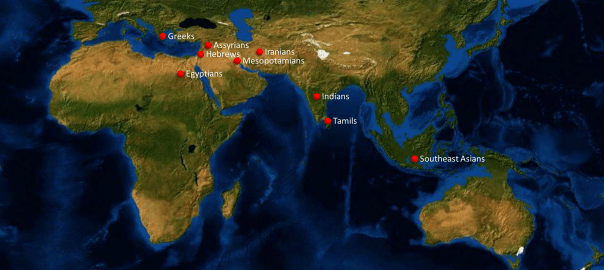
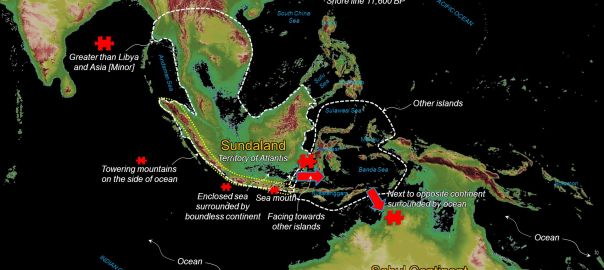


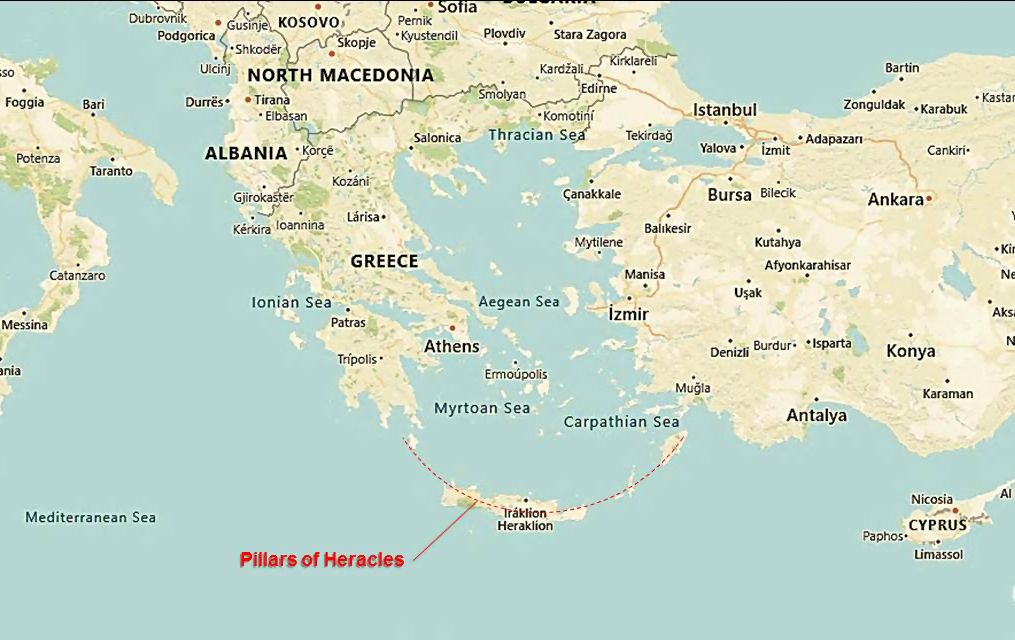

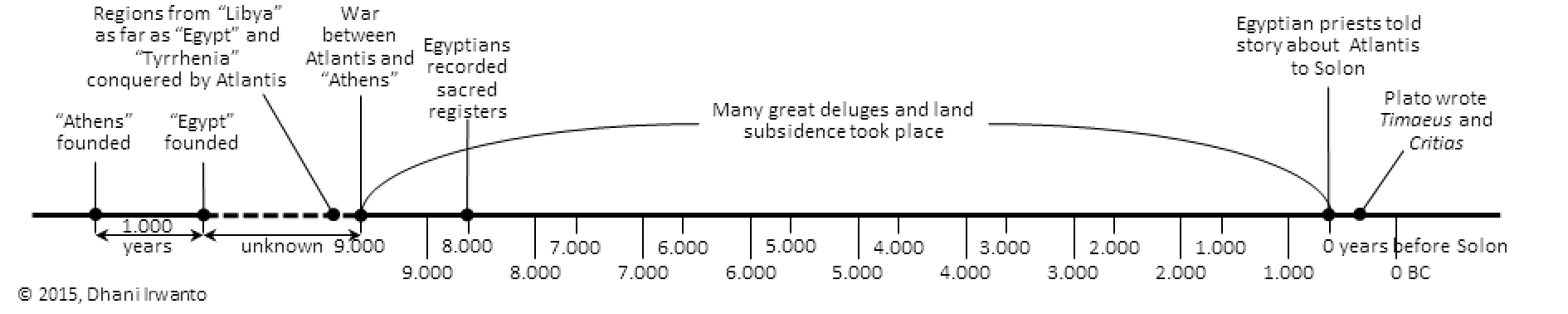


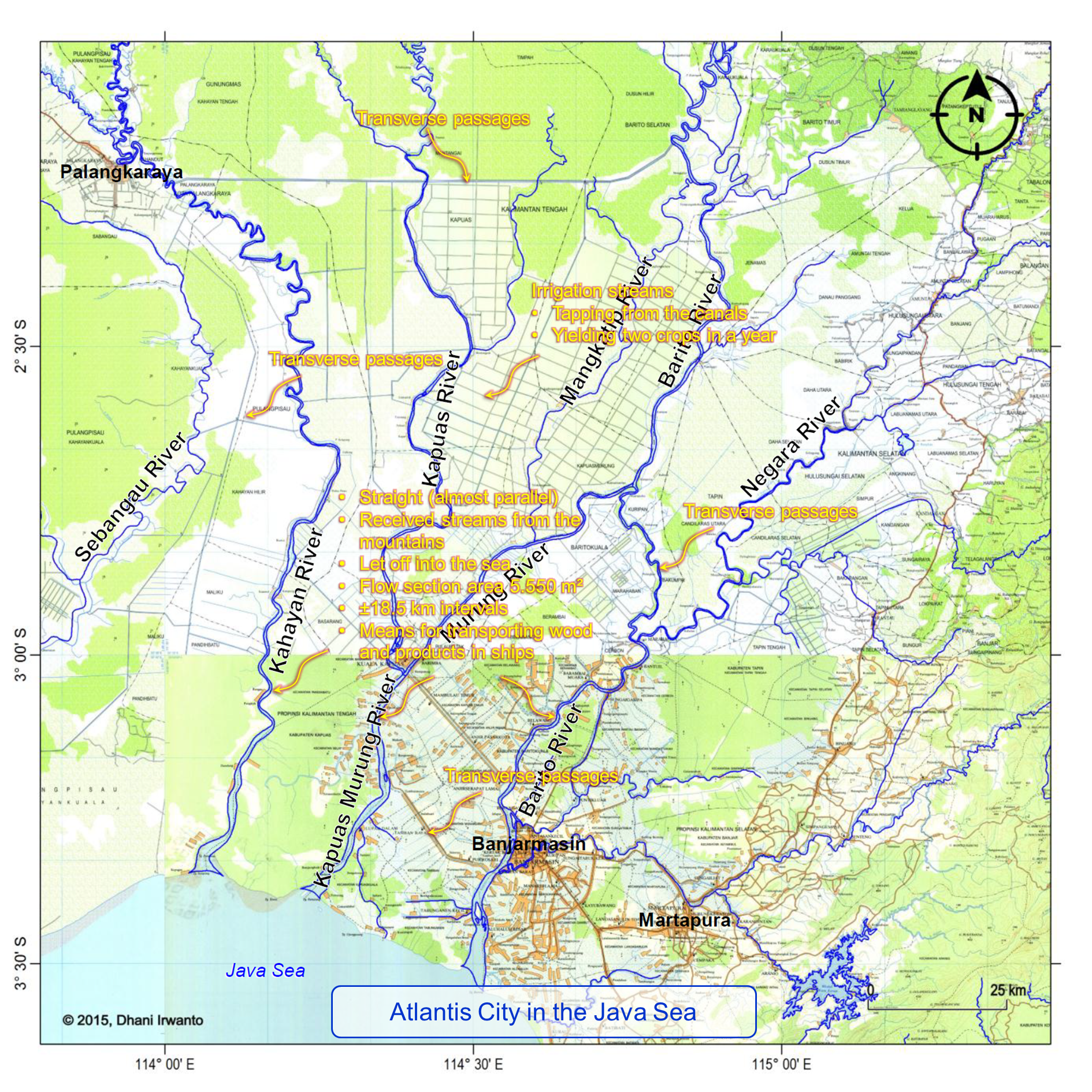


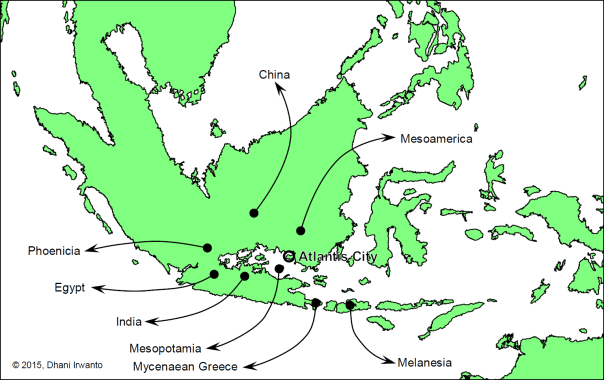
 Sundaland Research Program