Plato’s tale of Atlantis, told in Timaeus and Critias, has fascinated readers for over two millennia. Yet Plato was not writing in a vacuum. Across the world, from India to Mesopotamia, from Egypt to Tamil traditions, we find stories that sound strangely familiar. These are not “proofs” of Atlantis, but parallels—echoes of catastrophe, paradise, or vanished lands.
Kumari Kandam (Tamil Memory of a Sunken Land)
The Tamil tradition speaks of Kumari Kandam, a lost landmass once ruled by the Pandyan kings. Ancient Tamil texts like Silappatikaram and Kaliththokai describe Sangam academies—gatherings of poets—some of which were said to have been drowned by the sea. Later Puranic texts placed Kumari Kandam in the deep south, now swallowed by the ocean.
It was imagined as a vast territory divided into 49 regions, crossed by mountains with 48 peaks, irrigated by channels from four great rivers. Mining of gems and gold was central. Eventually, the land was said to have been “swallowed by the sea” (Katalkol).
In modern times, revivalists fused this myth with the Victorian hypothesis of Lemuria, a now-abandoned scientific theory about a sunken Indian Ocean continent. Tamil nationalists embraced it as ancestral memory. In my earlier article on Lemuria, I showed how Kumari Kandam became conflated with Lemuria and even Mu, giving the myth a global spin.
Atlantis echo: A golden civilization, irrigated plains, gem mines, destroyed by rising seas.
Kangdez (Iranian Fortress-Paradise)
Iranian epic literature preserves the memory of Kangdez (Fortress of Kang). In the Shāhnāmeh and Bundahishn, Kangdez appears as a miraculous walled city in the Far East. Slides highlight its placement: “at the far eastern ocean, about six months to a year’s voyage from Iran, near the equator, outside China, east of India.”
Descriptions of Kangdez include concentric rings of walls layered with metals and precious stones, plentiful waters, eternal springs, and places of play, silver and gold towers, and a great plain influenced by the sea’s tides with rivers flowing south from volcano-studded mountains.
Atlantis echo: Both traditions emphasize concentric fortifications, gleaming metals, abundance of water, and a paradisal yet precarious geography.
Neserser (Egypt’s Island of Osiris)
In the Book of the Dead (Papyrus of Nu), we encounter Neserser—“the Island of Fire” in the far East, where the sun rises. It is the dwelling place of Osiris (Ausares, Asar) and Thoth. The imagery is vivid: Osiris enthroned in the center of six or seven concentric circles on a sacred lake, a volcanic-like “island and lake of fire” dedicated to Ra, floods that reshape the landscape, and Thoth residing nearby, keeper of divine knowledge.
Later Egyptologists described these circles as “hidden after the flood.”
Atlantis echo: Here again are concentric circles, a sacred island, a great flood, and divine kingship.
Mount Nisir (Mesopotamian Flood Memory)
The Epic of Gilgamesh recounts a great flood, where Utnapishtim builds an ark. After seven days, the boat grounds on Mount Nisir. Slides add color: the land in the Far East was like paradise, with forested mountains, rivers, vast plains, noisy birds, cicadas, and monkeys screaming in the trees.
This imagery is tropical—not the dry Mesopotamian steppe, but a lush, equatorial realm. Some scholars note that “Nisir” is phonetically close to “Neserser” and even “Nusasura.”
Atlantis echo: The flood, the grounding of survivors on a mountain, the paradise-like tropical plain.
The Asuras and the Ahuras
In early Vedic India, the Asuras were not evil—Varuna, guardian of cosmic law and the waters, was chief among them. Later texts, however, cast the Asuras as enemies of the Devas, while Varuna retained dignity as a god of oceans.
In Iranian religion, the cognate term Ahura (as in Ahura Mazda) was elevated as the supreme god, while the Daevas (same root as Devas) became demons.
India (early Vedas): Asuras = powerful lords, led by Varuna
India (later): Asuras = demons
Iran: Ahuras = good, Daevas = bad
Assyria: Ashur = supreme deity
Egypt: Osiris (Asar, Asari) = supreme deity with concentric-circle symbolism
Atlantis echo: The Atlantean kings were “Poseidon’s sons.” Poseidon parallels Varuna/Baruna, lord of seas and boundaries. The name “Atlas” recalls “Asura/Ashur/Osiris.” We glimpse a very old naming web that Solon may have repurposed.
“Atlas” and “Poseidon” as Borrowed Names
Plato openly said he borrowed names “to make the tale intelligible to his audience.” Thus Atlas and Poseidon may be Greek masks for older gods.
Atlas: The mountain-bearing Titan in Greek myth; but also linked to the root “Asura/Asar.”
Poseidon: God of seas and quakes, mirroring Varuna/Baruna/Vouruna—Indo-Iranian lords of waters and oaths.
These echoes suggest that Solon translated Near Eastern deities into Greek equivalents. The concentric rings, sacred kingship, and sea-lord all survive the translation.
The Garden of Eden
Finally, the Garden of Eden—a paradise watered by a river dividing into four: Tigris, Euphrates, Gihon, and Pishon. Genesis places Eden in the East, yet beyond ordinary geography. Some scholars argue Eden reflects older Mesopotamian “Dilmun” traditions—a far-off, pristine land. My 2015 article even suggested Kalimantan as Eden’s real-world counterpart.
Atlantis echo: Eden shares the archetype of a paradise lost—an ordered, fertile place destroyed or closed off after human transgression.
Gosong Gia and Nusantara Echoes
Slides mention Nusasura—possibly the “original name of Atlantis.” It combines nusa (island) and Asura. Old maps show names like Nusasira or Nisaira, perhaps distorted echoes. The Gosong Gia reef in the Java Sea is suggested as a drowned remnant. Even the people of Bawean Island hold myths of a sunken land.
Atlantis echo: If Atlantis lay in the Java Sea, Nusantara traditions like Nusasura may be its local survival in name.
Neserser, Punt, and Southeast Asia: The Egyptian Connection
Plato insists that his Atlantis story came from Egyptian priests at Sais, who told Solon the tale. If so, then the Egyptian worldview—their maps of trade, geography, and sacred memory—shaped what Plato inherited.
The Egyptians had firsthand knowledge of Southeast Asia, preserved in their accounts of the Land of Punt. Punt, described as the Ta Netjer or “land of the gods,” was not a vague myth but a real destination of repeated voyages, from Khufu to Rameses III. The great expedition of Hatshepsut (c. 1493 BCE) is famously carved on her temple walls, showing Egyptian ships sailing to Punt’s harbors.
Products: Gold, camphor (kapur barus), benzoin (kemenyan), cinnamon, ebony, nutmeg, short-horned cows, elephants, and macaques—all endemic to Sumatra and neighboring islands.
Architecture: Puntite houses on stilts match Sumatran and Enggano traditions.
People: Puntites depicted with lighter skin, straight noses, and Malay-style dress, jewelry, and weapons.
Names: Chief Parehu resembles Enggano names (Paraúha, Puríhio). His wife Ati recalls common Indonesian nicknames.
This is not coincidence—it is a cultural fingerprint.
Now let’s place this beside Neserser. The Book of the Dead speaks of Osiris enthroned at the center of six or seven concentric circles, on an island-lake in the far East. The imagery of circles, water, divine enthronement, and flood resonates directly with Plato’s Atlantis.
If the Egyptians already connected their cosmology to the far East—to Sumatra, the “land of origin”—then the parallels between Neserser and Atlantis may not be abstract at all. They may reflect Egypt’s sacred geography projected upon Southeast Asia.
The Thread of Transmission:
Egypt knew Sumatra as Punt—the source of incense, gold, and sacred products.
Neserser represented a circular, island-paradise of Osiris in the East.
Atlantis, as told by priests to Solon, may have drawn on this same Eastern sacred memory.
In this light, Atlantis is not a purely Mediterranean invention. It may encode Egypt’s knowledge of Southeast Asia, filtered through myth, memory, and Plato’s philosophy.
In the Book of the Dead (Papyrus of Nu), we encounter Neserser—“the Island of Fire” in the far East, where the sun rises. It is the dwelling place of Osiris (Ausares, Asar) and Thoth. The imagery is vivid: Osiris enthroned in the center of six or seven concentric circles on a sacred lake, a volcanic-like “island and lake of fire” dedicated to Ra, floods that reshape the landscape, and Thoth residing nearby, keeper of divine knowledge.
Later Egyptologists described these circles as “hidden after the flood.”
Atlantis echo: Here again are concentric circles, a sacred island, a great flood, and divine kingship.
Connecting the Dots: A Discussion
The parallels between Plato’s Atlantis and global myths—from Tamil Kumari Kandam to Mesopotamian Nisir, from Iranian Kangdez to Biblical Eden—show a striking pattern of shared motifs: floods, lost paradises, concentric sacred cities, and divine kingship.
Among these, the Egyptian contribution is the most critical. Plato himself acknowledged that the story came from Egyptian priests. Their sacred geography included Neserser, the concentric island of Osiris in the far East, and their historical voyages reached as far as Punt—identified with Sumatra, the ‘Land of Origin.’
When we combine Neserser’s sacred concentric circles with Punt’s real-world geography and resources, a powerful connection emerges: Egypt not only imagined an eastern paradise, but had knowledge of one. Atlantis may be the philosophical echo of Egypt’s long memory of Southeast Asia.
Thus, the Atlantis story can be seen as a tapestry woven from many threads—myths of lost lands, religious cosmologies, and Egypt’s own encounters with Southeast Asia. Connecting these dots allows us to glimpse Atlantis not as an isolated legend, but as part of a wider human memory of catastrophe, paradise, and rebirth.
Conclusion: When Myths Rhyme Across Oceans
Kumari Kandam, Kangdez, Neserser, Nisir, Asuras, Atlas, Eden—each speaks in its own voice, yet the chorus is familiar. Lost lands, floods, circular cities, divine kings, and paradise destroyed.
Plato may have woven a Greek philosophical tale. But the motifs he used—perhaps borrowed, perhaps remembered—echo far older and wider. Atlantis may not be alone; it may be part of a global pattern of mythic memory of catastrophe and rebirth.
Comparative Snapshot: Parallels at a Glance
A concise table to visualize recurring motifs and where Southeast Asia fits in the Egyptian knowledge frame.
Tradition/Source
Core Setting
Key Motifs
Flood/Collapse
Concentric/Sacred Center
Sea-Lord/Lawgiver
SE Asia Link
Kumari Kandam (Tamil)
Southern drowned land
Golden age, irrigated plains, gem mining, lost coasts
Yes – land swallowed by sea
No explicit circles (ordered realms)
Implied righteous kingship
Indirect (Indian Ocean south)
Kangdez (Iranian)
Fortress in the Far East, near equator
Concentric walls, metals, springs, tidal plain, volcanoes
Implied peril at sea’s edge
Yes – concentric fortifications
Sovereign order (Iranian epic)
Points East; equatorial hints
Neserser (Egypt)
Island-lake in the Far East
Osiris enthroned; 6–7 circles; ‘lake of fire’
Yes – flood imagery; ‘hidden’ after
Yes – canonical concentric circles
Osiris/Ra as sacral law & kingship
Conceptual East (sunrise); bridge to Punt
Mount Nisir (Gilgamesh)
Mountain of grounding
Paradise-like East; forests, birds, monkeys; great flood
Yes – global flood narrative
No (mountain refuge)
Divine warning & survival order
Tropical imagery resonates with SE Asia
Asuras/Ahuras (Indo-Iranian)
Cosmic moral order
Waters, oaths, boundaries (Varuna/Ahura Mazda)
Not central
Symbolic circles (order)
Yes – sea-lord/lawgiver archetype
Cultural substrate across Indo-Iran
Atlas/Poseidon (Greek)
Atlantean kingship; sea-quake god
Names tied to sea power, metals, concentric city
Yes – sudden destruction
Yes – Atlantis capital rings
Poseidon (cf. Varuna/Baruna)
By proxy via Indo-Iran → Egypt
Garden of Eden (Genesis)
Eastern paradise, 4 rivers
Pristine garden, moral test, exile
Yes – loss/expulsion (not flood)
No circles; central river hub
Implied divine law
ANE roots; not specific to SE Asia
Nusasura/Gosong Gia (Java Sea)
Shoal/reef & island lore
Name echoes (nusa + asura); local sunken-land myths
This study revisits Critias 115a–b, where Plato records the Egyptian priest’s description of the fruits of Atlantis, emphasizing both extraordinary size and a tetradic utility: hard rind, drink, food, and oil. These descriptions have long puzzled commentators, as no Mediterranean species fulfills all four functions. By applying a consilience framework integrating semiotics, philology, linguistics, archaeobotany, ecology, and cultural history, this article argues that the coconut (Cocos nucifera L.) uniquely satisfies the textual criteria. The tetrad is interpreted as a set of context clues deliberately supplied to Solon for a product unfamiliar to Classical Greece. Order-1 analysis establishes the denotative baseline; Order-2 clarifies pragmatic intent and audience reception; Order-3 integrates ecological suitability, genetic timelines, Austronesian cultural continuities, and spatial models of Sundaland. Counter-fruit testing eliminates alternative candidates, while explicit falsifiability criteria ensure that the hypothesis remains open to disproof. In integration with other puzzle pieces—elephants, rice and legumes, reef shoals, and the East-Mouth spatial model—the coconut emerges as a decisive marker of Sundaland’s ecological and cultural plausibility as Atlantis’ setting. The result is not only a refined reading of Plato’s text but also a testable historical claim that bridges myth, ecology, and prehistory.
The central aim of this article is to evaluate the coconut (Cocos nucifera L.) as a potential puzzle piece in the reconstruction of Atlantis when situated within the Sundaland framework. This evaluation requires more than a botanical description; it calls for a multidisciplinary approach that spans philology, semiotics, linguistics, archaeobotany, and cultural anthropology. The scope of the inquiry is not confined to identifying a fruit that fits Plato’s description but extends to assessing how such a fruit could function as a communicative bridge between the Egyptian priest and Solon, and by extension, between the ancient world and the modern researcher. By refining both textual anchors and contextual interpretations, this section establishes why the coconut is worth considering and how its analysis contributes to the broader Sundaland–Atlantis hypothesis.
1.2 Textual Anchors and Contextual Hypothesis
Plato’s dialogues contain a handful of striking agricultural references, two of which stand out as possible allusions to coconut. The first appears in Critias 115a, where the land of Atlantis is said to bear ‘καρπὸς θαυμαστὸν τὸ μέγεθος’ (karpòs thaumastòn tò mégethos), literally ‘fruit wondrous in size.’ The second, more elaborate passage is found in Critias 115b:
Literal translation: “… and the fruits having a hard rind, providing drinks and meats and ointments …”
Taken together, these two textual anchors yield a description of both extraordinary size and fourfold utility. The latter is particularly significant, as it points not merely to a generic fruit but to a tetrad of functions: (1) husk or shell (σκληροφόρους, sklērophórous), (2) liquid drink (πόματα, pómata), (3) edible flesh (ἐδωδάς, edodàs), and (4) oil or ointment (ἀλείμματα, aleímmata). This tetradic pattern maps directly onto the coconut’s properties and surpasses the descriptive adequacy of any Mediterranean species. The Egyptian priest’s choice to describe rather than name the fruit suggests an intentional strategy of supplying Solon with context clues for something outside Greek experience.
1.3 Key Lexemes
Several Greek words in these passages are decisive for interpretation:
καρπός (karpós) — generic term for fruit or produce, without species specificity.
θαυμαστόν (thaumastón) — marvelous, wondrous, denoting both admiration and unfamiliarity.
μέγεθος (mégethos) — magnitude, size, scale beyond the ordinary.
σκληροφόρους (sklērophórous) — literally ‘hard-rind-bearing,’ an unusual descriptor in agricultural contexts.
πόματα (pómata) — drinks, liquids suitable for consumption.
ἐδωδάς (edodàs) — foods or meats, highlighting nutritive content.
ἀλείμματα (aleímmata) — ointments or oils, typically derived from plants.
This lexical constellation indicates not a poetic flourish but a functional inventory. The tetrad is too specific to be incidental: it points to a practical knowledge of a foreign plant whose properties were being translated into Greek conceptual categories.
1.4 Context-Clue Hypothesis and Unfamiliarity Claim
The deliberate use of a functional tetrad rather than a name implies a communicative act designed to overcome unfamiliarity. The Egyptian priest, aware that Solon would not recognize the fruit by name, supplied its uses as context clues. These clues were pedagogical in nature: they bridged the cultural gap between an Egyptian knowledge of exotic products and a Greek listener unacquainted with them. For Plato’s audience, however, the effect was one of marvel and exoticism, reinforcing Atlantis as a land of abundance and strangeness. This unfamiliarity claim is central to understanding why the description survives not as a loanword but as a tetradic inventory of functions.
1.5 Timeline Policy
A methodological safeguard is required when handling these passages: Solon’s reception of the priest’s words may reflect either contemporary Egyptian knowledge of coconut through Indian Ocean trade or inherited memory of earlier exchanges connected to Sundaland. The present-tense verbs used in Critias (ἐξέφερε, exéphére, ‘it bore forth’) suggest immediacy, but transmission effects may blur temporal boundaries. For analytical purposes, this study treats the description as a preserved fossil of real knowledge, whether current in Solon’s time or remembered from deeper antiquity.
1.6 Research Questions (What Must Be Solved)
From these anchors, lexemes, and context clues, several guiding research questions emerge:
Can the tetradic description in Critias 115b be convincingly mapped onto the coconut’s properties?
Does the use of context clues confirm that the priest was describing an unfamiliar yet real product rather than a metaphorical abundance?
How does the coconut integrate with other puzzle pieces such as rice, legumes, elephants, and the East-Mouth spatial model?
What external evidence (archaeobotanical, genetic, linguistic) supports the antiquity and distribution of coconut in the Indo-Pacific?
What safeguards and falsifiability tests are necessary to ensure the hypothesis remains rigorous and not merely confirmatory?
These questions frame the methodological path forward and clarify why coconut deserves focused analysis within the Atlantis–Sundaland research program.
2. Methods
2.1 Semiotics
Semiotics provides the conceptual framework for decoding Plato’s references to agricultural products that were unfamiliar to his audience. The coconut tetrad in Critias 115b—hard rind, drink, food, oil—is especially suited to semiotic analysis because it appears as a deliberate set of signs chosen to communicate across cultural gaps. By using semiotics, we can trace how signs functioned at multiple levels: as literal descriptors, as connotative symbols of exotic abundance, and as mythic markers of Atlantis’ otherness.
Saussure’s Dyadic Model: The relationship between signifier and signified is destabilized here. The priest uses the general signifier καρπός (karpós, fruit) but supplements it with descriptive functions, since the precise signified—coconut—was unknown in Greek lexicon. This gap is filled by functional descriptors.
Peirce’s Triadic Model: The interpretant is central. For Solon, the tetrad served as practical context clues to approximate an unfamiliar referent. For Plato’s audience, however, the same tetrad produced the interpretant of exotic marvel, an image of distant abundance.
Barthes’ Orders of Signification: At the first order (denotation), the tetrad enumerates material uses. At the second order (connotation), it signals strangeness and wealth. At the third order (myth), it naturalizes Atlantis as a land of wondrous fertility beyond Mediterranean norms.
2.2 Linguistics
Linguistic analysis sharpens the reading of Critias 115a–b by focusing on semantics and contextual cues. The choice of words such as σκληροφόρους (sklērophórous, hard-rind-bearing) and ἀλείμματα (aleímmata, ointments) is unusual in classical agricultural registers. These lexemes, when clustered together with πόματα (pómata, drinks) and ἐδωδάς (edodàs, foods), form a tetradic set that describes not a symbolic fruit but a specific utilitarian profile. The priest’s enumeration thus reads as a functional inventory—intelligible through usage rather than through species naming.
2.3 Language Analysis
Language analysis applies structural and pragmatic tools to test whether the tetrad holds under substitution and contextual shifts:
Syntagmatic Analysis: The sequential ordering (hard rind → drink → food → oil) implies completeness, suggesting that the priest deliberately arranged the functions to convey a full profile.
Paradigmatic Analysis: Substitution with familiar Mediterranean fruits shows immediate failure. A fig offers sweet flesh but no drink or oil. A pomegranate has arils and juice but no hard rind or oil. The tetrad collapses without coconut.
Commutation Test: If one function is replaced (e.g., substituting ‘ointment’ with ‘wine’), coherence is lost. The tetrad is fragile and holds only with coconut.
Pragmatics: The priest chose functional descriptors rather than a name precisely to bridge the gap between his knowledge and Solon’s ignorance. The tetrad thus acted as a teaching tool—a form of cross-cultural pedagogy.
2.4 Philology
Philological examination shows that the tetradic lexemes are authentic and consistent across manuscript traditions. Their combination is unique in Greek literature, where fruits are usually described in terms of sweetness, fertility, or abundance, but rarely through such a fourfold functional inventory. This anomaly strongly suggests that the priest was transmitting real practical knowledge of a foreign plant. In this sense, the tetrad is a philological fossil of cross-cultural knowledge exchange.
2.5 Timeline Discipline
To avoid anachronism, the tetradic description must be tested against the known timeline of coconut domestication and dispersal. Archaeobotanical and genetic studies confirm that coconuts were already widespread in Southeast Asia and had reached the Indian Ocean by the second millennium BCE. This makes it plausible that Egyptians or Phoenicians could have encountered coconut products. The timeline discipline thus permits us to read Critias 115b as reflecting current or remembered reality rather than pure invention.
2.6 Order-3 Analysis
At the highest integrative level, Order-3 analysis situates coconut within a puzzle piece catalogue of multiple evidentiary strands relevant to Sundaland Atlantis. The coconut tetrad is tested for consilience across textual, ecological, cultural, and spatial domains.
2.6.1 Evidence Classes
The main evidence classes include philological anchors (Critias 115a–b), linguistic features, archaeobotanical and genetic data, ecological and climatic factors, cultural practices, and spatial models. Each contributes independently to the evaluation.
2.6.2 Puzzle Piece Catalogue
The catalogue includes elephants, rice and legumes, coconut origin and distribution, climatic suitability, coconut tradition, East-Mouth spatial model with nautical corridors, ancient trans-oceanic contacts, coral-reef shoal chronology, timeline discipline, legendization in transmission, and toponymic/lexical parallels. Each functions as an independent puzzle piece, with coconut distinguished by its unique tetradic profile.
2.6.3 Consilience Test
Consilience testing is applied by scoring each puzzle piece across independent domains—textual specificity, biogeographic fit, archaeobotanical and genetic data, cultural continuity, spatial plausibility, subsistence coherence, timeline discipline, and transmission robustness. Each criterion is rated on a 0–3 scale (0 = absent; 3 = strong and specific) and weighted according to its diagnostic power. The composite score is calculated by summing the weighted contributions.
This procedure does not presuppose the outcome for any single candidate but establishes a transparent framework by which all puzzle pieces can be evaluated. Later sections apply this method to coconut and alternative fruits, reporting scores and thresholds to distinguish between strong, tentative, and weak support. In this way, the consilience test operates as a methodological bridge between individual lines of evidence and the integrative results.
2.6.4 Counter-Fruit Test
The counter-fruit test introduces systematic comparison by substituting alternative species—such as pomegranate, fig, date palm, breadfruit, calabash, and areca/betel nut—for the tetrad described in Critias 115b. Each candidate is assessed against the four functional criteria (hard rind, drink, food, oil) using the same scoring rubric applied to coconut. The test is designed not to assume failure in advance but to create a transparent comparative framework that challenges the coconut hypothesis. Results of these substitutions are presented in Section 4, where their performance relative to coconut is documented.
2.6.5 Falsifiability
Falsifiability criteria are explicitly built into the method. Disproof could arise from textual evidence showing the tetrad applied to a Mediterranean fruit, archaeobotanical absence of coconut in the Indo-Pacific at the relevant time, genetic timelines incompatible with Plato’s era, ecological unsuitability, absence of relevant lexicon, spatial model misfits, or semantic proof that ἀλείμματα cannot mean plant oil. By specifying these pathways, the method ensures that the hypothesis remains open to rigorous testing rather than closed confirmation.
3. Workflow
3.1 Overview
The methodological workflow for testing the coconut hypothesis proceeds through three analytic orders. This tiered design ensures that textual analysis is first anchored in the Greek passages, then expanded through pragmatic interpretation for Plato’s audience, and finally reconstructed with external evidence from ecology, archaeology, and cultural history. Each order contributes incrementally: Order-1 clarifies denotation, Order-2 uncovers communicative intention, and Order-3 integrates interdisciplinary evidence to yield a consilient synthesis.
3.2 Inputs & Outputs
The inputs to the workflow include the primary textual anchors from Critias 115a–b, key lexemes identified through philology, and comparative data from archaeobotany, genetics, and Austronesian cultural practices. The outputs vary by analytic order: Order-1 yields denotative baselines, Order-2 produces pragmatic insights into unfamiliarity and context clues, and Order-3 delivers a reconstruction tested through the puzzle piece catalogue, consilience scoring, counter-fruit challenges, and falsifiability checks. The workflow thus transforms raw text into structured hypotheses and measurable results.
3.3 Order-1 Workflow — Text Only
At the first order, the analysis remains strictly within the textual register. Here the aim is to extract philological baselines: the meaning of καρπὸς θαυμαστὸν τὸ μέγεθος and the tetrad of functions in Critias 115b. No assumptions about geography, botany, or culture are made at this stage. The coconut is not yet invoked; instead, the focus is on what the Greek text literally says. This provides a control level against which later interpretations can be tested.
3.4 Order-2 Workflow — Audience & Pragmatics
At the second order, the focus shifts to how the Egyptian priest’s words would have been understood by Solon and, later, by Plato’s audience. The unfamiliarity claim becomes central. The absence of a name and the reliance on a tetradic description function as deliberate context clues. For Solon, these clues pointed to a practical reality outside his cultural experience. For Plato’s readers, however, they connoted marvel and exotic abundance. Order-2 analysis thus explains why the priest spoke in functional terms and why the Greeks preserved those terms as marvels rather than as technical descriptions.
3.5 Order-3 Workflow — Reconstruction
At the third order, external evidence enters. The coconut tetrad is tested against the puzzle piece catalogue, where it interacts with other markers such as elephants, rice, legumes, climatic suitability, and the East-Mouth spatial model. Consilience scoring quantifies explanatory power, while the Counter-Fruit Test challenges coconut’s uniqueness by attempting substitutions with alternative species. Finally, falsifiability criteria ensure that the hypothesis remains open to disproof. Order-3 is therefore the stage where philology, pragmatics, ecology, and cultural history converge to produce a reconstruction that is both integrative and testable.
4. Integrated Analyses & Results
4.1 Overview & Conventions
This section integrates results from the three analytic orders into a single framework. At Order-1, we establish philological baselines from Critias 115a–b. At Order-2, we explore audience reception and pragmatic effects, including the Egyptian priest’s communicative strategy. At Order-3, we assemble textual, ecological, genetic, and cultural evidence into a consilient model. The coconut tetrad—hard rind, drink, food, oil—serves as the keystone of this integration. Conventions followed in this section include direct citation of Greek terms (with transliteration and literal translation), cross-reference to the puzzle piece catalogue, and explicit attention to negative testing and falsifiability.
At the first order, the task is to determine what the text literally says. In Critias 115a, Plato records the phrase καρπὸς θαυμαστὸν τὸ μέγεθος (karpòs thaumastòn tò mégethos)—‘fruit wondrous in size.’ This establishes magnitude as a defining feature. In 115b, the priest specifies: καρποὺς τοὺς σκληροφόρους, πόματα καὶ ἐδωδὰς καὶ ἀλείμματα παρέχοντας (karpoùs toùs sklērophórous, pómata kaì edodàs kaì aleímmata parékhontas)—‘fruits having a hard rind, providing drinks and meats and ointments.’ Taken together, the two clauses form a tetrad: husk/shell, drink, food, oil. At Order-1, no geographical or botanical assumptions are made, but the linguistic anomaly of such a functional tetrad already suggests deliberate instruction rather than poetic flourish.
At the second order, we ask how this description would have functioned in context. For Solon, the tetrad was a practical teaching device. The priest avoided a foreign loanword, instead supplying uses intelligible to a Greek but not associated with any familiar species. For Plato’s Athenian audience, however, the same inventory produced the interpretant of exotic marvel: a land whose fruits surpassed the Mediterranean norm. Thus, Order-2 analysis demonstrates that the tetrad was communicative in design, serving simultaneously as a bridge for Solon and a wonder for Plato’s readers.
At the third order, external evidence is introduced. Archaeobotanical and genetic studies confirm dual domestication of coconut in South and Southeast Asia, with dispersal across the Indian and Pacific Oceans. Lexical evidence from Austronesian languages (niu, nyior, niyor) confirms antiquity and diffusion of coconut culture. Ecologically, the tropical-maritime belt of Sundaland aligns with climatic requirements for coconut cultivation. Spatially, the East-Mouth model situates coconut belts within canalizable reef corridors, offering logistical plausibility for trade and subsistence. When combined, these independent strands achieve consilience: coconut emerges as the only fruit that fits both text and environment.
4.5 Coconut as a Puzzle Piece
Coconut’s evidential strength lies in its dual role: it satisfies the philological tetrad exactly, and it integrates seamlessly with the wider puzzle piece catalogue for Sundaland Atlantis.
4.5.1 Puzzle Piece Catalogue
A1 Elephants: Biogeographic marker consistent with Indo-Malayan fauna.
Using a weighted 0–3 rubric, coconut consistently scores 2.7–2.9 across categories: 3 for textual specificity, 3 for biogeographic fit, 2–3 for archaeobotany/genetics, 3 for cultural continuity, 2–3 for spatial model fit, 3 for subsistence coherence, 2 for timeline discipline, 3 for transmission robustness. The composite indicates strong support.
4.5.3 Counter-Fruit Test
The counter-fruit test is designed to guard against confirmation bias by actively seeking alternative species that might satisfy the tetrad described in Critias 115b. Candidate fruits are selected from both Mediterranean and wider Old World contexts, including pomegranate, fig, date palm, breadfruit, calabash, and areca/betel nut. Each candidate is evaluated against the four functional criteria—hard rind, drink, food, and oil—using the same scoring rubric applied to coconut.
Pomegranate: Has rind and juice but no oil; fails tetrad.
Fig: No drink or oil; fails multiple functions.
Date Palm: No natural drink; desert ecology misfits Sundaland.
Breadfruit: Staple food but lacks drink and oil.
Calabash: Hard shell container but little food, no drink, no oil.
Areca/Betel Nut: Hard nut for chewing; no drink or meat.
All candidates fail at least two tetrad functions and misalign with Sundaland ecology.
4.5.4 Falsifiability
The coconut hypothesis can be disproven by several pathways:
Textual Refutation: Greek passage where tetrad unambiguously applies to non-coconut fruit.
Archaeobotanical Disproof: Evidence of coconut absence in Indo-Malaya during priest’s era.
Genetic Contradiction: Revised chronology dating dispersal after Plato.
Climatic Contradiction: Proof Sundaland climate unsuitable for coconut.
Linguistic Void: Absence of coconut lexicon in early Austronesian strata.
Spatial Misfit: Failure of East-Mouth model to support coconut corridors.
Functional Mismatch: If ἀλείμματα cannot mean plant oil/ointment in this register.
4.5.5 Integrated Results
Coconut gains diagnostic strength not only through its tetradic alignment with Critias 115b but also within the broader puzzle piece catalogue applied to Sundaland Atlantis. Integrated with elephants, rice + legume, climatic suitability, and Austronesian trans-oceanic dispersal, coconut anchors the subsistence and cultural profile of the Atlantean plain.
The East-Mouth spatial model (−60 m shoreline, reef gaps, canalizable passages) provides environmental plausibility for coconut belts and trade logistics. Cultural continuities—lexicon (niu/nyior), craft traditions, and oil uses—further validate the tetrad as context clues supplied by the Egyptian priest.
Consilience tests score coconut highly across textual, ecological, and cultural lines. The Counter-Fruit Test shows that no Mediterranean or Near Eastern fruit satisfies the tetrad, and falsifiability criteria ensure the hypothesis remains testable. Together, coconut emerges as one of the strongest markers tying Plato’s agricultural description to the ecological realities of Sundaland.
By integrating catalogue, scoring, counter-fruit testing, and falsifiability, coconut is shown not only as a philological match but as a scientifically robust puzzle piece for situating Atlantis in Sundaland.
5. Discussion
5.1 Philology vs. Geographical Plausibility
A key tension in interpreting Critias 115a–b is balancing philological precision with geographical plausibility. On the philological side, the tetradic description—hard rind, drink, food, oil—is precise enough to exclude all Mediterranean fruits. Yet this precision alone is insufficient unless the ecology of the proposed locus can support coconut cultivation. Sundaland provides this ecological plausibility: a tropical, maritime environment where coconut thrives naturally and forms part of subsistence and culture. Thus, philology and geography converge, rather than conflict, in the Sundaland framework.
5.2 Timeline Alignment
The priest’s words to Solon are expressed in the present tense, suggesting immediacy: the land ‘bore forth’ its fruits at the time of narration. This raises methodological questions: was the priest describing a contemporary reality known through trade, or a memory of a more ancient past? Archaeobotanical and genetic evidence shows that coconuts had already dispersed widely across the Indo-Pacific by the second millennium BCE, well before Solon’s era. Thus, both interpretations remain viable: the description could reflect either living knowledge circulating in Egypt or a fossilized tradition preserved from deep antiquity. In either case, the present tense functions as a rhetorical device to render the description vivid and authoritative.
5.3 Legendization in Transmission
The path from Egyptian priest to Solon to Plato inevitably introduced processes of transmission and adaptation. One such process is legendization: functional descriptions become framed as marvels, and concrete agricultural facts acquire the aura of myth. The coconut tetrad is an exemplary case. For the priest, it was a set of context clues designed to bridge cultural unfamiliarity. For Solon, it conveyed exotic practicality. For Plato, retelling to his audience, it became an emblem of Atlantis’ strangeness and abundance. Recognizing this process of legendization allows us to explain why a foreign fruit survives in Greek literature not as a loanword but as a functional tetrad that borders on mythic imagery.
5.4 Integration with Other Puzzle Pieces
Coconut does not stand in isolation. It aligns with other puzzle pieces: elephants as faunal markers, rice and legumes as staples, coral-reef shoals as geological features, and the East-Mouth spatial model as geographical geometry. Together, these pieces form a coherent picture of a tropical, maritime plain consistent with Plato’s narrative. The coconut tetrad, by virtue of its specificity and uniqueness, strengthens the catalogue rather than merely adding to it. In consilience, each puzzle piece increases the explanatory coherence of the whole hypothesis.
5.5 Risks, Confounds, and Methodological Safeguards
No reconstruction is free from risks. One risk is over-interpretation: forcing a unique description to fit coconut while ignoring alternative explanations. Another confound is anachronism: projecting later coconut traditions backward into Plato’s era. To mitigate these, the Counter-Fruit Test ensures that alternatives are fairly considered, and falsifiability protocols set boundaries for disproof. By explicitly acknowledging risks and setting controls, the coconut hypothesis remains methodologically robust rather than speculative.
In sum, the discussion demonstrates that coconut as the referent of Critias 115b is not an arbitrary choice but a disciplined inference: it aligns philology with ecology, reconciles timeline uncertainties, accounts for legendization in transmission, and integrates seamlessly into the wider consilience framework of Sundaland Atlantis.
6. Conclusion
The coconut tetrad of Critias 115b—hard rind, drink, food, and oil—emerges as one of the most decisive context clues offered by the Egyptian priest to Solon. Unlike metaphorical flourishes or symbolic exaggerations, this description is concrete, utilitarian, and unique. It corresponds precisely to the material profile of the coconut, a plant outside the experience of Classical Greece yet central to the tropical ecologies of Sundaland. The tetrad thereby functions as both a linguistic fossil and a cultural bridge: it preserved the memory of Atlantis’ agricultural reality in a form intelligible, though exotic, to Solon and Plato’s audience.
Through the application of semiotics, linguistics, philology, and interdisciplinary consilience, the coconut has been tested and confirmed as a robust puzzle piece within the Sundaland–Atlantis framework. Order-1 analysis established the philological baseline; Order-2 clarified the communicative role of unfamiliarity and context clues; Order-3 integrated ecological plausibility, genetic timelines, cultural traditions, and spatial models. Each analytic order reinforced the others, yielding a convergent result. The coconut is not an arbitrary identification but the most parsimonious solution to the textual problem posed by Critias 115b.
Furthermore, by subjecting the hypothesis to counter-fruit testing and falsifiability criteria, the analysis remains scientifically open. Alternative candidates fail to replicate the tetrad, while clear pathways for disproof ensure that the coconut argument does not collapse into circular reasoning. This methodological transparency strengthens the case rather than weakens it.
In broader perspective, the coconut integrates seamlessly with other puzzle pieces: elephants as faunal markers, rice and legumes as staples, coral-reef shoals as geological features, and the East-Mouth spatial model as a navigational geometry. Together, these strands weave a coherent picture of Sundaland as the plausible cradle of Atlantis. The coconut, by virtue of its tetradic uniqueness, serves as a keystone in this reconstruction. It anchors Plato’s text to the ecological and cultural realities of Southeast Asia, transforming a mythic marvel into a testable historical clue.
The conclusion, therefore, is not merely that the coconut fits Plato’s words, but that it does so with explanatory power unmatched by any alternative. It stands as a decisive consilient marker: a fruit wondrous in size, bearing a hard rind, providing drink, food, and oil—exactly as the Egyptian priest described. In this convergence of philology, ecology, and culture, the coconut illuminates both the text of *Critias* and the deeper history of Sundaland Atlantis.
References
Luc Baudouin and Patricia Lebrun, Coconut (Cocos nucifera L.) DNA studies support the hypothesis of an ancient Austronesian migration from Southeast Asia to America, 2008. Springer Link, March 2009, Volume 56, Issue 2, pp. 257-
Bee F. Gunn, Luc Baudouin and Kenneth M. Olsen, Independent Origins of Cultivated Coconut (Cocos nucifera L.) in the Old World Tropics, 2011. PLoS ONE 6(6): e21143. doi:10.1371/journal.pone.0021143.
Jones TL, Storey AA, Matisoo-Smith EA and Ramirez-Aliaga JM, Polynesians in America: pre-Columbian contacts with the New World, 2011. Lanham, MD: AltaMira Press.
Luc Baudouin, Bee F. Gunn and Kenneth M. Olsen, The presence of coconut in southern Panama in pre-Columbian times: clearing up the confusion, 2013. Annals of Botany: doi:10.1093/aob/mct244.
Saussure, F. de. (1916/1983). Course in General Linguistics (trans. R. Harris). London: Duckworth. [Foundational dyadic model; cited per synthesis in Irwanto (2025), Note 4].
Peirce, C. S. (1992–1998). The Essential Peirce: Selected Philosophical Writings (Vols. 1–2). Bloomington: Indiana University Press. [Triadic sign–object–interpretant; per Note 4].
Barthes, R. (1957/1972). Mythologies (trans. A. Lavers). New York: Hill and Wang. [Orders of signification; per Note 4].
Barthes, R. (1964/1967). Elements of Semiology (trans. A. Lavers & C. Smith). New York: Hill and Wang. [Semiotic method; per Note 4].
Barthes, R. (1977). Image–Music–Text (ed. & trans. S. Heath). New York: Hill and Wang. [Applications to text analysis; per Note 4].
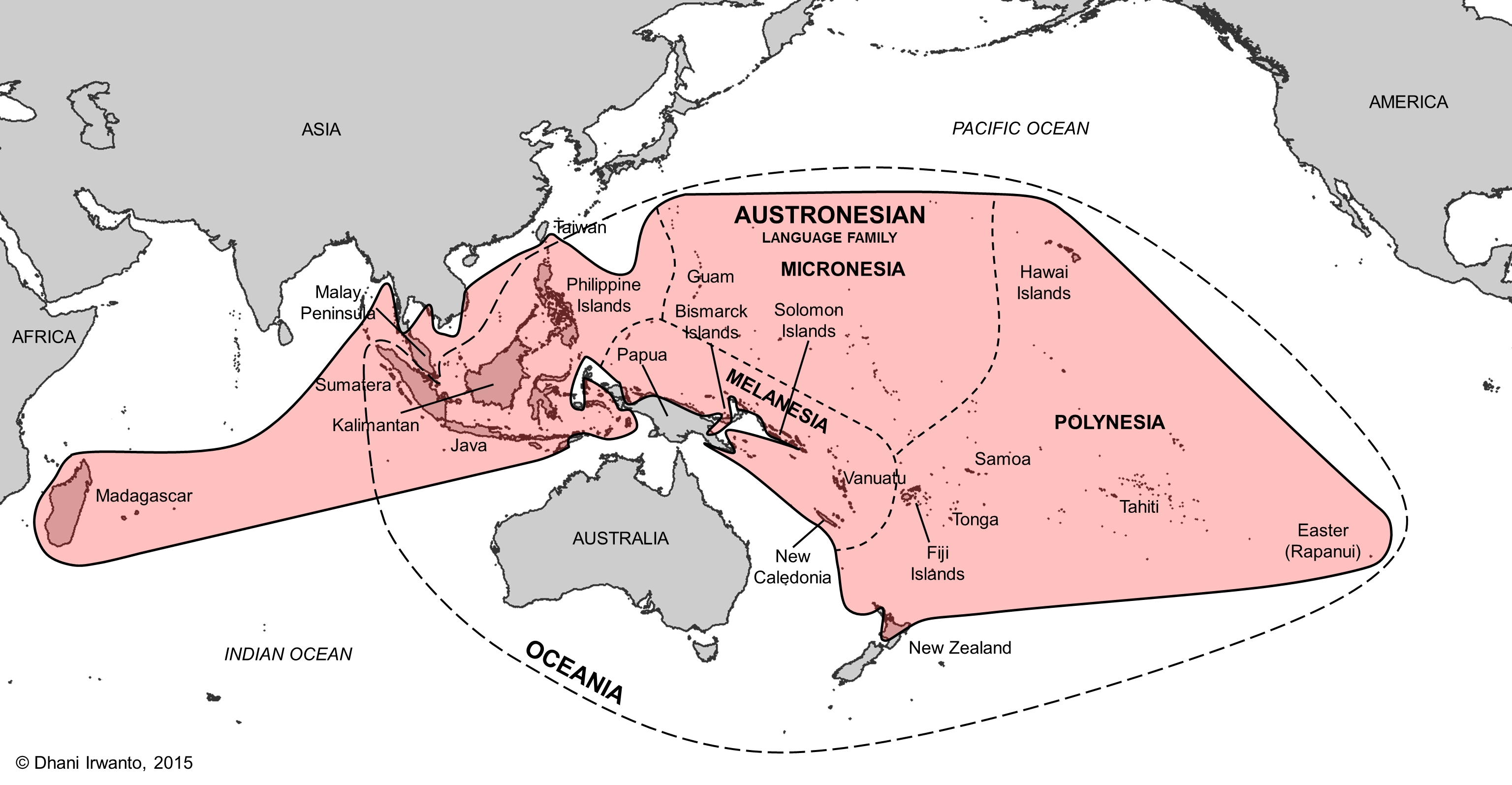
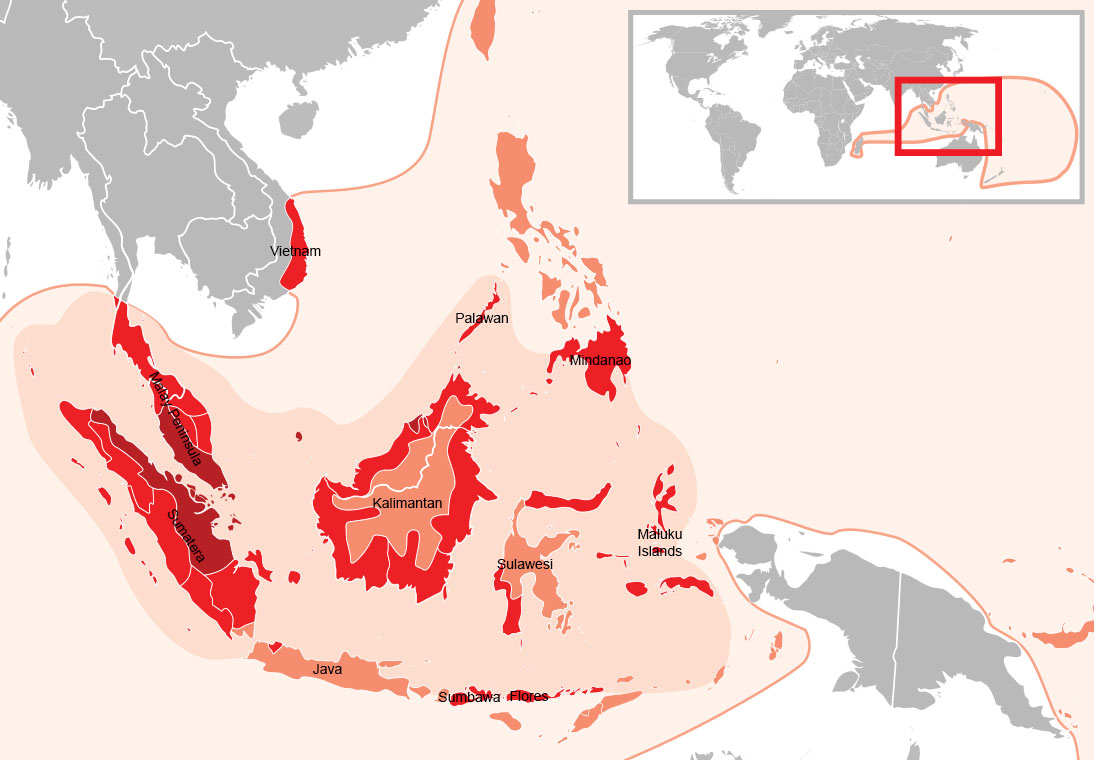
The Austronesian language family stretches halfway around the world, covering a wide geographic area from Madagascar to Easter Island, and from Taiwan and Hawai to New Zealand. The family includes most of the languages spoken on the islands of the Pacific with the exception of the indigenous Papuan and Australian languages.
Austronesian languages are spoken in Brunei, Cambodia, Chile, China, Cook Islands, East Timor, Fiji, French Polynesia, Guam, Indonesia, Kiribati, Madagascar, Malaysia, Marshall Islands, Mayotte, Micronesia, Myanmar, Nauru, New Caledonia, New Zealand, Niue, Northern Mariana Islands, Palau, Papua New Guinea, Philippines, Samoa, Solomon Islands, Suriname, Taiwan, Thailand, Tokelau, Tonga, Tuvalu, USA, Vanuatu, Vietnam, Wallis and Futuna. The total number of speakers of Austronesian languages is about 386 million people, making it the fifth-largest language family by number of speakers, behind only the Indo-European, Sino-Tibetan, Niger-Congo and Afroasiatic languages.
Figure 1 – Spread of Austronesian language family
The existence of the Austronesian language family was first discovered in the 17th century when Polynesian words were compared to words in Malay. Otto Dempwolff was the first researcher to extensively explore Austronesian languages using the comparative method. Another German, Wilhelm Schmidt, coined the German word austronesisch which comes from Latin auster (south wind) and Greek nêsos (island). The name Austronesian was formed from the same roots. The family is aptly named, as the vast majority of Austronesian languages are spoken on islands: only a few languages are indigenous to mainland Asia.
With 1268 languages, Austronesian is one of the largest and the most geographically far spread language families of the world. Austronesian and Niger-Congo are the two largest language families in the world, each having roughly one-fifth of the total languages counted in the world. The geographical span of Austronesian languages was the largest of any language family before the spread of Indo-European in the colonial period, ranging from Madagascar off the southeastern coast of Africa to Easter Island in the eastern Pacific.
Despite extensive research into Austronesian languages, their origin and early history remain a matter of debate. Some scholars propose that the ancestral Proto-Austronesian language originated in Taiwan (Formosa), while other linguists believe that it originated in the islands of Indonesia.
The Austronesian language family is usually divided into two branches: Formosan and Malayo-Polynesian, with the latter is by far the largest of the two. Malayo-Polynesian is traditionally divided into two main sub-branches: Western and Central-Eastern.
The Western sub-branch includes 531 languages spoken in Madagascar, Malaysia, Indonesia, the Philippines, parts of Taiwan, Thailand, Vietnam, Micronesia (Chamorro and Palauan, represents over 300 million speakers and includes such widely spoken languages as Javanese, Malay, and Tagalog. The Central-Eastern sub-branch, sometimes referred to as Oceanic, contains around 706 languages spoken in most of New Guinea and throughout the islands of Melanesia, Micronesia and Polynesia but excluding the aboriginal Australian and Papuan languages, represents only under 2 million speakers.
The seven largest Austronesian speakers are: Javanese (~100 million), Filipino/Tagalog (~70 million native, ~100 million total), Malay (Malaysian/Indonesian) (~45 million native, ~250 million total), Sundanese (~39 million), Cebuano (~19 million native, ~30 million total), Malagasy (~17 million) and Madurese (~14 million). Twenty or so Austronesian languages are official in their respective countries.
Javanese
Javanese language is a member of the Malayo-Polynesian branch of the Austronesian language family. Its closest relatives are Malay, Sundanese, Madurese and Balinese languages. It is the most spoken Austronesian language, and the tenth largest language by native speakers in the world, and the largest language without official status in the world. Javanese is considered to be one of the world’s classical languages, with a literary tradition that goes back over a thousand years.
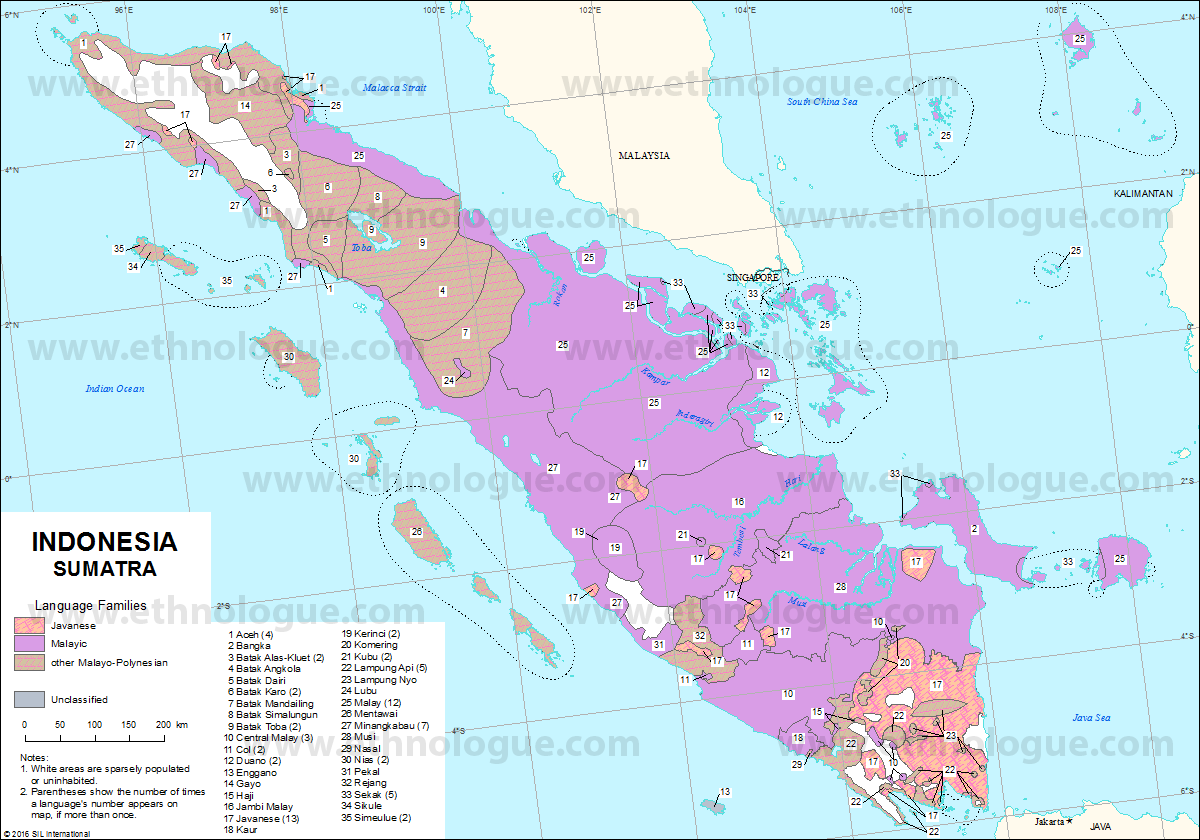
Javanese is the native language of more than 100 million people. Javanese is spoken by over 75 million people in the central and eastern parts of the island of Java. There are also pockets of Javanese speakers in the northern coast of western Java, mainly around Banten and Cirebon. Approximately 7.5 million Javanese speakers reside on the island of Sumatera in the North Sumatera Utara and Lampung (southern Sumatera) provinces. It is also spoken in Malaysia (concentrated in the states of Selangor and Johor), in the Netherlands and in Singapore. In addition, there are Javanese settlements in Papua, Sulawesi, Maluku, Kalimantan and Sumatera. Javanese is also spoken in the former Dutch colony of Surinam and New Caledonia.
Javanese is one of the Austronesian languages, but it is not particularly close to other languages and is difficult to classify. Most speakers of Javanese also speak Indonesian, the standardized form of Malay spoken in Indonesia, for official and commercial purposes as well as a means to communicate with non-Javanese-speaking Indonesians.
Scholars recognize four stages in the development of Javanese language: Old Javanese (up to the 13th century), Middle Javanese (up to the 15th century), New Javanese (up to the 19th century), and Modern Javanese (present-day Javanese).
The Javanese language can be traced back to at least 450 CE via the Sanskrit Tarumanegara inscription, although accounts regarding the origins of the Javanese people and their language are largely speculative. The oldest attestation of a work composed entirely in Javanese is the Sukabumi inscription located in the district of Pare in the Kediri regency of East Java, a work that dates from 804 CE, which is a copy of the original, dated 120 years earlier. The 8th and 9th centuries marked the beginning of the Javanese literary tradition, punctuated by the Buddhist treatise Sang Hyang Kamahayanikan and a Javanese rendition of the Sanskrit epic Ramayana. In 1293, the eastward expansion of the Hindu-Buddhist-Eastern Javanese empire known as Majapahit resulted in the spread of the Javanese language and writing system to Bali and Madura. Around the middle of the 14th century, Javanese replaced Balinese as the language of government and literature in Bali.
The Majapahit Empire saw the rise of Middle Javanese as effectively a new language, intermediate between Old and New Javanese, though Middle Javanese is similar enough to New Javanese to be understood by anyone who is well acquainted with current literary Javanese.
The Majapahit empire fell to Islamic forces around the turn of the 16th century, signaling the end of the Hindu Javanese empire. This ushered in the rise of the Islamic Javanese empire known as Mataram Sultanate, which was originally a vassal state of Majapahit. The 16th century saw the emergence of the New Javanese language. As the empire conquered a number of Sundanese areas of western Java, the Javanese language and culture spread westward. In its wake, Javanese became the dominant language, absorbing and heavily influencing languages like Sundanese, as was the case with Balinese in the 14th century. It was also the court language in Palembang, South Sumatera, until the palace was sacked by the Dutch in the late 18th century.
In later years, contact with Dutch colonizers and other Indonesian ethnic groups influenced the character of the language in numerous ways, the most notable being the influx of foreign loanwords.
Tagalog
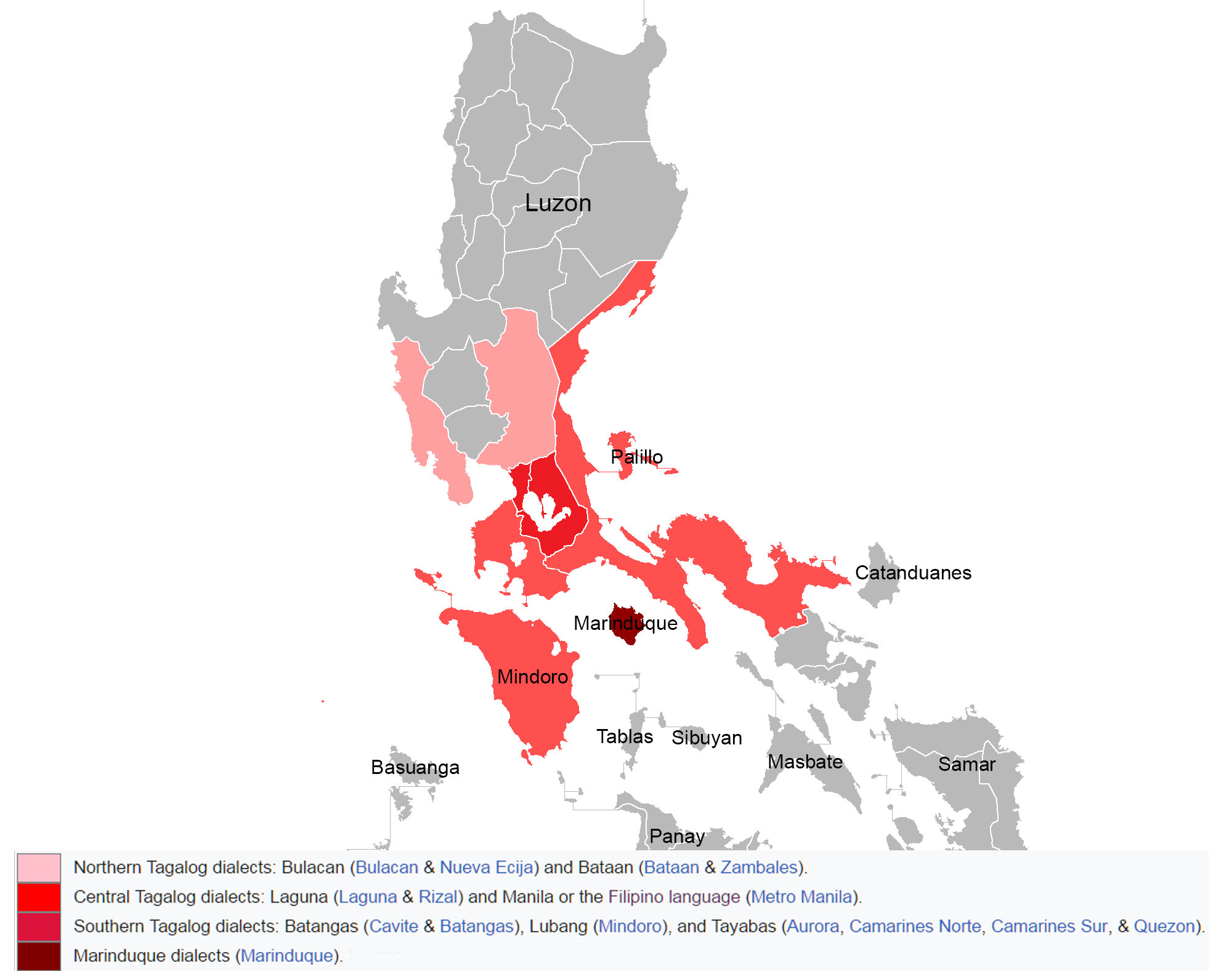
Tagalog language is a member of the Malayo-Polynesian branch of the Austronesian language family with more than 70 million speakers (28 million speakers as first language) in the Philippines, particularly in Manila, central and southern parts of Luzon, and also on the islands of Lubang, Marinduque, and the northern and eastern parts of Mindoro. Being Malayo-Polynesian, it is related to other Austronesian languages, such as Javanese, Malay (Indonesian and Malaysian), Sundanese, Cebuano, Malagasy and Madurese. It is the second most spoken Austronesian language after Javanese and before Malay. Tagalog speakers can also be found in many other countries, including Canada, Guam, Midway Islands, Saudi Arabia, United Arab Emirates, United Kingdom and USA.
Figure 4 – Spread of Tagalog language (Source: Wikimedia Commons)
Tagalog was originally native to the southern part of Luzon, prior to spreading as a second language over all the islands of the Philippine archipelago, due to its selection as the basis for Filipino, the national language of the Philippines, and to the fact that Tagalog is spoken in the capital of Manila. From 1961 to 1987, Tagalog was also known as Pilipino, before it was changed to Filipino. Filipino has been influenced, principally in vocabulary by the languages with which they have come into contact: Sanskrit, Arabic, Chinese, English and Spanish.
The first written record of Tagalog is the Laguna Copperplate Inscription, which dates to 900 CE and exhibits fragments of the language along with Sanskrit, Malay, Javanese and Old Tagalog. The first known complete book to be written in Tagalog is the Doctrina Christiana (Christian Doctrine), printed in 1593.
Malay
Malay language, spoken in Brunei, Indonesia, Malaysia, Singapore, parts of Thailand and southern Philippines, is a major language of the Austronesian language family. Over a period of two millennia, from a form that probably consisted of only 157 original words, Malay has undergone various stages of development that derived from different layers of foreign influences through international trade, religious expansion, colonization and developments of new socio-political trends. Within Austronesian, Malay language is part of a cluster of numerous closely related forms of speech known as the Malayan languages, which were spread across Malay Peninsula and the archipelago by Malay traders from Sumatera.
Modern Malay language has various official names. In Singapore and Brunei it is called Bahasa Melayu (Malay language); in Malaysia, Bahasa Malaysia (Malaysian language); and in Indonesia, Bahasa Indonesia (Indonesian language); where the latter contributes about 60% of the total of all speakers. However, in areas of central to southern Sumatera where the language is indigenous, Indonesians refer to it as Bahasa Melayu and consider it one of their regional languages.
Figure 5 – Spread of Malay language (Source: Wikimedia Commons)
The oldest form of Malay language, the Ancient Malay or Proto-Malay language, was descended from Proto-Malayo-Polynesian language spoken by the earliest Austronesian settlers in Southeast Asia, that derived from Proto-Austronesian which began to break up by at least 2000 BCE. Proto-Malay language was spoken in Kalimantan at least by 1000 BCE and was, it has been argued, the ancestral language of all subsequent Malay dialects. Linguists generally agree that the homeland of the Malayic-Dayak languages is in Kalimantan, based on its geographic spread in the interior, its variations that are not due to contact-induced change, and its sometimes conservative character. Around the beginning of the first millennium, Malayic speakers had established settlements in the coastal regions of modern-day South Central Vietnam, Tambelan, Riau Islands, Sumatera, Malay Peninsula, Kalimantan, Luzon, Maluku Islands, Bangka-Belitung Islands, and Java.
With the penetration and proliferation of Dravidian vocabulary and the influence of major Indian religions, Ancient Malay evolved into the Old Malay language. The oldest uncontroversial specimen of Old Malay is the 7th-century-CE Sojomerto inscription from Central Java, Kedukan Bukit inscription from South Sumatera and several other inscriptions dating from the 7th to 10th centuries discovered in Sumatera, Malay Peninsula, western Java, other islands in the archipelago, and Luzon.
Malay evolved extensively into Classical Malay through the gradual influx of numerous Arabic and Persian vocabulary, when Islam made its way to the region. Earliest instances of Arabic lexicons incorporated in the pre-classical Malay written in Kawi was found in the Minyetujoh inscription dated 1380 CE from Aceh. Pre-Classical Malay took on a more radical form as attested in the 1303 CE Terengganu inscription and the 1468 CE Pengkalan Kempas inscription from Malay Peninsula. Initially, Classical Malay was a diverse group of dialects, reflecting the varied origins of the Malay kingdoms of Southeast Asia. The language spread through interethnic contact and trade across the archipelago as far as the Philippines. This contact resulted in a lingua franca that was called Bazaar Malay (melayu pasar, market Malay). It is generally believed that Bazaar Malay was a pidgin, a grammatically simplified means of communication that develops between two or more groups that do not have a language in common.
From 19th to 20th century, Malay language evolved progressively through a significant grammatical improvements and lexical enrichment into a modern language with more than 800,000 phrases in various disciplines.
Role of Austronesian-speaking People around the World
Austronesian-speaking people were a maritime people with considerable navigational skills. This maritime heritage has allowed the Austronesian-speaking people left their cultural and material marks in the regions of the world and it is not unreasonable to assume that they can reach other continents, including Americas. Archaeology, transfer of crops and material culture, and historical records can all contribute to explore Austronesian-speaking people relationships with the world communities. Genetic evidence increasingly has strengthened the belief of the existence of these relationships and supports the notion of cultural transfer that have been there before. Blow-guns, backstrap looms, bark-cloth, paper, coconuts, sweet potatoes, bottle-gourds, sailing rafts, are striking examples of technology spread by Austronesian contacts (Roger Blench, 2014).
Genomic analysis of cultivated coconut (Cocos nucifera) has shed light on the movements of Austronesian-speaking people. By examining 10 microsatelite loci, researchers found that there are 2 genetically distinct subpopulations of coconut – one originating in the Indian Ocean, the other in the Pacific Ocean. However, there is evidence of admixture, the transfer of genetic material, between the two populations. Given that coconuts are ideally suited for ocean dispersal, it seems possible that individuals from one population could have floated to the other. However, the locations of the admixture events are limited to Madagascar and coastal east Africa and exclude the Seychelles. This pattern coincides with the known trade routes of Austronesian sailors. Additionally, there is a genetically distinct subpopulation of coconut on the eastern coast of South America which has undergone a genetic bottleneck resulting from a founder effect; however, its ancestral population is the pacific coconut, which suggests that Austronesian-speaking people may have sailed as far east as the Americas.
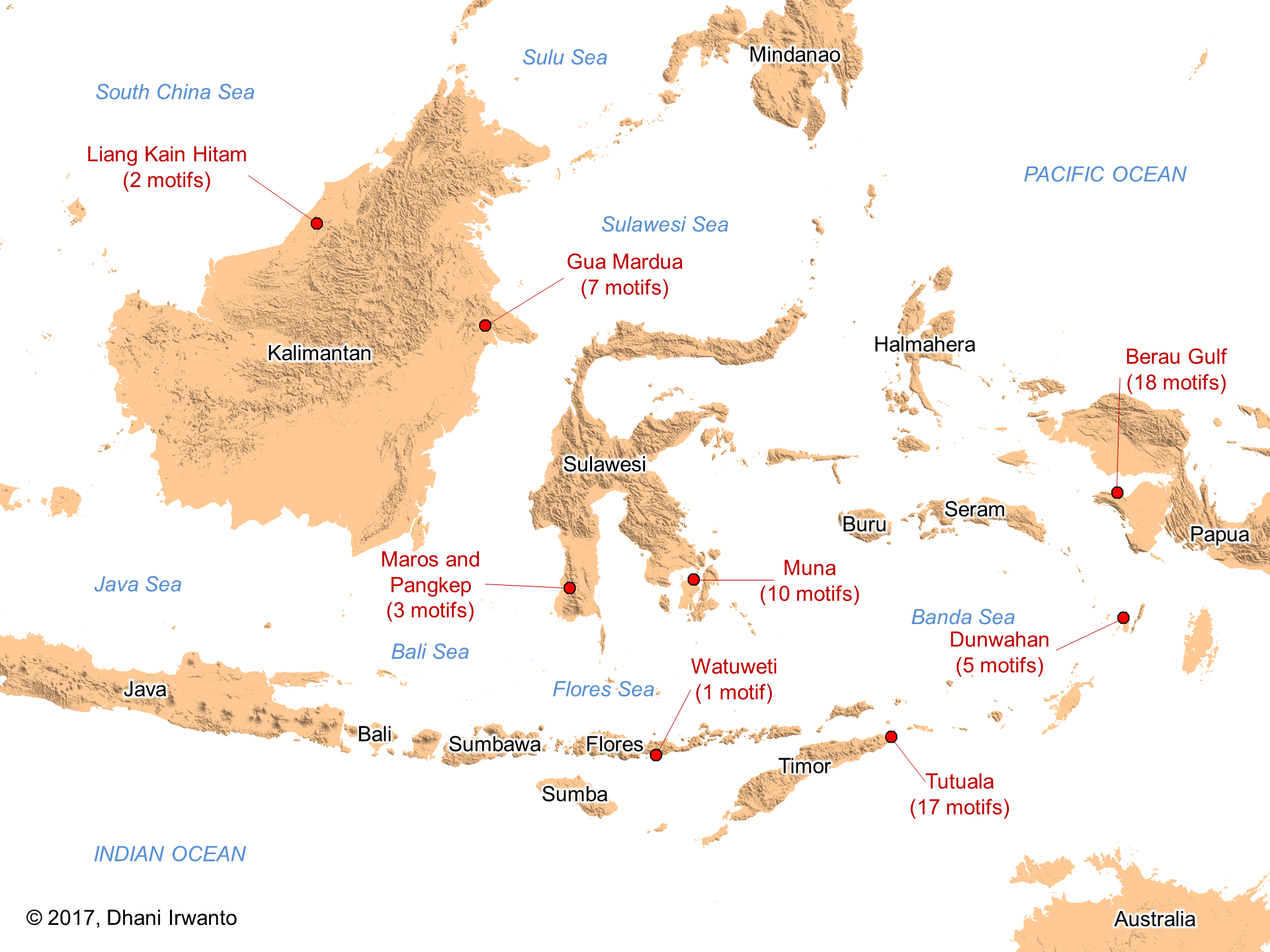
The earliest known evidences of maritime activities in the regions of Austronesian-speaking people are found as cave paintings in the islands of Muna (Southeast Sulawesi), Kai (Maluku), Arguni (Papua), Kalimantan, Sulawesi, Flores and Timor dated back for more than 10,000 years BCE, those are fully decorated by sailboat paintings. A study by Fritz and Paul Sarasin published in Nature (2014) suggests that paintings in the Maros-Pangkep caves in Sulawesi range from 17,400 to 39,900 years old. Similarities of prehistorical remains found in Java and Australian Aborigines show that ancient maritime activities had been made between them. Long distance sailing technology in the region must have appeared much earlier, with the peopling of Australia through Southeast Asia some 40,000 years ago (Green, 2006). Jukung, a type of boat used by the people of southern Kalimantan is found similarly in Madagascar, as well as their languages are closely similar.
Figure 6 – Locations of rock arts with boat paintings
Archaeologists have revealed ample evidence of the active maritime networks in the Southeast Asian region that existed from at least 5,000 years ago, at the beginning of the Austronesian migration that spread throughout all of insular Southeast Asia and most of the Pacific (Bellwood, 1985, 1991, 1995; Bellwood and Dizon, 2005; Horridge, 1995; Reid, 1988; Ronquillo, 1998; Scott, 1994; Solheim, 1988, 2006). As pointed out by linguists, archaeologists and anthropologists, shared cultural traits such as language, agriculture, animal husbandry and pottery-making are evidence of the Austronesian maritime connection. Likewise a boat building tradition emerged out of Southeast Asian islands but scarcely addressed in archaeology and history subjects.
Similarities between boat-building technology in the regions of Austronesian-speaking people and in the Indian Ocean about 5,000 years ago were observed. Wooden boards added on the canoe hulls and sewn-plank boats spread across the archipelago were also observed on the boats in Egypt, Mesopotamia and the Indus River Valley. However, Horridge (2006) claimed that it is not appropriate to correlate them seeing that the Austronesian speaking people spread over the archipelago long before they were influenced by boat-building technology in the Indian Ocean or even Egypt. He shows that the Austronesian boats were developed using a triangular-shaped sail since about 200 BCE demonstrated by the spread of bronze kettle which is one of the artifacts of the Dong Son culture, but this sail type was developed in the Indian Ocean more recently about 200 CE and was adopted by the Portuguese sailors a thousand years later.
Austronesian boats on its development have unique characteristics with a triangular sail and single outrigger. The outrigger is made of bamboo trunks with transverse connectors at the top of the hull, while the triangular sail is formed using bamboo sticks supported by a slanting mast (Horridge, 2006).
Cloves and cinnamon were allegedly trade commodities brought by Austronesian speaking sailors towards India and Sri Lanka, and perhaps also towards the east coast of Africa by outrigged boats. They left trails of influences such as boat design, boat building techniques, outriggers, fishing techniques and so on as evidenced in the Greek literature (Christie, 1957 in Horridge, 2006). Hornel (1928 in Horridge, 2006) supported this argument that the boat shape in Bantu tribe in Victoria Nyanza, Uganda in East Africa is similar to those in Indonesia.


 Sundaland Research Program