A research by Dhani Irwanto, 2 October 2025
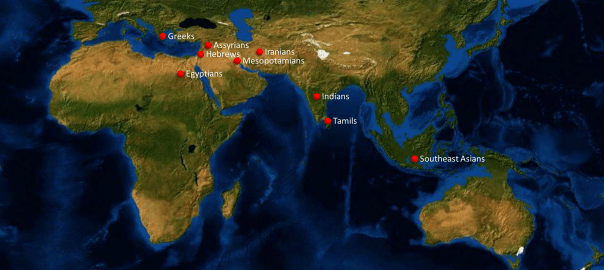
Plato’s tale of Atlantis, told in Timaeus and Critias, has fascinated readers for over two millennia. Yet Plato was not writing in a vacuum. Across the world, from India to Mesopotamia, from Egypt to Tamil traditions, we find stories that sound strangely familiar. These are not “proofs” of Atlantis, but parallels—echoes of catastrophe, paradise, or vanished lands.
Kumari Kandam (Tamil Memory of a Sunken Land)
The Tamil tradition speaks of Kumari Kandam, a lost landmass once ruled by the Pandyan kings. Ancient Tamil texts like Silappatikaram and Kaliththokai describe Sangam academies—gatherings of poets—some of which were said to have been drowned by the sea. Later Puranic texts placed Kumari Kandam in the deep south, now swallowed by the ocean.
It was imagined as a vast territory divided into 49 regions, crossed by mountains with 48 peaks, irrigated by channels from four great rivers. Mining of gems and gold was central. Eventually, the land was said to have been “swallowed by the sea” (Katalkol).
In modern times, revivalists fused this myth with the Victorian hypothesis of Lemuria, a now-abandoned scientific theory about a sunken Indian Ocean continent. Tamil nationalists embraced it as ancestral memory. In my earlier article on Lemuria, I showed how Kumari Kandam became conflated with Lemuria and even Mu, giving the myth a global spin.
Atlantis echo: A golden civilization, irrigated plains, gem mines, destroyed by rising seas.
Kangdez (Iranian Fortress-Paradise)
Iranian epic literature preserves the memory of Kangdez (Fortress of Kang). In the Shāhnāmeh and Bundahishn, Kangdez appears as a miraculous walled city in the Far East. Slides highlight its placement: “at the far eastern ocean, about six months to a year’s voyage from Iran, near the equator, outside China, east of India.”
Descriptions of Kangdez include concentric rings of walls layered with metals and precious stones, plentiful waters, eternal springs, and places of play, silver and gold towers, and a great plain influenced by the sea’s tides with rivers flowing south from volcano-studded mountains.
Atlantis echo: Both traditions emphasize concentric fortifications, gleaming metals, abundance of water, and a paradisal yet precarious geography.
Neserser (Egypt’s Island of Osiris)
In the Book of the Dead (Papyrus of Nu), we encounter Neserser—“the Island of Fire” in the far East, where the sun rises. It is the dwelling place of Osiris (Ausares, Asar) and Thoth. The imagery is vivid: Osiris enthroned in the center of six or seven concentric circles on a sacred lake, a volcanic-like “island and lake of fire” dedicated to Ra, floods that reshape the landscape, and Thoth residing nearby, keeper of divine knowledge.
Later Egyptologists described these circles as “hidden after the flood.”
Atlantis echo: Here again are concentric circles, a sacred island, a great flood, and divine kingship.
Mount Nisir (Mesopotamian Flood Memory)
The Epic of Gilgamesh recounts a great flood, where Utnapishtim builds an ark. After seven days, the boat grounds on Mount Nisir. Slides add color: the land in the Far East was like paradise, with forested mountains, rivers, vast plains, noisy birds, cicadas, and monkeys screaming in the trees.
This imagery is tropical—not the dry Mesopotamian steppe, but a lush, equatorial realm. Some scholars note that “Nisir” is phonetically close to “Neserser” and even “Nusasura.”
Atlantis echo: The flood, the grounding of survivors on a mountain, the paradise-like tropical plain.
The Asuras and the Ahuras
In early Vedic India, the Asuras were not evil—Varuna, guardian of cosmic law and the waters, was chief among them. Later texts, however, cast the Asuras as enemies of the Devas, while Varuna retained dignity as a god of oceans.
In Iranian religion, the cognate term Ahura (as in Ahura Mazda) was elevated as the supreme god, while the Daevas (same root as Devas) became demons.
India (early Vedas): Asuras = powerful lords, led by Varuna
- India (later): Asuras = demons
- Iran: Ahuras = good, Daevas = bad
- Assyria: Ashur = supreme deity
- Egypt: Osiris (Asar, Asari) = supreme deity with concentric-circle symbolism
Atlantis echo: The Atlantean kings were “Poseidon’s sons.” Poseidon parallels Varuna/Baruna, lord of seas and boundaries. The name “Atlas” recalls “Asura/Ashur/Osiris.” We glimpse a very old naming web that Solon may have repurposed.
“Atlas” and “Poseidon” as Borrowed Names
Plato openly said he borrowed names “to make the tale intelligible to his audience.” Thus Atlas and Poseidon may be Greek masks for older gods.
Atlas: The mountain-bearing Titan in Greek myth; but also linked to the root “Asura/Asar.”
Poseidon: God of seas and quakes, mirroring Varuna/Baruna/Vouruna—Indo-Iranian lords of waters and oaths.
These echoes suggest that Solon translated Near Eastern deities into Greek equivalents. The concentric rings, sacred kingship, and sea-lord all survive the translation.
The Garden of Eden
Finally, the Garden of Eden—a paradise watered by a river dividing into four: Tigris, Euphrates, Gihon, and Pishon. Genesis places Eden in the East, yet beyond ordinary geography. Some scholars argue Eden reflects older Mesopotamian “Dilmun” traditions—a far-off, pristine land. My 2015 article even suggested Kalimantan as Eden’s real-world counterpart.
Atlantis echo: Eden shares the archetype of a paradise lost—an ordered, fertile place destroyed or closed off after human transgression.
Gosong Gia and Nusantara Echoes
Slides mention Nusasura—possibly the “original name of Atlantis.” It combines nusa (island) and Asura. Old maps show names like Nusasira or Nisaira, perhaps distorted echoes. The Gosong Gia reef in the Java Sea is suggested as a drowned remnant. Even the people of Bawean Island hold myths of a sunken land.
Atlantis echo: If Atlantis lay in the Java Sea, Nusantara traditions like Nusasura may be its local survival in name.
Neserser, Punt, and Southeast Asia: The Egyptian Connection
Plato insists that his Atlantis story came from Egyptian priests at Sais, who told Solon the tale. If so, then the Egyptian worldview—their maps of trade, geography, and sacred memory—shaped what Plato inherited.
The Egyptians had firsthand knowledge of Southeast Asia, preserved in their accounts of the Land of Punt. Punt, described as the Ta Netjer or “land of the gods,” was not a vague myth but a real destination of repeated voyages, from Khufu to Rameses III. The great expedition of Hatshepsut (c. 1493 BCE) is famously carved on her temple walls, showing Egyptian ships sailing to Punt’s harbors.
Punt was, I argue, Sumatra:
- Products: Gold, camphor (kapur barus), benzoin (kemenyan), cinnamon, ebony, nutmeg, short-horned cows, elephants, and macaques—all endemic to Sumatra and neighboring islands.
- Architecture: Puntite houses on stilts match Sumatran and Enggano traditions.
- People: Puntites depicted with lighter skin, straight noses, and Malay-style dress, jewelry, and weapons.
- Names: Chief Parehu resembles Enggano names (Paraúha, Puríhio). His wife Ati recalls common Indonesian nicknames.
This is not coincidence—it is a cultural fingerprint.
Now let’s place this beside Neserser. The Book of the Dead speaks of Osiris enthroned at the center of six or seven concentric circles, on an island-lake in the far East. The imagery of circles, water, divine enthronement, and flood resonates directly with Plato’s Atlantis.
If the Egyptians already connected their cosmology to the far East—to Sumatra, the “land of origin”—then the parallels between Neserser and Atlantis may not be abstract at all. They may reflect Egypt’s sacred geography projected upon Southeast Asia.
The Thread of Transmission:
- Egypt knew Sumatra as Punt—the source of incense, gold, and sacred products.
- Neserser represented a circular, island-paradise of Osiris in the East.
- Atlantis, as told by priests to Solon, may have drawn on this same Eastern sacred memory.
In this light, Atlantis is not a purely Mediterranean invention. It may encode Egypt’s knowledge of Southeast Asia, filtered through myth, memory, and Plato’s philosophy.
In the Book of the Dead (Papyrus of Nu), we encounter Neserser—“the Island of Fire” in the far East, where the sun rises. It is the dwelling place of Osiris (Ausares, Asar) and Thoth. The imagery is vivid: Osiris enthroned in the center of six or seven concentric circles on a sacred lake, a volcanic-like “island and lake of fire” dedicated to Ra, floods that reshape the landscape, and Thoth residing nearby, keeper of divine knowledge.
Later Egyptologists described these circles as “hidden after the flood.”
Atlantis echo: Here again are concentric circles, a sacred island, a great flood, and divine kingship.
Connecting the Dots: A Discussion
The parallels between Plato’s Atlantis and global myths—from Tamil Kumari Kandam to Mesopotamian Nisir, from Iranian Kangdez to Biblical Eden—show a striking pattern of shared motifs: floods, lost paradises, concentric sacred cities, and divine kingship.
Among these, the Egyptian contribution is the most critical. Plato himself acknowledged that the story came from Egyptian priests. Their sacred geography included Neserser, the concentric island of Osiris in the far East, and their historical voyages reached as far as Punt—identified with Sumatra, the ‘Land of Origin.’
When we combine Neserser’s sacred concentric circles with Punt’s real-world geography and resources, a powerful connection emerges: Egypt not only imagined an eastern paradise, but had knowledge of one. Atlantis may be the philosophical echo of Egypt’s long memory of Southeast Asia.
Thus, the Atlantis story can be seen as a tapestry woven from many threads—myths of lost lands, religious cosmologies, and Egypt’s own encounters with Southeast Asia. Connecting these dots allows us to glimpse Atlantis not as an isolated legend, but as part of a wider human memory of catastrophe, paradise, and rebirth.
Conclusion: When Myths Rhyme Across Oceans
Kumari Kandam, Kangdez, Neserser, Nisir, Asuras, Atlas, Eden—each speaks in its own voice, yet the chorus is familiar. Lost lands, floods, circular cities, divine kings, and paradise destroyed.
Plato may have woven a Greek philosophical tale. But the motifs he used—perhaps borrowed, perhaps remembered—echo far older and wider. Atlantis may not be alone; it may be part of a global pattern of mythic memory of catastrophe and rebirth.
Comparative Snapshot: Parallels at a Glance
A concise table to visualize recurring motifs and where Southeast Asia fits in the Egyptian knowledge frame.
| Tradition/Source | Core Setting | Key Motifs | Flood/Collapse | Concentric/Sacred Center | Sea-Lord/Lawgiver | SE Asia Link |
| Kumari Kandam (Tamil) | Southern drowned land | Golden age, irrigated plains, gem mining, lost coasts | Yes – land swallowed by sea | No explicit circles (ordered realms) | Implied righteous kingship | Indirect (Indian Ocean south) |
| Kangdez (Iranian) | Fortress in the Far East, near equator | Concentric walls, metals, springs, tidal plain, volcanoes | Implied peril at sea’s edge | Yes – concentric fortifications | Sovereign order (Iranian epic) | Points East; equatorial hints |
| Neserser (Egypt) | Island-lake in the Far East | Osiris enthroned; 6–7 circles; ‘lake of fire’ | Yes – flood imagery; ‘hidden’ after | Yes – canonical concentric circles | Osiris/Ra as sacral law & kingship | Conceptual East (sunrise); bridge to Punt |
| Mount Nisir (Gilgamesh) | Mountain of grounding | Paradise-like East; forests, birds, monkeys; great flood | Yes – global flood narrative | No (mountain refuge) | Divine warning & survival order | Tropical imagery resonates with SE Asia |
| Asuras/Ahuras (Indo-Iranian) | Cosmic moral order | Waters, oaths, boundaries (Varuna/Ahura Mazda) | Not central | Symbolic circles (order) | Yes – sea-lord/lawgiver archetype | Cultural substrate across Indo-Iran |
| Atlas/Poseidon (Greek) | Atlantean kingship; sea-quake god | Names tied to sea power, metals, concentric city | Yes – sudden destruction | Yes – Atlantis capital rings | Poseidon (cf. Varuna/Baruna) | By proxy via Indo-Iran → Egypt |
| Garden of Eden (Genesis) | Eastern paradise, 4 rivers | Pristine garden, moral test, exile | Yes – loss/expulsion (not flood) | No circles; central river hub | Implied divine law | ANE roots; not specific to SE Asia |
| Nusasura/Gosong Gia (Java Sea) | Shoal/reef & island lore | Name echoes (nusa + asura); local sunken-land myths | Yes – submergence memory | Reef annuli (natural rings) | Asura/Baruna name web | Direct Java Sea locus |
| Egyptian Punt = Sumatra | ‘Land of Origin’ at sunrise | Incense (benzoin), camphor, cinnamon, gold; stilt houses; macaques | No collapse; active trade | Sacred east; gardens/temples receive | Egypt’s sacred economy | Direct – Egyptians knew Sumatra |
 Sundaland Research Program