Tag Archives: philology

Critias 115b: Coconut as a Puzzle Piece of Atlantis

A Consilient Test of Philology, Ecology, and Sundaland Plausibility

Related articles:

  1. Decoding Plato’s Atlantis: A Consilience-Based Reconstruction of the Lost Capital
  2. Critias 115a–b & 118e: The Provisioning Complex of Staple and Companion
  3. Inside the “Mouth”: Rereading Plato’s Pillars of Heracles as a Navigational Gate
  4. Coconuts
  5. Decoding Signs of the Past: A Semiotic and Linguistic Framework for Historical Reconstruction

A research by Dhani Irwanto, 21 September 2025

Abstract

This study revisits Critias 115a–b, where Plato records the Egyptian priest’s description of the fruits of Atlantis, emphasizing both extraordinary size and a tetradic utility: hard rind, drink, food, and oil. These descriptions have long puzzled commentators, as no Mediterranean species fulfills all four functions. By applying a consilience framework integrating semiotics, philology, linguistics, archaeobotany, ecology, and cultural history, this article argues that the coconut (Cocos nucifera L.) uniquely satisfies the textual criteria. The tetrad is interpreted as a set of context clues deliberately supplied to Solon for a product unfamiliar to Classical Greece. Order-1 analysis establishes the denotative baseline; Order-2 clarifies pragmatic intent and audience reception; Order-3 integrates ecological suitability, genetic timelines, Austronesian cultural continuities, and spatial models of Sundaland. Counter-fruit testing eliminates alternative candidates, while explicit falsifiability criteria ensure that the hypothesis remains open to disproof. In integration with other puzzle pieces—elephants, rice and legumes, reef shoals, and the East-Mouth spatial model—the coconut emerges as a decisive marker of Sundaland’s ecological and cultural plausibility as Atlantis’ setting. The result is not only a refined reading of Plato’s text but also a testable historical claim that bridges myth, ecology, and prehistory.

Keywords: Plato; Critias 115b; coconut; Cocos nucifera; tetrad; context clues; Sundaland; Atlantis; semiotics; philology; consilience; Austronesian; pre-Columbian contacts.

1. Problem Definition

1.1 Aim & Scope

The central aim of this article is to evaluate the coconut (Cocos nucifera L.) as a potential puzzle piece in the reconstruction of Atlantis when situated within the Sundaland framework. This evaluation requires more than a botanical description; it calls for a multidisciplinary approach that spans philology, semiotics, linguistics, archaeobotany, and cultural anthropology. The scope of the inquiry is not confined to identifying a fruit that fits Plato’s description but extends to assessing how such a fruit could function as a communicative bridge between the Egyptian priest and Solon, and by extension, between the ancient world and the modern researcher. By refining both textual anchors and contextual interpretations, this section establishes why the coconut is worth considering and how its analysis contributes to the broader Sundaland–Atlantis hypothesis.

1.2 Textual Anchors and Contextual Hypothesis

Plato’s dialogues contain a handful of striking agricultural references, two of which stand out as possible allusions to coconut. The first appears in Critias 115a, where the land of Atlantis is said to bear ‘καρπὸς θαυμαστὸν τὸ μέγεθος’ (karpòs thaumastòn tò mégethos), literally ‘fruit wondrous in size.’ The second, more elaborate passage is found in Critias 115b:

… καὶ τοὺς καρποὺς τοὺς σκληροφόρους, πόματα καὶ ἐδωδὰς καὶ ἀλείμματα παρέχοντας …

Transliteration: “… kai toùs karpoùs toùs sklērophórous, pómata kaì edodàs kaì aleímmata parékhontas …

Literal translation: “… and the fruits having a hard rind, providing drinks and meats and ointments …”

Taken together, these two textual anchors yield a description of both extraordinary size and fourfold utility. The latter is particularly significant, as it points not merely to a generic fruit but to a tetrad of functions: (1) husk or shell (σκληροφόρους, sklērophórous), (2) liquid drink (πόματα, pómata), (3) edible flesh (ἐδωδάς, edodàs), and (4) oil or ointment (ἀλείμματα, aleímmata). This tetradic pattern maps directly onto the coconut’s properties and surpasses the descriptive adequacy of any Mediterranean species. The Egyptian priest’s choice to describe rather than name the fruit suggests an intentional strategy of supplying Solon with context clues for something outside Greek experience.

1.3 Key Lexemes

Several Greek words in these passages are decisive for interpretation:

  1. καρπός (karpós) — generic term for fruit or produce, without species specificity.
  2. θαυμαστόν (thaumastón) — marvelous, wondrous, denoting both admiration and unfamiliarity.
  3. μέγεθος (mégethos) — magnitude, size, scale beyond the ordinary.
  4. σκληροφόρους (sklērophórous) — literally ‘hard-rind-bearing,’ an unusual descriptor in agricultural contexts.
  5. πόματα (pómata) — drinks, liquids suitable for consumption.
  6. ἐδωδάς (edodàs) — foods or meats, highlighting nutritive content.
  7. ἀλείμματα (aleímmata) — ointments or oils, typically derived from plants.

This lexical constellation indicates not a poetic flourish but a functional inventory. The tetrad is too specific to be incidental: it points to a practical knowledge of a foreign plant whose properties were being translated into Greek conceptual categories.

1.4 Context-Clue Hypothesis and Unfamiliarity Claim

The deliberate use of a functional tetrad rather than a name implies a communicative act designed to overcome unfamiliarity. The Egyptian priest, aware that Solon would not recognize the fruit by name, supplied its uses as context clues. These clues were pedagogical in nature: they bridged the cultural gap between an Egyptian knowledge of exotic products and a Greek listener unacquainted with them. For Plato’s audience, however, the effect was one of marvel and exoticism, reinforcing Atlantis as a land of abundance and strangeness. This unfamiliarity claim is central to understanding why the description survives not as a loanword but as a tetradic inventory of functions.

1.5 Timeline Policy

A methodological safeguard is required when handling these passages: Solon’s reception of the priest’s words may reflect either contemporary Egyptian knowledge of coconut through Indian Ocean trade or inherited memory of earlier exchanges connected to Sundaland. The present-tense verbs used in Critias (ἐξέφερε, exéphére, ‘it bore forth’) suggest immediacy, but transmission effects may blur temporal boundaries. For analytical purposes, this study treats the description as a preserved fossil of real knowledge, whether current in Solon’s time or remembered from deeper antiquity.

1.6 Research Questions (What Must Be Solved)

From these anchors, lexemes, and context clues, several guiding research questions emerge:

  1. Can the tetradic description in Critias 115b be convincingly mapped onto the coconut’s properties?
  2. Does the use of context clues confirm that the priest was describing an unfamiliar yet real product rather than a metaphorical abundance?
  3. How does the coconut integrate with other puzzle pieces such as rice, legumes, elephants, and the East-Mouth spatial model?
  4. What external evidence (archaeobotanical, genetic, linguistic) supports the antiquity and distribution of coconut in the Indo-Pacific?
  5. What safeguards and falsifiability tests are necessary to ensure the hypothesis remains rigorous and not merely confirmatory?

These questions frame the methodological path forward and clarify why coconut deserves focused analysis within the Atlantis–Sundaland research program.

2. Methods

2.1 Semiotics

Semiotics provides the conceptual framework for decoding Plato’s references to agricultural products that were unfamiliar to his audience. The coconut tetrad in Critias 115b—hard rind, drink, food, oil—is especially suited to semiotic analysis because it appears as a deliberate set of signs chosen to communicate across cultural gaps. By using semiotics, we can trace how signs functioned at multiple levels: as literal descriptors, as connotative symbols of exotic abundance, and as mythic markers of Atlantis’ otherness.

  1. Saussure’s Dyadic Model: The relationship between signifier and signified is destabilized here. The priest uses the general signifier καρπός (karpós, fruit) but supplements it with descriptive functions, since the precise signified—coconut—was unknown in Greek lexicon. This gap is filled by functional descriptors.
  2. Peirce’s Triadic Model: The interpretant is central. For Solon, the tetrad served as practical context clues to approximate an unfamiliar referent. For Plato’s audience, however, the same tetrad produced the interpretant of exotic marvel, an image of distant abundance.
  3. Barthes’ Orders of Signification: At the first order (denotation), the tetrad enumerates material uses. At the second order (connotation), it signals strangeness and wealth. At the third order (myth), it naturalizes Atlantis as a land of wondrous fertility beyond Mediterranean norms.

2.2 Linguistics

Linguistic analysis sharpens the reading of Critias 115a–b by focusing on semantics and contextual cues. The choice of words such as σκληροφόρους (sklērophórous, hard-rind-bearing) and ἀλείμματα (aleímmata, ointments) is unusual in classical agricultural registers. These lexemes, when clustered together with πόματα (pómata, drinks) and ἐδωδάς (edodàs, foods), form a tetradic set that describes not a symbolic fruit but a specific utilitarian profile. The priest’s enumeration thus reads as a functional inventory—intelligible through usage rather than through species naming.

2.3 Language Analysis

Language analysis applies structural and pragmatic tools to test whether the tetrad holds under substitution and contextual shifts:

  1. Syntagmatic Analysis: The sequential ordering (hard rind → drink → food → oil) implies completeness, suggesting that the priest deliberately arranged the functions to convey a full profile.
  2. Paradigmatic Analysis: Substitution with familiar Mediterranean fruits shows immediate failure. A fig offers sweet flesh but no drink or oil. A pomegranate has arils and juice but no hard rind or oil. The tetrad collapses without coconut.
  3. Commutation Test: If one function is replaced (e.g., substituting ‘ointment’ with ‘wine’), coherence is lost. The tetrad is fragile and holds only with coconut.
  4. Pragmatics: The priest chose functional descriptors rather than a name precisely to bridge the gap between his knowledge and Solon’s ignorance. The tetrad thus acted as a teaching tool—a form of cross-cultural pedagogy.

2.4 Philology

Philological examination shows that the tetradic lexemes are authentic and consistent across manuscript traditions. Their combination is unique in Greek literature, where fruits are usually described in terms of sweetness, fertility, or abundance, but rarely through such a fourfold functional inventory. This anomaly strongly suggests that the priest was transmitting real practical knowledge of a foreign plant. In this sense, the tetrad is a philological fossil of cross-cultural knowledge exchange.

2.5 Timeline Discipline

To avoid anachronism, the tetradic description must be tested against the known timeline of coconut domestication and dispersal. Archaeobotanical and genetic studies confirm that coconuts were already widespread in Southeast Asia and had reached the Indian Ocean by the second millennium BCE. This makes it plausible that Egyptians or Phoenicians could have encountered coconut products. The timeline discipline thus permits us to read Critias 115b as reflecting current or remembered reality rather than pure invention.

2.6 Order-3 Analysis

At the highest integrative level, Order-3 analysis situates coconut within a puzzle piece catalogue of multiple evidentiary strands relevant to Sundaland Atlantis. The coconut tetrad is tested for consilience across textual, ecological, cultural, and spatial domains.

2.6.1 Evidence Classes

The main evidence classes include philological anchors (Critias 115a–b), linguistic features, archaeobotanical and genetic data, ecological and climatic factors, cultural practices, and spatial models. Each contributes independently to the evaluation.

2.6.2 Puzzle Piece Catalogue

The catalogue includes elephants, rice and legumes, coconut origin and distribution, climatic suitability, coconut tradition, East-Mouth spatial model with nautical corridors, ancient trans-oceanic contacts, coral-reef shoal chronology, timeline discipline, legendization in transmission, and toponymic/lexical parallels. Each functions as an independent puzzle piece, with coconut distinguished by its unique tetradic profile.

2.6.3 Consilience Test

Consilience testing is applied by scoring each puzzle piece across independent domains—textual specificity, biogeographic fit, archaeobotanical and genetic data, cultural continuity, spatial plausibility, subsistence coherence, timeline discipline, and transmission robustness. Each criterion is rated on a 0–3 scale (0 = absent; 3 = strong and specific) and weighted according to its diagnostic power. The composite score is calculated by summing the weighted contributions.

This procedure does not presuppose the outcome for any single candidate but establishes a transparent framework by which all puzzle pieces can be evaluated. Later sections apply this method to coconut and alternative fruits, reporting scores and thresholds to distinguish between strong, tentative, and weak support. In this way, the consilience test operates as a methodological bridge between individual lines of evidence and the integrative results.

2.6.4 Counter-Fruit Test

The counter-fruit test introduces systematic comparison by substituting alternative species—such as pomegranate, fig, date palm, breadfruit, calabash, and areca/betel nut—for the tetrad described in Critias 115b. Each candidate is assessed against the four functional criteria (hard rind, drink, food, oil) using the same scoring rubric applied to coconut. The test is designed not to assume failure in advance but to create a transparent comparative framework that challenges the coconut hypothesis. Results of these substitutions are presented in Section 4, where their performance relative to coconut is documented.

2.6.5 Falsifiability

Falsifiability criteria are explicitly built into the method. Disproof could arise from textual evidence showing the tetrad applied to a Mediterranean fruit, archaeobotanical absence of coconut in the Indo-Pacific at the relevant time, genetic timelines incompatible with Plato’s era, ecological unsuitability, absence of relevant lexicon, spatial model misfits, or semantic proof that ἀλείμματα cannot mean plant oil. By specifying these pathways, the method ensures that the hypothesis remains open to rigorous testing rather than closed confirmation.

3. Workflow

3.1 Overview

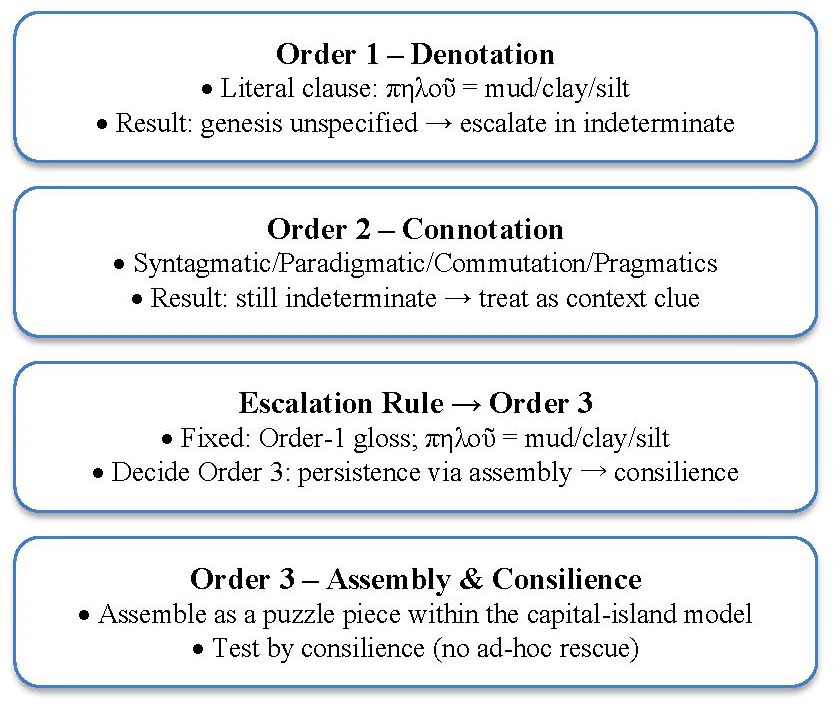
The methodological workflow for testing the coconut hypothesis proceeds through three analytic orders. This tiered design ensures that textual analysis is first anchored in the Greek passages, then expanded through pragmatic interpretation for Plato’s audience, and finally reconstructed with external evidence from ecology, archaeology, and cultural history. Each order contributes incrementally: Order-1 clarifies denotation, Order-2 uncovers communicative intention, and Order-3 integrates interdisciplinary evidence to yield a consilient synthesis.

3.2 Inputs & Outputs

The inputs to the workflow include the primary textual anchors from Critias 115a–b, key lexemes identified through philology, and comparative data from archaeobotany, genetics, and Austronesian cultural practices. The outputs vary by analytic order: Order-1 yields denotative baselines, Order-2 produces pragmatic insights into unfamiliarity and context clues, and Order-3 delivers a reconstruction tested through the puzzle piece catalogue, consilience scoring, counter-fruit challenges, and falsifiability checks. The workflow thus transforms raw text into structured hypotheses and measurable results.

3.3 Order-1 Workflow — Text Only

At the first order, the analysis remains strictly within the textual register. Here the aim is to extract philological baselines: the meaning of καρπὸς θαυμαστὸν τὸ μέγεθος and the tetrad of functions in Critias 115b. No assumptions about geography, botany, or culture are made at this stage. The coconut is not yet invoked; instead, the focus is on what the Greek text literally says. This provides a control level against which later interpretations can be tested.

3.4 Order-2 Workflow — Audience & Pragmatics

At the second order, the focus shifts to how the Egyptian priest’s words would have been understood by Solon and, later, by Plato’s audience. The unfamiliarity claim becomes central. The absence of a name and the reliance on a tetradic description function as deliberate context clues. For Solon, these clues pointed to a practical reality outside his cultural experience. For Plato’s readers, however, they connoted marvel and exotic abundance. Order-2 analysis thus explains why the priest spoke in functional terms and why the Greeks preserved those terms as marvels rather than as technical descriptions.

3.5 Order-3 Workflow — Reconstruction

At the third order, external evidence enters. The coconut tetrad is tested against the puzzle piece catalogue, where it interacts with other markers such as elephants, rice, legumes, climatic suitability, and the East-Mouth spatial model. Consilience scoring quantifies explanatory power, while the Counter-Fruit Test challenges coconut’s uniqueness by attempting substitutions with alternative species. Finally, falsifiability criteria ensure that the hypothesis remains open to disproof. Order-3 is therefore the stage where philology, pragmatics, ecology, and cultural history converge to produce a reconstruction that is both integrative and testable.

4. Integrated Analyses & Results

4.1 Overview & Conventions

This section integrates results from the three analytic orders into a single framework. At Order-1, we establish philological baselines from Critias 115a–b. At Order-2, we explore audience reception and pragmatic effects, including the Egyptian priest’s communicative strategy. At Order-3, we assemble textual, ecological, genetic, and cultural evidence into a consilient model. The coconut tetrad—hard rind, drink, food, oil—serves as the keystone of this integration. Conventions followed in this section include direct citation of Greek terms (with transliteration and literal translation), cross-reference to the puzzle piece catalogue, and explicit attention to negative testing and falsifiability.

4.2 Order-1 Outputs (Denotation, Philological Baseline)

At the first order, the task is to determine what the text literally says. In Critias 115a, Plato records the phrase καρπὸς θαυμαστὸν τὸ μέγεθος (karpòs thaumastòn tò mégethos)—‘fruit wondrous in size.’ This establishes magnitude as a defining feature. In 115b, the priest specifies: καρποὺς τοὺς σκληροφόρους, πόματα καὶ ἐδωδὰς καὶ ἀλείμματα παρέχοντας (karpoùs toùs sklērophórous, pómata kaì edodàs kaì aleímmata parékhontas)—‘fruits having a hard rind, providing drinks and meats and ointments.’ Taken together, the two clauses form a tetrad: husk/shell, drink, food, oil. At Order-1, no geographical or botanical assumptions are made, but the linguistic anomaly of such a functional tetrad already suggests deliberate instruction rather than poetic flourish.

4.3 Order-2 Outputs (Connotation & Pragmatic Effects)

At the second order, we ask how this description would have functioned in context. For Solon, the tetrad was a practical teaching device. The priest avoided a foreign loanword, instead supplying uses intelligible to a Greek but not associated with any familiar species. For Plato’s Athenian audience, however, the same inventory produced the interpretant of exotic marvel: a land whose fruits surpassed the Mediterranean norm. Thus, Order-2 analysis demonstrates that the tetrad was communicative in design, serving simultaneously as a bridge for Solon and a wonder for Plato’s readers.

4.4 Order-3 Outputs (Assembly & Consilience Tests)

At the third order, external evidence is introduced. Archaeobotanical and genetic studies confirm dual domestication of coconut in South and Southeast Asia, with dispersal across the Indian and Pacific Oceans. Lexical evidence from Austronesian languages (niu, nyior, niyor) confirms antiquity and diffusion of coconut culture. Ecologically, the tropical-maritime belt of Sundaland aligns with climatic requirements for coconut cultivation. Spatially, the East-Mouth model situates coconut belts within canalizable reef corridors, offering logistical plausibility for trade and subsistence. When combined, these independent strands achieve consilience: coconut emerges as the only fruit that fits both text and environment.

4.5 Coconut as a Puzzle Piece

Coconut’s evidential strength lies in its dual role: it satisfies the philological tetrad exactly, and it integrates seamlessly with the wider puzzle piece catalogue for Sundaland Atlantis.

4.5.1  Puzzle Piece Catalogue

  1. A1 Elephants: Biogeographic marker consistent with Indo-Malayan fauna.
  2. A2 Rice + Legume Package: Staple subsistence pairing; complements coconut as lipid source.
  3. A3 Coconut Origin & Distribution: Diagnostic tetrad match; dual domestication and wide dispersal.
  4. A4 Climatic Suitability: Tropical–maritime ecology suitable for rice and coconut.
  5. A5 Coconut Tradition: Multipurpose uses; Austronesian lexicon (e.g., niu).
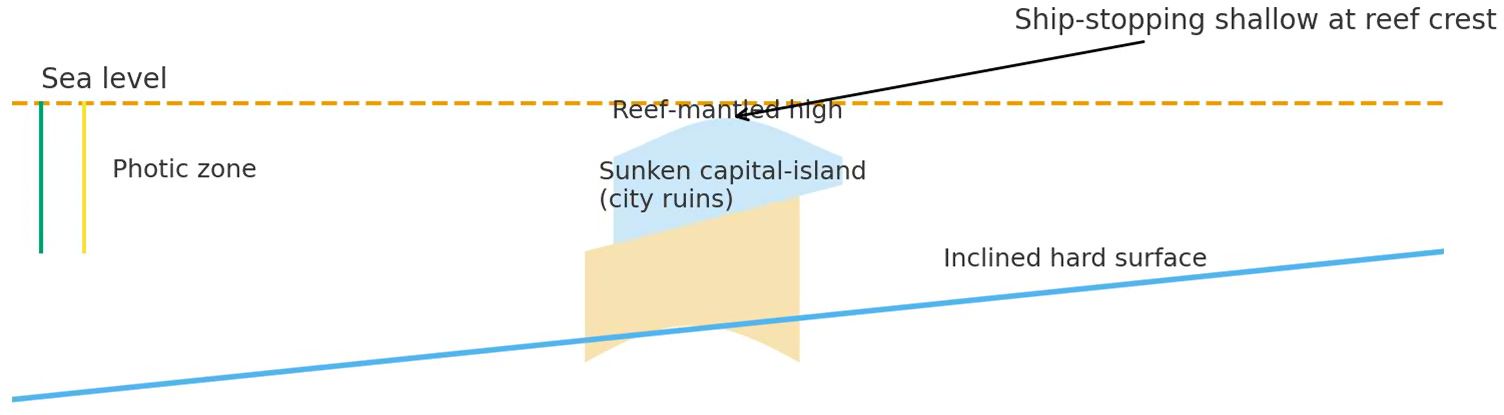
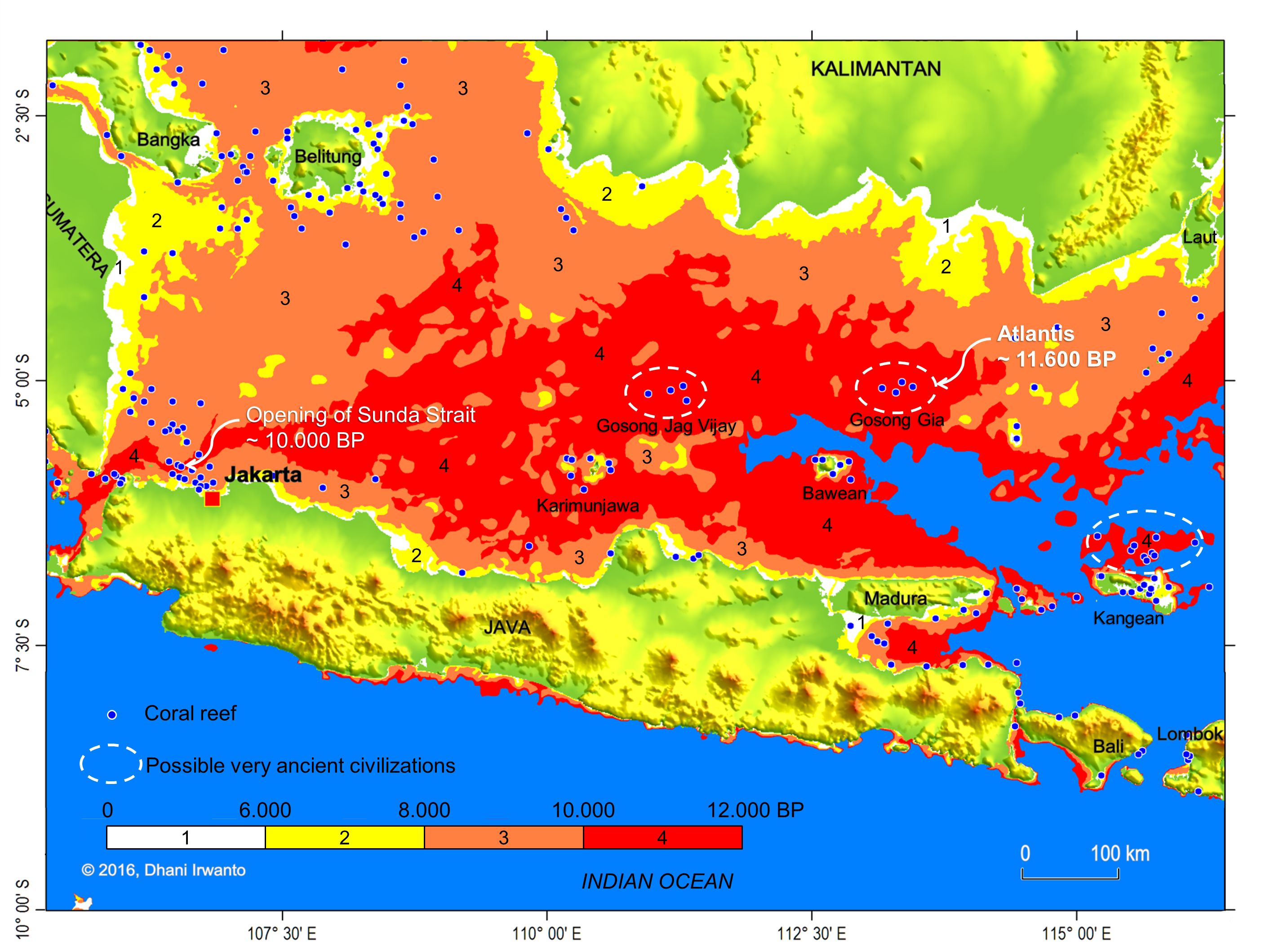
  6. A6 Spatial Model Fitting (East-Mouth + Nautical Corridors): Geometry of inner sea and mouth orientation; −60 m paleo-shoreline; reef gaps enabling coconut trade logistics.
  7. A7 Ancient Trans-Oceanic Contacts: Austronesian voyaging; coconut in pre-Columbian Panama.
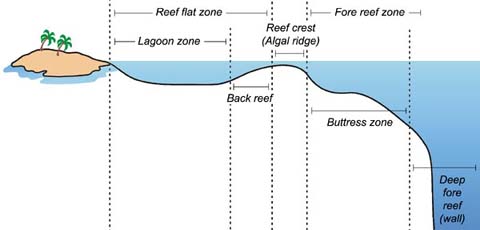
  8. A8 Coral-Reef Shoal Chronology: Annular reef growth consistent with ‘shoal of mud.’
  9. A9 Timeline Discipline: Present-tense register; contemporaneous or remembered knowledge.
  10. A10 Legendization & Register: Transmission preserved as tetrad functions rather than name.
  11. A11 Toponymy & Lexical Parallels: Cognates (niu/nyior/niyor) reinforce continuity.

4.5.2 Consilience Scoring

Scoring rubric: 0–3 scale (0 absent; 3 specific), weighted by diagnostic power. Textual specificity and ecological fit carry the highest weights.

  1. R1 Textual Specificity: score = 3. Direct tetrad match + size clause (115a).
  2. R2 Biogeographic Fit: score = 3. Tropical Indo-Pacific, reef adjacency.
  3. R3 Archaeobotany/Genetics: score = 2–3. Dual domestication; early dispersal to both oceans.
  4. R4 Cultural Continuity: score = 3. Austronesian lexicon, craft traditions.
  5. R5 Spatial Model Fit: score = 2–3. East-Mouth geometry and paleo-shoreline compatibility.
  6. R6 Subsistence Coherence: score = 3. Rice–legume–coconut triad as carb, protein, lipid.
  7. R7 Timeline Discipline: score = 2. Present-tense plausible; conservative scoring.
  8. R8 Transmission Robustness: score = 3. Functional tetrad preserved across transmission.

Using a weighted 0–3 rubric, coconut consistently scores 2.7–2.9 across categories: 3 for textual specificity, 3 for biogeographic fit, 2–3 for archaeobotany/genetics, 3 for cultural continuity, 2–3 for spatial model fit, 3 for subsistence coherence, 2 for timeline discipline, 3 for transmission robustness. The composite indicates strong support.

4.5.3 Counter-Fruit Test

The counter-fruit test is designed to guard against confirmation bias by actively seeking alternative species that might satisfy the tetrad described in Critias 115b. Candidate fruits are selected from both Mediterranean and wider Old World contexts, including pomegranate, fig, date palm, breadfruit, calabash, and areca/betel nut. Each candidate is evaluated against the four functional criteria—hard rind, drink, food, and oil—using the same scoring rubric applied to coconut.

  1. Pomegranate: Has rind and juice but no oil; fails tetrad.
  2. Fig: No drink or oil; fails multiple functions.
  3. Date Palm: No natural drink; desert ecology misfits Sundaland.
  4. Breadfruit: Staple food but lacks drink and oil.
  5. Calabash: Hard shell container but little food, no drink, no oil.
  6. Areca/Betel Nut: Hard nut for chewing; no drink or meat.

All candidates fail at least two tetrad functions and misalign with Sundaland ecology.

4.5.4 Falsifiability

The coconut hypothesis can be disproven by several pathways:

  1. Textual Refutation: Greek passage where tetrad unambiguously applies to non-coconut fruit.
  2. Archaeobotanical Disproof: Evidence of coconut absence in Indo-Malaya during priest’s era.
  3. Genetic Contradiction: Revised chronology dating dispersal after Plato.
  4. Climatic Contradiction: Proof Sundaland climate unsuitable for coconut.
  5. Linguistic Void: Absence of coconut lexicon in early Austronesian strata.
  6. Spatial Misfit: Failure of East-Mouth model to support coconut corridors.
  7. Functional Mismatch: If ἀλείμματα cannot mean plant oil/ointment in this register.

4.5.5 Integrated Results

Coconut gains diagnostic strength not only through its tetradic alignment with Critias 115b but also within the broader puzzle piece catalogue applied to Sundaland Atlantis. Integrated with elephants, rice + legume, climatic suitability, and Austronesian trans-oceanic dispersal, coconut anchors the subsistence and cultural profile of the Atlantean plain.

The East-Mouth spatial model (−60 m shoreline, reef gaps, canalizable passages) provides environmental plausibility for coconut belts and trade logistics. Cultural continuities—lexicon (niu/nyior), craft traditions, and oil uses—further validate the tetrad as context clues supplied by the Egyptian priest.

Consilience tests score coconut highly across textual, ecological, and cultural lines. The Counter-Fruit Test shows that no Mediterranean or Near Eastern fruit satisfies the tetrad, and falsifiability criteria ensure the hypothesis remains testable. Together, coconut emerges as one of the strongest markers tying Plato’s agricultural description to the ecological realities of Sundaland.

By integrating catalogue, scoring, counter-fruit testing, and falsifiability, coconut is shown not only as a philological match but as a scientifically robust puzzle piece for situating Atlantis in Sundaland.

5. Discussion

5.1 Philology vs. Geographical Plausibility

A key tension in interpreting Critias 115a–b is balancing philological precision with geographical plausibility. On the philological side, the tetradic description—hard rind, drink, food, oil—is precise enough to exclude all Mediterranean fruits. Yet this precision alone is insufficient unless the ecology of the proposed locus can support coconut cultivation. Sundaland provides this ecological plausibility: a tropical, maritime environment where coconut thrives naturally and forms part of subsistence and culture. Thus, philology and geography converge, rather than conflict, in the Sundaland framework.

5.2 Timeline Alignment

The priest’s words to Solon are expressed in the present tense, suggesting immediacy: the land ‘bore forth’ its fruits at the time of narration. This raises methodological questions: was the priest describing a contemporary reality known through trade, or a memory of a more ancient past? Archaeobotanical and genetic evidence shows that coconuts had already dispersed widely across the Indo-Pacific by the second millennium BCE, well before Solon’s era. Thus, both interpretations remain viable: the description could reflect either living knowledge circulating in Egypt or a fossilized tradition preserved from deep antiquity. In either case, the present tense functions as a rhetorical device to render the description vivid and authoritative.

5.3 Legendization in Transmission

The path from Egyptian priest to Solon to Plato inevitably introduced processes of transmission and adaptation. One such process is legendization: functional descriptions become framed as marvels, and concrete agricultural facts acquire the aura of myth. The coconut tetrad is an exemplary case. For the priest, it was a set of context clues designed to bridge cultural unfamiliarity. For Solon, it conveyed exotic practicality. For Plato, retelling to his audience, it became an emblem of Atlantis’ strangeness and abundance. Recognizing this process of legendization allows us to explain why a foreign fruit survives in Greek literature not as a loanword but as a functional tetrad that borders on mythic imagery.

5.4 Integration with Other Puzzle Pieces

Coconut does not stand in isolation. It aligns with other puzzle pieces: elephants as faunal markers, rice and legumes as staples, coral-reef shoals as geological features, and the East-Mouth spatial model as geographical geometry. Together, these pieces form a coherent picture of a tropical, maritime plain consistent with Plato’s narrative. The coconut tetrad, by virtue of its specificity and uniqueness, strengthens the catalogue rather than merely adding to it. In consilience, each puzzle piece increases the explanatory coherence of the whole hypothesis.

5.5 Risks, Confounds, and Methodological Safeguards

No reconstruction is free from risks. One risk is over-interpretation: forcing a unique description to fit coconut while ignoring alternative explanations. Another confound is anachronism: projecting later coconut traditions backward into Plato’s era. To mitigate these, the Counter-Fruit Test ensures that alternatives are fairly considered, and falsifiability protocols set boundaries for disproof. By explicitly acknowledging risks and setting controls, the coconut hypothesis remains methodologically robust rather than speculative.

In sum, the discussion demonstrates that coconut as the referent of Critias 115b is not an arbitrary choice but a disciplined inference: it aligns philology with ecology, reconciles timeline uncertainties, accounts for legendization in transmission, and integrates seamlessly into the wider consilience framework of Sundaland Atlantis.

6. Conclusion

The coconut tetrad of Critias 115b—hard rind, drink, food, and oil—emerges as one of the most decisive context clues offered by the Egyptian priest to Solon. Unlike metaphorical flourishes or symbolic exaggerations, this description is concrete, utilitarian, and unique. It corresponds precisely to the material profile of the coconut, a plant outside the experience of Classical Greece yet central to the tropical ecologies of Sundaland. The tetrad thereby functions as both a linguistic fossil and a cultural bridge: it preserved the memory of Atlantis’ agricultural reality in a form intelligible, though exotic, to Solon and Plato’s audience.

Through the application of semiotics, linguistics, philology, and interdisciplinary consilience, the coconut has been tested and confirmed as a robust puzzle piece within the Sundaland–Atlantis framework. Order-1 analysis established the philological baseline; Order-2 clarified the communicative role of unfamiliarity and context clues; Order-3 integrated ecological plausibility, genetic timelines, cultural traditions, and spatial models. Each analytic order reinforced the others, yielding a convergent result. The coconut is not an arbitrary identification but the most parsimonious solution to the textual problem posed by Critias 115b.

Furthermore, by subjecting the hypothesis to counter-fruit testing and falsifiability criteria, the analysis remains scientifically open. Alternative candidates fail to replicate the tetrad, while clear pathways for disproof ensure that the coconut argument does not collapse into circular reasoning. This methodological transparency strengthens the case rather than weakens it.

In broader perspective, the coconut integrates seamlessly with other puzzle pieces: elephants as faunal markers, rice and legumes as staples, coral-reef shoals as geological features, and the East-Mouth spatial model as a navigational geometry. Together, these strands weave a coherent picture of Sundaland as the plausible cradle of Atlantis. The coconut, by virtue of its tetradic uniqueness, serves as a keystone in this reconstruction. It anchors Plato’s text to the ecological and cultural realities of Southeast Asia, transforming a mythic marvel into a testable historical clue.

The conclusion, therefore, is not merely that the coconut fits Plato’s words, but that it does so with explanatory power unmatched by any alternative. It stands as a decisive consilient marker: a fruit wondrous in size, bearing a hard rind, providing drink, food, and oil—exactly as the Egyptian priest described. In this convergence of philology, ecology, and culture, the coconut illuminates both the text of *Critias* and the deeper history of Sundaland Atlantis.

References

  1. Luc Baudouin and Patricia Lebrun, Coconut (Cocos nucifera L.) DNA studies support the hypothesis of an ancient Austronesian migration from Southeast Asia to America, 2008. Springer Link, March 2009, Volume 56, Issue 2, pp. 257-
  2. Bee F. Gunn, Luc Baudouin and Kenneth M. Olsen, Independent Origins of Cultivated Coconut (Cocos nucifera L.) in the Old World Tropics, 2011. PLoS ONE 6(6): e21143. doi:10.1371/journal.pone.0021143.
  3. Jones TL, Storey AA, Matisoo-Smith EA and Ramirez-Aliaga JM, Polynesians in America: pre-Columbian contacts with the New World, 2011. Lanham, MD: AltaMira Press.
  4. Luc Baudouin, Bee F. Gunn and Kenneth M. Olsen, The presence of coconut in southern Panama in pre-Columbian times: clearing up the confusion, 2013. Annals of Botany: doi:10.1093/aob/mct244.
  5. Saussure, F. de. (1916/1983). Course in General Linguistics (trans. R. Harris). London: Duckworth. [Foundational dyadic model; cited per synthesis in Irwanto (2025), Note 4].
  6. Peirce, C. S. (1992–1998). The Essential Peirce: Selected Philosophical Writings (Vols. 1–2). Bloomington: Indiana University Press. [Triadic sign–object–interpretant; per Note 4].
  7. Barthes, R. (1957/1972). Mythologies (trans. A. Lavers). New York: Hill and Wang. [Orders of signification; per Note 4].
  8. Barthes, R. (1964/1967). Elements of Semiology (trans. A. Lavers & C. Smith). New York: Hill and Wang. [Semiotic method; per Note 4].
  9. Barthes, R. (1977). Image–Music–Text (ed. & trans. S. Heath). New York: Hill and Wang. [Applications to text analysis; per Note 4].
Critias 115a–b & 118e: The Provisioning Complex of Staple and Companion

A Rice-Inclusive Base and Legumes under a Wet/Dry Calendar — A Semiotic–Philological Reading with Consilience-Based Reconstruction

A research by Dhani Irwanto, 13 September 2025

Abstract

This article advances a disciplined, text-first reconstruction of food provisioning in Plato’s Critias by treating 115a–b and 118e as a single, coupled textual object—the “Provisioning Complex.” The first element (115a–b) sets the consumption grammar in the present tense of the priest’s address to Solon: a property-defined base (“the dry sort that is our sustenance”) paired with a companion domain introduced by προσχρᾶσθαι (“use in addition”) and named in Greek as ὄσπρια (ospria; pulses/legumes). The second element (118e) supplies the operating calendar that makes the provisioning system intelligible: two harvests per year, in winter by the rains of heaven and in summer by water from canals. We tag all of 115a–b as B (audience gloss) and carry 118e alongside as a textual seasonality constraint from Order-1 onward. Under a context-clue hypothesis, the Greek wording intentionally supplies categories rather than foreign species names, preserving intelligibility while remaining non-diagnostic among cereals and species-neutral for the companion.

Methodologically, Orders-1/-2 (text and pragmatics) enforce lexical discipline (property vs. class), structural tests, and timeline hygiene, and license two legitimate parses to be carried in parallel: Dual-Basket (DB: a staple cereal umbrella with a distinct legume companion) and Single-Umbrella (SU: one dry-seed staple umbrella in which ospria functions as an illustrative example). Order-3 (reconstruction) proceeds by a consilience-based Puzzle Model that scores independent properties for Internal Coherence (IC, −2…+2) and External Consistency (EC, A/B/C). Seasonality (PP3) is treated as a text-driven hard constraint; base–complement pairing (PP17) registers the relationship-level interlock captured by προσχρᾶσθαι without forcing a species-level identity for the companion. The companion is deliberately kept species-agnostic—legume-class—in Order-3, because in provisioning practice it “follows” the base (co-located or logistically tethered nodes for procurement, processing, and storage).

Applied to the southern Kalimantan case (Sundaland), the pattern that emerges—perimeter/inland/transverse canals with plausible tidal modulation; a wet/dry agricultural calendar consistent with 118e; drying floors and granaries; standardized logistics (container metrology, canal-node wharfage); and regional plausibility for a rice-inclusive staple umbrella—generates strong puzzle interlock. Using the 17-piece catalogue (including PP17), the integrated results yield Σ(IC) DB = 31 (mean ≈ 1.82) and Σ(IC) SU = 29 (mean ≈ 1.71). These exceed the adoption threshold of no negative IC and mean IC ≥ +1 across the hydraulic–storage–cereal core and favor DB where provisioning contexts show cereal + legume co-signals; SU remains a viable fallback where cereal dominance persists and legume traces are sparse.

We conclude that the phrase “the dry sort that is our sustenance” is best read as a dry, storable staple umbrella into which rice plausibly fits by processing logic (cultivation → harvest → drying → storage) and provisioning infrastructure, while ospria marks the companion class. The analytical division of labor is deliberate: the text supplies grammar; the archaeology supplies species. Decisive next steps include dated co-films of cereal + legume residues on provisioning containers (starch morphometry, paleoproteomics, targeted biomarkers), stratified double-harvest signatures aligned to hydraulic phases, and granary microstratigraphy that records drying → storage sequences. Positive legume co-signals in provisioning contexts will raise PP17 and prefer DB; sustained cereal-only provisioning would strengthen SU. In either case, the Provisioning Complex remains the governing constraint that ties meal grammar to agronomic seasonality from the first line of analysis.

Keywords: Critias 115a–b; Critias 118e; ospria; dried staple; rice; double harvest; canals; anjir; Sundaland; semiotics; consilience; PP3; PP17; Dual-Basket; Single-Umbrella.

1. Problem Definition

1.1 Aim & Scope

This section defines the exact problem the article tackles and the textual constraints we will carry forward. At Critias 115a–b, the priest’s speech to Solon presents a triad: “the cultivated produce; the dry sort that is our sustenance; and the things we use in addition for the sake of the staple—we call all its kinds ‘ospria’.” We treat this triad as a deliberate context clue crafted for a Classical Greek audience.

Instead of naming species from the source region, the speaker uses a property label for the base food (“dry … sustenance”) and a Greek class-name for the companion (ospria, ‘pulses/legumes’). This rhetorical economy implies lexical unfamiliarity: the specific base cereal and the specific companion items in the remote region were not available—or not secure—in recognizable Greek crop-names. The audience receives intelligible categories, not species.

1.2 Textual Anchors

We anchor our reading in two clauses:

  1. Critias 115a–b (consumption grammar): “… τὸν ἥμερον καρπόν, τὸν τε ξηρόν, ὃς ἡμῖν τῆς τροφῆς ἕνεκα ἐστιν, καὶ ὅσοις χάριν τοῦ σίτου προσχρώμεθα — καλοῦμεν δὲ αὐτοῦ τὰ μέρη σύμπαντα ὄσπρια;” “… the cultivated produce, and the dry [kind] which is for us for the sake of nourishment, and the things that we use in addition for the sake of the staple — we call all its kinds ‘ospria’ (pulses/legumes).” The present forms (ἐστιν, προσχρώμεθα, καλοῦμεν) mark an audience-directed gloss in the priest’s present (Solon’s time).
  2. Critias 118e (operating calendar): “δύο γὰρ τοῦ ἐνιαυτοῦ θερισμοί — τὸν μὲν ἐν χειμῶνι ὑπὸ τοῦ οὐρανοῦ ὑετοῦ, τὸν δ᾽ ἐν θέρει ὑπὸ τῶν ἐκ τῶν ὀχετῶν ὑδάτων;” “twice in the year they gathered the fruits—in winter by the rains of heaven and in summer by water from canals.”

1.3 Key Lexemes

Several Greek words in these passages are decisive for interpretation:

A. Base (staple) vs. Companion (supplement)

  1. σῖτος (sîtos) — staple grain/bread‐stuff domain. In our reading: base (provisioning staple), class-level, species-neutral.
  2. ὄσπρια (óspria) — pulses/legumes (class name). In our reading: companion domain; species left open.
  3. προσχρῶμαι (proscrômai) — “use in addition, employ besides.” Signals the supplemental function of ὄσπρια relative to σῖτος.
  4. τροφή (trophḗ) — sustenance, nourishment. Anchors “staple” in the provisioning sense (quantity, storability, logistics).

B. Property label for the base (the “dry sort”)

  1. ξηρός (xērós) — dry. Implies post-harvest drying → storage.
  2. τὸν ἥμερον καρπόν (ton hḗmeron karpón) — “the cultivated produce/crop.” Grounds agricultural (not wild) production.

C. Naming & categorization (how the text frames classes)

  1. καλέω (kaléō) — to call, name. (“We call… ὄσπρια.”) Signals Greek class-labeling rather than foreign species names.
  2. μέρος/τὰ μέρη σύμπαντα (méros/tà mérē sýmpanta) — part(s), kinds (collectively). Marks a category set rather than a singular item.
  3. χάριν (τοῦ σίτου) (chárin [tou sîtou]) — “for the sake of (the staple).” Purpose/ advantage construction tying companions to the base.
  4. ὅσος/ὅσοις (hósos/hósois) — “those [things] which.” Introduces the companion set used alongside σῖτος.

D. Seasonality & hydraulics (118e anchors)

  1. θερισμός/θερισμοί (therismós/therismoí) — harvest/harvests. Basis for double-harvest reading.
  2. χειμών (cheimṓn) — winter (rainy half). Part of the wet season anchor.
  3. θέρος (théros) — summer (dry half). Part of the dry season anchor.
  4. ὑετός (hyetós) — rain. Source of winter-season water.
  5. ὀχετός (ochetós) — channel/ditch/canal. Points to managed water in the dry season.
  6. ὕδωρ/ὕδατα (hýdōr/hýdata) — water (pl.). The medium carried by canals in summer.
  7. ἐνιαυτός (eniautós) — (agricultural) year. Frame for the “two harvests in the year.”

E. Deictics & perspective (audience gloss)

  1. ἡμῖν (hēmîn) — “for us.” Dative of advantage; reinforces audience-directed present-tense framing (Timeline-B).
  2. ἐστίν (estin) — “is”; plus present forms throughout (ἐστίν/προσχρώμεθα/ καλοῦμεν) — mark present-tense gloss to Solon.

1.4 Context-Clue Hypothesis and Unfamiliarity Claim

The deliberate use of a functional triad rather than a name implies a communicative act designed to overcome unfamiliarity. The Egyptian priest, aware that Solon would not recognize the base food and the companion by name, supplied its uses as context clues. These clues were pedagogical in nature: they bridged the cultural gap between an Egyptian knowledge of exotic products and a Greek listener unacquainted with them. For Plato’s audience, however, the effect was one of marvel and exoticism, reinforcing Atlantis as a land of abundance and strangeness. This unfamiliarity claim is central to understanding why the description survives not as a loanword but as a triadic inventory of functions.

1.5 Timeline Policy

We apply a conservative all-B tagging to 115a–b: the present-tense forms are read as a Solon-era gloss for a Greek audience. 118e is carried alongside as a textual seasonality constraint from Order-1 onward. We do not presuppose that these categories persisted unchanged over the ~9,000-year interval; any carry-back into the remote epoch is treated as an Order-3 hypothesis subject to independent corroboration (hydraulics, storage/drying, residues, botanical remains, chronology).

1.6 Research Questions (What Must Be Solved)

  1. RQ1 — Identify the unfamiliar foods. Which specific base staple and companion best satisfy the Provisioning Complex (115a–b + 118e) when tested materially?
  2. RQ2 — Choose the better parse. Under what evidence patterns should we prefer DB (paired cereal + legumes) or SU (single dry-seed umbrella), and what findings would flip that preference?
  3. RQ3 — Specify decisive evidence. Which hydraulic features, storage/drying infrastructures, residue profiles, and micro/macro-botanical signatures would settle species identification and parse preference while respecting the Order-1 neutrality of the wording?

2. Methods

2.1 Overview & Design Goals

This section specifies the analytic toolkit used to interpret Critias 115a–b together with 118e and to carry that reading from text to reconstruction. We adopt a conservative, text-first discipline: 115a–b is treated as an all-B audience gloss (present-tense: ἐστιν, προσχρώμεθα, καλοῦμεν), and 118e contributes the seasonal operating schedule (“twice yearly”: winter by rains; summer by canal water). From Order-1 onward these two clauses are handled as a single Provisioning Complex that constrains all subsequent analysis. We carry two legitimate parses in parallel—Dual-Basket (DB) and Single-Umbrella (SU)—and evaluate reconstructions by consilience, not assertion.

2.2 Semiotics

Purpose. This subsection specifies how semiotic theory is operationalized in the article. We use (i) Saussure to discipline lexical claims at the clause level, (ii) Peirce to trace reference from words to world (and to classify evidence types), and (iii) Barthes to keep the three “orders” of meaning distinct (Order-1 text, Order-2 audience/pragmatics, Order-3 reconstruction).

2.2.1 Saussure’s Dyadic Model (signifier ↔ signified)

Unit of analysis. The signifier is the Greek wording; the signified is the concept invoked by that wording, not a species label.

Signifiers in 115a–b:

  1. τὸν ἥμερον καρπόν (the cultivated produce)
  2. τὸν τε ξηρόν … ὃς ἡμῖν τῆς τροφῆς ἕνεκα ἐστιν (“the dry sort that is our sustenance”)
  3. σῖτος (the staple grain domain)
  4. ὄσπρια (the legume class)

Guardrail. Do not collapse a signified (e.g., “dry, storable staple domain”) into a modern species name at Order-1. Species labels, if any, are earned later by material tests (Order-3).

Axes.

  1. Syntagmatic (in-phrase fit): the triad forms a coordinated schema (base + in-addition companion), not a head-term with glosses.
  2. Paradigmatic (contrast set): ὄσπρια (legumes) must not duplicate the staple domain (σῖτος); the contrast underwrites the “two baskets” reading (while still allowing a single-umbrella parse).
  3. Commutation tests. Replace candidate terms with near-synonyms and check if provisioning sense breaks. If swapping out ὄσπρια with a non-legume “companion” destroys the provisioning logic, the legume class is semantically load-bearing.

Outcome. Saussure constrains our lexicon: “dry sort = property-defined staple domain; ὄσπρια = named companion class.” No species is asserted at the textual order.

2.2.2 Peirce’s Triadic Model (Representamen — Object — Interpretant)

Mapping.

  1. Representamen (R): the clauses themselves (115a–b; 118e).
  2. Object (O): the provisioning reality at Solon’s horizon (Timeline B), including cultivation, drying/storage, and the wet/dry calendar.
  3. Interpretant (I): the understanding intended for a Classical Greek audience (context-clue function).

Immediate vs dynamic object.

  1. Immediate O: the text-internal categories (staple domain; legume class).
  2. Dynamic O: the empirically testable agrarian-hydraulic system (canals, double harvests, granaries).

Types of signs (for evidence triage).

  1. Symbols (conventional): σῖτος, ὄσπρια.
  2. Indices (causal/contiguous): 118e’s “winter by rain/summer by canal water” is indexical of a specific climatic–hydraulic regime; granary floors, drying yards, and canal sills are likewise indexical traces.
  3. Icons (resemblance): rectilinear canal plans or maps that mimic hydrological geometry.

Operational rule. In adjudicating Order-3, indexical evidence (seasonality signatures, residue films, stratified storage) is privileged over purely symbolic analogies. Icons help, but indices decide.

Outcome. Peirce gives us a chain of reference and an evidence hierarchy: lexical symbols set categories; indices anchor them in the world.

2.2.3 Barthes’ Orders of Signification (denotation → connotation → myth)

  1. Order-1 (denotation). Literal clause sense: a property-defined staple (“dry, storable, for sustenance”) plus a named companion class (ὄσπρια), all in the present of the priest’s address (B-tag).
  2. Order-2 (connotation/audience pragmatics). The phrase operates as a context clue: where foreign species names would fail, the speaker supplies categories intelligible to Greeks. “Two harvests per year” (118e) is carried from Order-1 onward as the neutral seasonal frame.
  3. Order-3 (myth/second-order system). Here “myth” is non-pejorative: a higher-order, culturally legible story we reconstruct by consilience (Puzzle Model). Order-3 may propose a rice-inclusive base and a legume companion, but only as a testable synthesis anchored by indices.

Outcome. Barthes supplies the three “floors” for our method: keep textual denotation, audience connotation, and reconstructed narrative strictly separated, with explicit hand-offs.

2.2.4 Putting It Together: An Operational Protocol

Name only what the text names (Saussure, Order-1). Treat “dry sort” as a property label for the staple domain; treat ὄσπρια as a class name for the companion.

Trace reference to the world (Peirce). Seek indices of the provisioning system specified by 118e: double-harvest signatures, canal-water phasing, drying/storage micro-stratigraphy, residue co-films.

Keep the orders distinct (Barthes).

  1. Order-1: quote/parse; no species claims.
  2. Order-2: justify the context-clue function and the all-B policy.
  3. Order-3: run the Puzzle Model; prefer indexical corroboration; report IC/EC; keep the companion species-agnostic unless residues decide.

Parse discipline. Carry Dual-Basket (staple cereal + legume companion) and Single-Umbrella (one dry-seed staple umbrella with ospria illustrative) in parallel until Order-3 evidence picks a winner.

Fail-safe. If an Order-3 claim conflicts with Order-1 denotation (e.g., proposes a companion outside the legume class), the claim is rejected or re-scoped.

Net effect. Saussure protects the wording, Peirce binds words to world with an evidence hierarchy, and Barthes polices order-boundaries. Together they ensure that any species-level proposal (e.g., a rice-inclusive base) is a consequence of converging indices—not an assumption smuggled in at the textual order.

2.3 Text-Side Discipline & Translation Guardrails

σῖτος denotes the staple grain domain (‘bread-stuff’); ὄσπρια denotes the legume class (pulses). The phrase τὸν τε ξηρόν, ὃς ἡμῖν τῆς τροφῆς ἕνεκα ἐστιν functions as a property label for a dry, storable staple. The construction καὶ ὅσοις χάριν τοῦ σίτου προσχρώμεθακαλοῦμενὄσπρια assigns the companion role and names that domain in Greek. The result is a functional pairing—base (σῖτος) and complement (ὄσπρια)—rather than a mere list.

We read exactly what the words can bear. At 115a–b, the staple is signaled by a property label—τὸν τε ξηρόν, ὃς ἡμῖν τῆς τροφῆς ἕνεκα ἐστιν (‘the dry sort … for our sustenance’)—and the companion domain is defined by a Greek class-name—ὄσπρια (‘pulses/legumes’)—introduced with προσχρᾶσθαι (‘use in addition’). Guardrails: avoid translating σῖτος as “corn” (modern readers may take this as maize); retain ὄσπρια as “pulses/legumes”; render τὸν ξηρόν to preserve the dry-storage implication.

2.4 Two Parses Carried in Parallel

To avoid premature commitment, we carry two legitimate parses into later sections:

  1. Dual-Basket (DB): “dry … sustenance” = staple cereal umbrella (σῖτος domain); ὄσπρια = distinct legume complement used “in addition.” This aligns closely with προσχρᾶσθαι and Classical meal grammar (base + with-food).
  2. Single-Umbrella (SU): “dry … sustenance” = one dry-seed staple umbrella spanning cultivation → harvest → drying → storage; ospria = Greek-familiar example inside that umbrella. This maximizes enumerative economy and transmission robustness while flattening the cereal–pulse contrast.

2.5 Linguistics

We distinguish property labels (functional traits intelligible across contexts) from named classes (lexemes that anchor Greek taxonomy). In 115a–b, the staple is described by property (“dry … for sustenance”), while the supplement is named (ὄσπρια). This asymmetry is deliberate: it preserves audience intelligibility without forcing a species identification into the staple umbrella.

We treat the two clauses as one case. The complex constrains reconstruction along two axes: (i) consumption grammar—a dry, storable base with a companion domain used “in addition”; and (ii) agronomic seasonality—a wet/dry schedule yielding two annual harvests, winter by rainfall and summer by canal water. Any candidate that honors only one axis fails at the threshold.

2.6 Language Analysis

We apply four micro-tests:

  1. Syntagmatic: the triad is balanced coordination—not head + gloss—supporting a base + companion schema.
  2. Paradigmatic: the companion must not duplicate the staple umbrella; non-redundancy favors legumes.
  3. Commutation: alternative companions must preserve provisioning sense; dry, storable ‘with-foods’ fit best.
  4. Pragmatics: property + Greek class serves audience intelligibility.

A Cross-Clause Coherence test requires that any parse honoring the base–companion grammar also accommodate the 118e wet/dry operating schedule.

2.7 Philology & Transmission Controls

Purpose. This subsection sets the textual guardrails that keep our reading anchored to what the Greek can actually bear while minimizing anachronism from the Sais → Sonchis → Solon → Athenian oral circulation → Plato chain. Philology here is not about forcing species identifications out of a sparse lexicon; it is about respecting the form of Plato’s language—its categories, aspect, and coordinations—so that Order-3 reconstruction starts from a clean linguistic floor.

2.7.1 Base text, scope, and stance

Base text. We work from the standard OCT/Teubner text for Critias and adopt a conservative posture: no conjectural emendations and no special punctuation that would collapse coordinated items into apposition.

Unit of analysis. The “Provisioning Complex” comprises Critias 115a–b (consumption grammar) and 118e (seasonality). These are treated as a single textual case from Order-1 onward.

All-B tagging. The present-tense forms (e.g., ἐστιν, προσχρώμεθα, καλοῦμεν) function as an audience-facing gloss in Solon’s time. We therefore tag 115a–b as Timeline B (present frame), and we carry 118e as a textual seasonality constraint.

2.7.2 Lexical ranges and translation guardrails

  1. σῖτος (sitos): the staple grain domain (“bread-stuff,” “cereal staple”), not a species label. Avoid rendering as “corn” to prevent maize confusions; “staple grain(s)” is acceptable where a gloss is needed.
  2. ὄσπρια (ospria): the legume/pulse class (plural). This is a Greek category name, not a particular bean. We keep it species-agnostic by design.
  3. τὸν ἥμερον καρπόν: “the cultivated produce/crop,” marking human-managed production as the field of discourse.
  4. τὸν τε ξηρόν … ὃς ἡμῖν τῆς τροφῆς ἕνεκα ἐστιν: literally “and the dry kind, which is for us for sustenance.” The adjective ξηρός qualifies the state of use (dry, storable), not a botanical genus. The clause supplies a property-based label for the staple (dry, storage-grade).
  5. καὶ ὅσοις χάριν τοῦ σίτου προσχρώμεθα: “and the things we use in addition for the sake of the staple [σῖτος].” The verb προσχρᾶσθαι carries the sense “to make additional use of,” encoding a functional complement to the staple.
  6. καλοῦμεν δὲ αὐτοῦ τὰ μέρη σύμπαντα ὄσπρια: “and we call all its kinds ospria.” μέρη (“parts/kinds”) plus σύμπαντα (“the whole set”) yields a classificatory sweep, not a list of species.

Rendering policy. Keep σῖτος ~ “staple grain(s)”; ὄσπρια ~ “pulses/legumes”; preserve “dry sort” to carry storage semantics. Do not smuggle species names (e.g., “rice,” “wheat”) into Order-1 translations.

2.7.3 Syntax and information structure: the triad as coordination, not apposition

The sequence at 115a–b (“cultivated produce” · “the dry sort that is our sustenance” · “the things used in addition, called ospria”) is a coordinated triad, not a head-term with appositive clarifications. Consequences:

  1. The second member (“the dry sort … sustenance”) is not a synonym of the first; it narrows by property to the provisioning base.
  2. The third member introduces a second domain by function (supplement to σῖτος) and names it by Greek class (ὄσπρια).
  3. This coordination structurally licenses two parses that we carry forward in parallel:
  4. Dual-Basket (DB): property-defined staple (dry, storable cereal) plus a distinct legume companion (ὄσπρια) used in addition.
  5. Single-Umbrella (SU): one umbrella of dry-seed staple; ὄσπρια functions as the illustrative Greek-named subset within that umbrella.

The Greek does not decide between DB and SU; it permits both. Selection becomes an empirical matter in Order-3.

2.7.4 Aspect, deixis, and timeline hygiene

Present-tense deixis (ἐστιν/προσχρώμεθα/καλοῦμεν) situates the gloss in the audience’s present, justifying our all-B treatment of 115a–b.

Historical projection back to the remote epoch is a different operation (Order-3) and cannot be inferred from the grammar. We prevent “timeline bleed” by quarantining such projections for material tests (hydraulics, residues, macro/micro-botanicals, chronology).

2.7.5 Transmission and “legendization” risks (what philology will and won’t do)

Economy of enumeration. Across long oral transmission, categories endure better than species lists. The pairing property-term (staple) + Greek class (companion) is exactly the sort of audience-durable packaging one expects to survive.

What we will not infer. We will not retroject Greek taxonomies onto the source culture; we will not treat ὄσπρια as a single species; we will not read ξηρός as a crop identity.

What we will infer. The text encodes a consumption grammar (staple + companion) and a calendar (118e) that any reconstruction must honor.

2.7.6 Philology-to-method handoff

Order-1 deliverables from philology: (i) a property-defined staple (dry, storage-grade) in the σῖτος domain; (ii) a named companion class (ὄσπρια) used in addition; (iii) 118e seasonality as a hard textual constraint; (iv) all-B tagging for 115a–b.

Order-2 consequence: treat 115a–b as a context clue—categories supplied where foreign species names are absent/unsafe.

Order-3 mandate: test DB vs SU with independent evidence (hydraulic regime, storage infrastructure, double-harvest signatures, residues). Philology permits both parses; the archaeology adjudicates.

2.7.7 Mini-glossary (working senses)

  1. σῖτος: staple grain domain; provisioning base; not a species label.
  2. ὄσπρια: pulses/legumes as a class; species-neutral.
  3. ξηρός: “dry” as state of use (storage-ready), not botanical identity.
  4. προσχρᾶσθαι: “to use in addition,” encoding a functional supplement to the staple.
  5. μέρη σύμπαντα: “all the kinds/parts,” i.e., class coverage, not an item list.

Bottom line: Philology secures a disciplined reading—property-based staple + class-named companion under a wet/dry calendar—and explicitly limits what the Greek can decide. That discipline is what makes the subsequent consilience tests meaningful.

2.8 Context-Clue Hypothesis and Unfamiliarity Claim

We adopt the context-clue hypothesis: the speaker substitutes property terms and familiar Greek classes because the specific foods in the source region—the dominant base staple and its companion—were unfamiliar or lexically unavailable in precise Greek names. The speaker used (i) a property term for the staple and (ii) a Greek class-name for the companion so the audience would grasp the provisioning logic. Thus ospria operates as a category pointer here, not a species label for the remote region. This principle precludes extracting a species identity from wording alone and motivates carrying DB and SU in parallel. This stance is conservative and testable: it resists over-reading the text while predicting that species-level identities will be resolved via material evidence, not wording alone.

2.9 Timeline Discipline

To avoid assuming continuity across ~9,000 years, we tag all of 115a–b as Timeline-B (present-tense audience address) and carry 118e as a textual seasonality constraint from Order-1 forward. Any projection of these categories into the remote epoch is treated as an Order-3 hypothesis to be tested by independent evidence (hydraulics, storage, residues, botanical remains, chronology).

2.10 The Puzzle Model — Definition and Use

Reconstruction proceeds via a Puzzle Model. Each puzzle piece is an independently testable property of the target system (environmental, hydraulic, logistical, botanical, textual). We judge placements by interlock—how pieces fit without contradiction—and track two metrics: Internal Coherence (IC) scored from −2 (contradiction) to +2 (tight interlock), and External Consistency (EC) rated A (direct/dated), B (indirect), C (plausible). Adoption into synthesis requires no negative IC and mean IC ≥ +1 across the hydraulic–storage–cereal core. We report Σ(IC) and mean IC separately for DB and SU.

2.11 Evidence Classes for Order-3

We use six evidence classes:

  1. Hydraulics & landscape (perimeter/inland/transverse canals; inflows/outlets; bunds/levees; drying floors; flood management);
  2. Storage & logistics (granaries; ventilation; raised floors; standardized containers; nodes/wharfage; tallies/seals);
  3. Plant remains (micro-botanical—phytoliths, starch, weed spectra—and macro-botanical—charred grains/chaff; chaff temper);
  4. Residues on artefacts (starch/protein/lipid films on vessels/tools);
  5. Chronology (AMS on plant remains; OSL on canal fills/bunds/drying surfaces);
  6. Comparative texts (supporting context only, not primary for identification).

2.12 Puzzle Piece Catalogue (17 Items)

  1. Tropical belt placement.
  2. Wet-cultivation capacity.
  3. Twice-yearly harvest seasonality (118e).
  4. Coconut/palm co-occurrence.
  5. Alluvial/deltaic lowlands (broad plain).
  6. Monsoon reliability.
  7. Tidal modulation.
  8. Waterways & irrigation (perimeter/inland/transverse canals).
  9. Hydraulic competence (sluices/gates; maintained levels).
  10. Storage infrastructure (granaries/drying floors).
  11. Logistics standardization (container metrology; wharfage; tallies/seals).
  12. Rice-origins proximity (biogeographic plausibility within SEA/South/East Asia).
  13. Indian Ocean connectivity (maritime access and trade context).
  14. Faunal correlates (e.g., elephants) aligned with provisioning landscapes.
  15. Aromatics/commodities (archaeochemical/textual correlates).
  16. Staple provisioning dominance (capacity/standardization governs logistics).
  17. Base–complement pairing (σῖτος + ὄσπρια): operationalized by co-occurrence or dominance patterns in residues/storage—higher IC for DB where co-signals are robust; neutral to low for SU unless cereals dominate.

2.13 Sampling & Laboratory Protocols (Priority Contexts)

Prioritize: (i) stratified granary floors and drying yards; (ii) canal margins and bund crowns for weed/diatom assemblages; (iii) interior surfaces of cooking vessels and tools; (iv) use-wear zones on harvesting/processing implements; (v) foundation trenches of sluices/gates. Every sample receives full provenience, context description, and a pre-registered hypothesis (e.g., DB co-occurrence of cereal + legume signals vs SU cereal dominance).

2.14 Orders of Signification — Workflow & Gates

Order-1 (text-only): establish permissible readings; bar crop identities and geography. Order-2 (audience pragmatics): apply context-clue principle, structural tests, translation guardrails; still no geography. Order-3 (reconstruction): introduce geography and material culture; test cereals inside the staple umbrella and legume signals for DB; score via IC/EC.

2.15 Parse Gate (DB vs SU)

Prefer the parse that improves IC without contradiction. Choose DB when legume + cereal indicators co-occur in provisioning contexts (granaries, storage vessels, residue co-films) and when logistical organization indicates deliberate pairing (raises PP17). Choose SU when cereal signals dominate and legume traces are sparse/secondary. If undecided, carry both with parallel justifications.

2.16 Scoring & Acceptance Rule (IC/EC)

Score each piece for IC (−2…+2) and EC (A/B/C). Adopt a reconstruction into synthesis only when there is no negative IC and mean IC ≥ +1 across the hydraulic–storage–cereal core (PP5, PP8–PP11, PP16, with PP3 seasonality satisfied). Report Σ(IC) and mean IC separately for DB and SU.

2.17 Risks, Confounds, and Falsifiers

  1. Equifinality: natural levees and paleo-channels can mimic canals—mitigate by converging geometry + gates + fills + logistics nodes.
  2. Temporal palimpsests: later re-cuts overlay earlier networks—require stratified dating and interface sampling.
  3. Scale inflation: normalize reported dimensions by functional comparanda—privilege pattern coherence over literal numbers.
  4. Confounds: elite hoards or specialty depots misread as staple stores.
  5. Falsifiers: persistent absence of cereal/storage signatures in primary contexts; residue profiles incompatible with staple provisioning; canal chronologies inconsistent with 118e’s wet/dry framework.

2.18 Controlled Terms (Quick Reference)

  1. Staple (provisioning): bulk, dry-storable cereal base (σῖτος domain).
  2. Ospria: pulses/legumes, the named companion domain.
  3. Provisioning Complex: the coupled reading of 115a–b (consumption grammar) and 118e (seasonality) carried from Order-1 onward.
  4. DB/SU: Dual-Basket vs Single-Umbrella parses.
  5. All-B policy: tag all of 115a–b as Timeline-B.

3. Orders 1–3 Workflow

3.1 Overview

This section operationalizes the study from text to reconstruction, enforcing the all-B policy for Critias 115a–b and carrying 118e as a textual seasonality constraint from Order-1 onward. Together, 115a–b + 118e constitute the Provisioning Complex: a property-defined staple base with a named companion domain operating on a wet/dry, twice-yearly schedule. All steps below carry Dual-Basket (DB) and Single-Umbrella (SU) in parallel and evaluate candidates by consilience (IC/EC) rather than assertion.

3.2 Inputs & Outputs

Inputs. §1 Problem Definition (context-clue reading; all-B tagging; Provisioning Complex; DB/SU); §2 Methods (guardrails; structural tests; evidence classes; Puzzle Model; 17-piece catalogue; IC/EC rubric).

Outputs. (i) Order-1 reading notes and Provisioning Complex statement; (ii) Order-2 audience/pragmatic memo; (iii) Order-3 sampling plan; (iv) a populated Evidence Log; (v) DB/SU IC/EC tables; (vi) a parse decision or explicit parallel carriage; (vii) handoff to §4 Integrated Results.

3.3 Gate 1 — Pre-registration & Normalization

Before any fieldwork or labwork:

  1. register hypotheses (DB/SU), acceptance rule, and scoring thresholds (no negative IC; mean IC ≥ +1 across the hydraulic–storage–cereal core; PP3 seasonality must be satisfied);
  2. lock controlled terms (§2.18);
  3. state the Provisioning Complex as the textual premise;
  4. confirm all-B tagging for §1.5 references;
  5. publish the Evidence Log template.

3.4 Order-1 Workflow — Text-Only (No Geography, No Species)

  1. Step O1-1. Literal notes. Record the Greek and targeted glosses for 115a–b and 118e; highlight the property label for the base, the Greek class-name for the companion, and the present-tense framing.
  2. Step O1-2. Provisioning Complex statement. In one paragraph, state that 115a–b (base–companion grammar) and 118e (wet/dry schedule) are carried together from this point forward as the textual premise.
  3. Step O1-3. Parse statements. Write the DB and SU statements you will carry; include the cross-clause coherence requirement (a valid parse honors both the meal grammar and 118e’s schedule).

Deliverable O1: a one-page Order-1 sheet (placed at the head of the Evidence Log and cited in §4.2).

3.5 Order-2 Workflow — Audience/Pragmatics (Still Text-Side)

  1. Step O2-1. Context-clue memo. Explain why property + Greek class preserves intelligibility when specific names were unfamiliar or lexically unavailable; reiterate all-B tagging for 115a–b.
  2. Step O2-2. Structural tests. Apply syntagmatic balance, paradigmatic non-redundancy, commutation, and pragmatics. Document how προσχρᾶσθαι natively supports DB while SU remains legitimate by enumerative economy.

Deliverable O2: a two-paragraph memo to be cited in §4.3 and appended to the Evidence Log.

3.6 Order-3 Workflow — Reconstruction (Geography & Material Culture Enter)

At Order-3 we test the Provisioning Complex materially. Run the pipelines below in parallel; each datum maps to PP#, IC (DB/SU), and EC in the Evidence Log.

  1. Hydraulics & Landscape Pipeline. Map perimeter/inland/transverse canals; mountain inflows; sea outlets; bunds/levees; drying floors; sluices/gates and level controls. Cross-check spacing/geometry against functional comparanda and tidal/monsoon regimes. (Anchors: PP5, PP7–PP9.)
  2. Storage & Logistics Pipeline. Locate granaries (ventilation, raised floors), drying platforms, standardized containers (metrology), canal-node wharfage, tallies/seals; estimate provisioning capacity and dominance. (Anchors: PP10–PP11, PP16.)
  3. Plant Remains & Residues Pipeline. Recover micro-botanical (phytoliths—including rice husk/bulliform—starch, weed spectra) and macro-botanical (charred grains/chaff; chaff temper) signals; sample interiors of cooking vessels/tools for starch/protein/lipid films and co-films. (Anchors: PP2–PP3, PP12, PP17.)
  4. Plant Remains & Residues Pipeline. Apply AMS to plant remains; use OSL (or equivalent) on canal fills, bunds, drying surfaces, and gate foundations. Time-stamp hydraulic operation relative to 118e’s wet/dry cycle. (Anchors: PP3, PP8–PP9.)

3.7 Evidence Log — Template & Tagging

Use a standardized table so each datum carries its interpretive status. Timeline tag = B for any assumption derived from 115a–b. Chronology determines how (or whether) categories can be projected toward the remote epoch. Suggested fields: (i) ID; (ii) Provenience/ Context; (iii) Clause Anchor (115a–b/118e); (iv) Puzzle Piece (PP#); (v) Indicator(s); (vi) Parse Target (DB/SU); (vii) IC (DB); (viii) IC (SU); (ix) EC (A/B/C); (x) Dating Method/ID; (xi) Analyst Notes; (xii) Ref/Figure.

3.8 Parse Gate & Decision Rules (DB vs SU)

  1. Rule 1 — Evidence-led. Prefer DB when legume + cereal indicators co-occur in provisioning contexts and improve interlock (raises PP17); prefer SU when cereal signals dominate and legume traces are sparse or secondary.
  2. Rule 2 — No contradiction. Reject parses that introduce negative IC against the hydraulic–storage–cereal core or violate PP3 seasonality.
  3. Rule 3 — Transparency. If undecided, carry both parses with parallel justifications and report Σ(IC) and mean IC for each.

3.9 Scoring & Thresholds (IC/EC)

Score each piece for IC (−2…+2) and EC (A/B/C). Adopt into synthesis only when there is no negative IC and the mean IC ≥ +1 across the hydraulic–storage–cereal core (PP5, PP8–PP11, PP16) with PP3 satisfied. Report totals for DB and SU separately. Flag PP3 as a text-driven hard constraint: contradiction implies IC = −2 for both parses.

4. Integrated Analyses & Results (Orders 1–3)

4.1 Overview & Conventions

This section consolidates the outputs of Order-1 (text), Order-2 (audience/pragmatics), and Order-3 (reconstruction). We proceed from the Provisioning Complex—Critias 115a–b (base–companion consumption grammar) coupled with 118e (wet/dry, twice-yearly operating calendar)—adopted from Order-1 onward. The all-B policy holds for 115a–b (present-tense audience gloss). Both Dual-Basket (DB) and Single-Umbrella (SU) parses are carried in parallel. Scoring follows §2.16: Internal Coherence (IC) on −2…+2; External Consistency (EC) at A/B/C; adoption requires no negative IC and mean IC ≥ +1 across the hydraulic–storage–cereal core, with PP3 (seasonality) treated as a text-driven hard constraint.

4.2 Order-1 Outputs (Carried Forward)

4.2.1 Greek & Literal (Targeted Clauses)

  1. 115a–b: “… τὸν ἥμερον καρπόν, τὸν τε ξηρόν, ὃς ἡμῖν τῆς τροφῆς ἕνεκα ἐστιν, καὶ ὅσοις χάριν τοῦ σίτου προσχρώμεθα — καλοῦμεν δὲ αὐτοῦ τὰ μέρη σύμπαντα ὄσπρια.” Literal: “… the cultivated produce, and the dry [kind] which is for us for the sake of nourishment, and the things that we use in addition for the sake of the staple — we call all its kinds ‘ospria’ (pulses/legumes).”
  2. 118e: δύο γὰρ τοῦ ἐνιαυτοῦ θερισμοί — τὸν μὲν ἐν χειμῶνι ὑπὸ τοῦ οὐρανοῦ ὑετοῦ, τὸν δ᾽ ἐν θέρει ὑπὸ τῶν ἐκ τῶν ὀχετῶν ὑδάτων. Literal: “twice in the year they gathered the fruits—in winter by the rains of heaven and in summer by water from canals.”

4.2.2 Final Order-1 Reading

  1. Staple base (property label): “dry … sustenance” = dry, storable provisioning base (σῖτος domain).
  2. Companion (named class): ὄσπρια (‘pulses/legumes’) introduced by προσχρᾶσθαι (“use in addition”).
  3. Seasonality: a wet/dry, twice-yearly operating schedule (118e) belongs to the same textual case.
  4. Tagging: all of 115a–b is B (audience gloss). Species/geography remain outside Order-1.

4.3 Order-2 Outputs (Audience/Pragmatics)

4.3.1 Context-Clue Outcome

The text functions as a context clue for a Classical audience: a property term for the staple plus a Greek class-name for the companion conveys the provisioning logic without presuming that specific crop names from the source region were present in the Greek lexicon.

4.3.2       Structural Tests — Verdict

Test Question Verdict Implication
Syntagmatic Balanced coordination vs head + gloss? Balanced triad; not mere gloss Supports base + companion schema
Paradigmatic Does the companion duplicate the staple umbrella? No; pulses are distinct DB favored by non-redundancy
Commutation Do alternate companions preserve provisioning sense? Dry, stored ‘with-foods’ fit Legumes are natural fit
Pragmatics Does wording serve audience clarity? Property + Greek class Context-clue confirmed
Cross-Clause Does the parse honor 118e seasonality? Required from Order-1 Hard constraint on candidates

4.3.3 Parse Statements (Carried Forward)

  1. DB: staple cereal umbrella (property-defined) + distinct legume complement (ospria) used “in addition.”
  2. SU: one dry-seed staple umbrella; ospria is a Greek-familiar example inside the umbrella.

4.4 Bridge — Hypotheses & Sampling Plan (Order-3)

  1. H-DB1 (Co-residues): robust cereal + legume co-films in provisioning contexts (granaries, storage vessels) raise PP17 and favor DB.
  2. H-SU1 (Cereal dominance): cereal-dominant residues with sparse legume traces favor SU.
  3. H-HYD: canal geometries and gate features operate within the wet/dry framework (PP3, PP8–PP9).
  4. H-STOR: storage/drying infrastructure and logistics standardization show staple provisioning dominance (PP10–PP11/PP16).

Sampling priorities: stratified granary floors and drying yards; canal margins/bund crowns; interior surfaces of cooking vessels/tools; foundation trenches of sluices/gates. Each sample is logged with PP#, IC (DB/SU), EC, and dating.

4.5 Clause-to-Feature Mapping (southern Kalimantan)

Plato clause Key feature Southern Kalimantan analogue Relevance to staple reconstruction
115a: τὸν ἥμερον καρπόν Cultivated produce Long-standing managed lowlands; intensive agriculture Supports intensive cultivation context
115a: τὸν τε ξηρόν … τῆς τροφῆς ἕνεκα ἐστιν Staple (dry, storable base) Granaries; drying platforms; rice export tradition Matches provisioning & storability requirements
115a–b: ὅσοις … προσχρώμεθα — … ὄσπρια Companion domain (pulses) SEA legume complement, lauk (unspecified; e.g., Vigna spp.; soybean later historically) Operationalizes base–complement pairing (PP17); follows base placement in the Puzzle Model
118e: δύο θερισμοί Two harvests per year Wet/dry calendar; tidal irrigation (anjirhandil-saka) Consistent with double-cropping and managed water
118c–e: canals Waterways & irrigation Barito–Kapuas–Kahayan; transverse–inland–irrigation (anjirhandilsaka) Hydraulic capacity for wet cultivation & transport (PP8–PP9)
118e: winter rains/ summer canals Seasonal water sources Monsoon rains + regulated canal flows Implements 118e schedule (PP3)
Staple provisioning dominance Granary/export role; standardized sacks/containers Strengthens PP16 (logistics/capacity)

4.6 Puzzle Piece Scores (Catalogue with PP3 dual role; PP17 pre-scored)

Clarification: The IC/EC scores in this table evaluate the Order-3 base staple reconstruction (rice-inclusive umbrella). The companion identity is intentionally left unspecified at Order-3 and handled generically as legumes (ὄσπρια) in line with Order-1. Its interlock with the base is captured by PP17 (base–complement pairing); no separate companion species scoring is required.

PP# Name IC (DB) IC (SU) EC (A/B/C) Notes / Anchor
PP1 Within tropical belt (≤ ~23.5°) +2 +2 A
PP2 Wet cultivation capacity (paddy suitability) +2 +2 B
PP3 Twice-a-year harvest (Critias 118e) +2 +2 B Seasonality (118e); text-driven hard constraint—if contradicted, set IC = −2 for both parses.
PP4 Co-occurring palms incl. coconut +2 +2 A
PP5 Advanced waterways & irrigation on the plain +2 +2 B
PP6 Alluvial/deltaic lowlands +2 +2 B
PP7 Cereal storage infrastructure +1 +1 C
PP8 Pulse complementarity (ospria) +1 0 B Textual complement (ospria) present at Order-1; not species-specific.
PP9 Elephant habitat in fauna +1 +1 B
PP10 Aromatics/fragrant products +2 +2 A
PP11 Navigation & hydraulic engineering competence +2 +2 B
PP12 Monsoon rainfall reliability +2 +2 A
PP13 Tidal modulation potential +2 +2 B
PP14 Rice origins proximity (E/SE/S Asia) +2 +2 A
PP15 Indian Ocean trade connectivity +2 +2 A
PP16 Staple provisioning dominance (bulk-calorie economy) +2 +2 C
PP17 Base–complement pairing (σῖτος + ὄσπρια) +2 +1 A Textual complementarity at 115a–b (προσχρᾶσθαιὄσπρια); companion follows base placement.

With the 17-piece catalogue and the scored table, the integrated totals are: Σ(IC) DB = 31 (mean ≈ 1.82), Σ(IC) SU = 29 (mean ≈ 1.71).

4.7 Narrative Assessment

The combined Order-1/-2 outputs articulate a base–supplement economy voiced for a Classical audience: a dry, storable staple base paired with a named legume domain, operating under a wet/dry, twice-yearly schedule. In Order-3, the southern Kalimantan application shows pattern-level concordance across hydraulics (transverse/inland/ irrigation canals with plausible tidal modulation), seasonality (118e), provisioning infrastructure (granaries, drying yards, standardized containers), and regional plausibility for a rice-inclusive staple umbrella. These strands improve puzzle interlock; decisive adjudication still rests on dated micro-/macro-botanical signatures and residue profiles in primary provisioning contexts.

4.8 Parse Decision & Sensitivity

  1. Stance: carry DB and SU in parallel.
  2. Preference rules: favor DB where cereal + legume co-residues appear in provisioning contexts and logistical organization indicates deliberate pairing (raises PP17); favor SU where cereal signals dominate and legume traces are sparse or secondary.
  3. Flip conditions: robust, dated co-residues in storage/transport contexts strengthen DB; sustained cereal-only provisioning signatures strengthen SU.

4.9 Risks & Falsifiers (Results-Side)

Equifinality (canal look-alikes), temporal palimpsests (over-cut channels), scale inflation in reportage, category drift between parses. Falsifiers: absence of cereal/storage signatures in primary contexts; residue profiles incompatible with staple provisioning; canal chronologies inconsistent with 118e.

5. Discussion

5.1 Purpose & Scope

This section interprets the integrated results (§4) against the methodological railings (§2) and the problem definition (§1). We keep the Provisioning Complex (Critias 115a–b + 118e) in view: a property-defined staple base paired with a named legume domain and operating on a wet/dry, twice-yearly schedule carried from Order-1 onward. The goals are to explain why the Greek wording presents a legume class rather than a named cereal, to formalize the dependency between base and companion in provisioning terms, to weigh the DB/SU parses in light of the evidence, and to set out what would strengthen or falsify the reconstruction.

5.2 The Textual Premise Restated (Order-1 carried forward)

The staple is expressed as a property label—“the dry sort that is our sustenance”—while the companion is expressed as a Greek class-name, ὄσπρια (pulses), introduced with προσχρᾶσθαι (“use in addition”). This asymmetry is a deliberate context clue to keep the provisioning logic intelligible for a Classical audience when specific pre-Solon crop names are unavailable or unsafe to assert. Clause 118e supplies the operating calendar—two harvests per year, in winter by rains and in summer by canal water—which functions as a text-driven hard constraint on reconstruction (§4.6, PP3).

5.3 Why “Pulses” Appears (and Not “Rice”) in the Greek Wording

Under the context-clue hypothesis (§1.4; §2.8), the priest chooses audience-familiar categories rather than species names from the remote region. A property term for the staple (“dry … sustenance”) communicates function without committing to a specific cereal; a Greek class-name for the companion (“we call them ospria”) communicates the meal grammar without naming a foreign legume species. The combination is precise enough to carry provisioning sense and robust enough to survive transmission (§5.8), yet neutral as to species.

5.4 Staple in the Provisioning Sense (Quantity, Storability, Logistics)

Throughout this study, staple is used in the provisioning sense (§1.2; §2.7): the bulk, dry-storable base that governs quantity, storage, and logistics. This definition harmonizes the Order-1 property label with Order-3 infrastructure: drying floors, granaries, standardized containers, and canal nodes (§4.5; §4.6 PP10–PP11, PP16). Rice qualifies on processing logic—cultivation → harvest → drying → storage—but the wording at Order-1 remains non-diagnostic among cereals.

5.5 Follow-On Dependency: Why the Companion “Tracks” the Base

In provisioning systems, the companion is functionally dependent on where and how the base is produced and stored. The text marks this with προσχρᾶσθαι (“use in addition”), and the Puzzle Model captures it as PP17 (base–complement pairing). Practically, once the base is placed (Order-3), the companion follows: its procurement, processing, and storage nodes are co-located with, or logistically tethered to, the base’s provisioning network. This is why we do not need to fix a species-level identity for the companion in Order-3 scoring; the interlock is measured at the relationship level (DB) rather than at the species level.

5.6 Species-Level Agnosticism for the Companion (and What Would Decide It)

Order-1 gives a class (ὄσπρια), not a species. Order-3 therefore keeps the companion deliberately agnostic at the species level while retaining a strong interlock signal via PP17. The decision is evidentiary: a species claim requires co-occurring indicators in primary provisioning contexts—e.g., cereal phytoliths/chaff together with legume residues (starch morphometry; paleoproteomic markers) in granaries or storage vessels, or macro-remains (cotyledon/seed coat) with direct AMS dates. Absent such signals, the class-level reading remains both faithful to the text and sufficient for provisioning analysis.

5.7 DB vs SU: Consequences of the Two Parses

DB (Dual-Basket). Interprets the triad as a base + complement pairing. It leverages the native force of προσχρᾶσθαι and aligns with Classical meal grammar. In the results (§4.6), PP17 carries IC(DB)=+2, reflecting strong textual support; the consilience totals favor DB when provisioning contexts show co-residues or paired logistics (§4.9).

SU (Single-Umbrella). Interprets “dry … sustenance” as a single dry-seed staple umbrella and treats ospria as an illustrative example rather than a distinct basket. SU maximizes enumerative economy and transmission robustness but flattens the cereal–legume contrast. It is preferred only where cereal signals dominate and legume traces are persistently sparse (§4.9).

5.8 Timeline Discipline & Legendization in Transmission

We maintain the all-B tagging for 115a–b and carry 118e as a textual seasonality constraint from Order-1. The long transmission chain—Sais temple registers → Sonchis’ narration → Solon → oral circulation in Athens → Plato—invites localization, metaphorization, and personalization (§1.4 context-clue; the legendization account). The context-clue strategy (property + Greek class) is precisely what we would expect to survive such a chain: intelligible to the audience, resilient under retelling, and non-committal at species resolution.

5.9 Sensitivities, Limits, and Falsifiers

Sensitivities. Wetland geomorphology can mimic canals; later re-cuts overprint earlier networks; storage features can be misread as elite hoards.

Limits. Text cannot identify species; only material signatures can.

Falsifiers. (i) Absence of cereal/storage signals in primary contexts; (ii) residue profiles incompatible with staple provisioning; (iii) canal chronologies inconsistent with the 118e schedule; (iv) robust cereal-only provisioning with no legume co-signals in relevant contexts (would weaken PP17 and favor SU).

5.10 Implications for the Sundaland Application (Southern Kalimantan)

The Sundaland case (§4.5) coheres at the pattern level: canals (transverse/inland/ irrigation) with tidal modulation, wet/dry seasonality, drying floors and granaries, and a logistics system suitable for a dry-storable cereal base with legume companions. In this framework, the companion is expected to track the base’s nodes and flows (PP17). Species-level claims for the companion remain open until residues or macro-remains dictate otherwise; the reconstruction does not require that specificity to evaluate provisioning fitness.

Anjir System: a unique ancestral heritage tidal irrigation network in southern Kalimantan. Primary canals called “anjir” or “antasan” were constructed traversing two tidal rivers, also used as navigation purposes. Inland canals were built to irrigate and drain the fields from and to the anjir: secondary canals called “handil” or “tatah” and tertiary canals called “saka”. During low tides, the canals drain toxic water while during high tides fresh water enters the canals and conveyed to the fields. The system yields two rice crops in a year.

5.11 Forward Tests & Predictions

Predictions. (1) Double-harvest signatures in stratified contexts (wet/dry) aligned to gate/sluice phases; (2) co-films of cereal + legume residues on storage or transport containers; (3) granary microstratigraphy showing drying → storage sequences; (4) container metrology clustering around standardized provisioning units; (5) dateable hydraulic episodes that synchronize with the agricultural calendar implied by 118e.

Deciders. Positive detection of legume co-residues in provisioning contexts will raise PP17, strengthen DB, and narrow the companion’s species set; stable cereal-only provisioning would instead favor SU.

5.12 Closing Synthesis

The Greek wording gives us a functional grammar—a dry, storable staple base with a named legume domain—operating on a wet/dry year. The Puzzle Model turns that grammar into a testable reconstruction: once the base is placed, the companion follows operationally, whether or not we can yet name its species. In this light, rice remains a strong, testable base candidate; the companion stays intentionally species-agnostic until residues decide. This division of labor—text for grammar, material for species—keeps the analysis disciplined and cumulative.

6. Conclusion

6.1 What the Text Can Bear

Plato’s wording at Critias 115a–b gives a functional grammar—a dry, storable staple base (“the dry sort that is our sustenance”) paired with a named companion class (ὄσπρια, pulses), introduced with προσχρᾶσθαι (“use in addition”). Coupled with 118e (“twice yearly”: winter by rains, summer by canal water), we treat these clauses as a single Provisioning Complex carried from Order-1 onward. We adopt the all-B policy for 115a–b (audience-directed gloss). The text is non-diagnostic among cereals and species-neutral for the companion—by design, as a context clue for a Classical Greek audience when specific crop names from the source region were unavailable or unsafe to assert.

6.2 Methodological Outcome

A disciplined semiotic–philological reading (Orders-1/-2) sets the gates; reconstruction (Order-3) proceeds by a Puzzle Model that scores independent, interlocking properties (IC −2…+2, EC A/B/C). We carry Dual-Basket (DB) and Single-Umbrella (SU) parses in parallel; PP3 (seasonality) is a text-driven hard constraint, and PP17 (base–complement pairing) measures the relationship-level interlock without forcing species identity for the companion.

6.3 Reconstruction Verdict (with Scores)

Applying the model to the southern Kalimantan case yields strong pattern-level concordance across hydraulics, seasonality, storage/logistics, and regional cereal plausibility (rice-inclusive umbrella). With the 17-piece catalogue and the scored table, the integrated totals are: Σ(IC) DB = 31 (mean ≈ 1.82), Σ(IC) SU = 29 (mean ≈ 1.71). These meet the adoption threshold (no negative IC and mean IC ≥ +1 across the hydraulic–storage–cereal core) and favor DB when provisioning contexts produce cereal + legume co-signals; SU remains viable where cereal dominance persists.

6.4 Companion Policy (Follow-On Dependency, Species-Agnostic)

Operationally, the companion tracks the base: procurement, processing, and storage are co-located or tethered to base provisioning nodes. This “follow-on” dependency is encoded textually (προσχρᾶσθαι) and structurally (PP17). Accordingly, Order-3 keeps the companion species-agnostic (legume-class) until residues/macros decide. The reconstruction does not require a species name to evaluate provisioning fitness; it requires co-residue and logistics signatures that demonstrate pairing.

6.5 Implications for the Sundaland Application

The Sundaland (southern Kalimantan) application exhibits the right shape: transverse/ inland/irrigation canals with plausible tidal modulation, a wet/dry agricultural calendar consistent with 118e, evidence of drying/storage infrastructure and standardized logistics, and regional plausibility for a rice-inclusive staple umbrella. Within this frame, a legume companion is expected to follow the base through the provisioning network. Species-level identification for the companion is deliberately left open pending dated residues or diagnostic macro-remains.

6.6 Limits, Risks, and Decisive Tests

Limits. The text cannot assign species; transmission invites localization.

Risks. Equifinality in canal landscapes, temporal palimpsests, and scale inflation in reportage.

Decisive tests. (i) Double-harvest stratigraphy aligned with hydraulic phases; (ii) co-films of cereal + legume on provisioning containers (starch morphometry; paleoproteomics; targeted biomarkers); (iii) granary microstratigraphy that records drying → storage sequences; (iv) container metrology clustering; (v) well-dated hydraulic episodes consistent with 118e. Positive legume co-signals in provisioning contexts will raise PP17 and favor DB; sustained cereal-only provisioning would strengthen SU.

6.7 Final Statement

Within the textual limits of Critias 115a–b and 118e, the most economical, testable reading is that “the dry sort … for our sustenance” names a dry, storable staple umbrella into which rice plausibly fits on processing and provisioning logic, while ὄσπρια marks the companion class. Order-3 consilience in the Sundaland case supports this reconstruction at the pattern level and prefers DB under co-residue evidence. Species-level identity for the companion is deliberately left open pending residues; when the analytics decide it, PP17 will register the interlock, and the reconstruction will tighten without rewriting the textual premise.

References

Primary sources

  1. 1929. Timaeus. Critias. Cleitophon. Menexenus. Epistles. Translated by R. G. Bury. Loeb Classical Library 234. Cambridge, MA: Harvard University Press.
  2. 1916. Enquiry into Plants, Vols. I–II. Translated by Arthur F. Hort. Loeb Classical Library 70 & 79. Cambridge, MA: Harvard University Press.

Lexica & digital tools

  1. Liddell, H. G., R. Scott, and H. S. Jones. 1940. A Greek–English Lexicon, 9th ed., with revised supplement. Oxford: Clarendon Press. (LSJ)
  2. LSJ Online. Thesaurus Linguae Graecae (TLG)/Scaife resources for quick lexical checks and Greek text access.

Greek foodways, agriculture, and categories (background)

  1. Dalby, Andrew. 2003. Food in the Ancient World from A to Z. London & New York: Routledge.
  2. Garnsey, Peter. 1999. Food and Society in Classical Antiquity. Cambridge: Cambridge University Press.
  3. Isager, Signe, and Jens Erik Skydsgaard. 1992. Ancient Greek Agriculture: An Introduction. London & New York: Routledge.
  4. Wilkins, John, and Robin Nadeau, eds. 2015. A Companion to Food in the Ancient World. Chichester: Wiley-Blackwell.

Rice origins, domestication, and spread (for Order-2/3 context)

  1. Choi, J. Y., et al. 2017. “Multiple Origins but Single Domestication in Asian Rice.” Molecular Biology and Evolution 34(4): 969–979.
  2. Fuller, Dorian Q. 2011. “Pathways to Asian Civilizations: Tracing the Origins and Spread of Rice and Rice Cultures.” Rice 4: 78–92.
  3. Fuller, Dorian Q., et al. 2009. “The Domestication Process and Domestication Rate in Rice: Spikelet Bases from the Lower Yangtze.” Science 323(5919): 1607–1610.
  4. Fuller, Dorian Q., Allaby, R., and Willcox, G. 2011. “Consilience of Genetics and Archaeobotany in the Entangled History of Rice.” Archaeological and Anthropological Sciences 2: 115–131.
  5. Higham, Charles. 2014. Early Mainland Southeast Asia: From First Humans to Angkor. Bangkok: River Books.

Southeast Asian tidal irrigation & Kalimantan canal traditions (Order-3 instantiation)

  1. Hatta, M., et al. 2023. “Managing the Newly-Opened Tidal Paddy Fields for Rice Production in Indonesia.” Agronomy 13(2): 327. (Open access.)
  2. Niatika, U., et al. 2025. “Towards Sustainable Water Management in the Terusan Tengah Swamp Irrigation System, Central Kalimantan.” In IOP Conf. Ser.: Earth & Environmental Science.
  3. Revina, S., et al. 2022. “The Effect of Tides on Water Salinity and Acidity in the Main Channel of Anjir Serapat Lowland Irrigation Area, Central Kalimantan.” Atlantis Press/Proc. ICOSEAT 2022.
  4. Sulaiman, A. A., Sulaeman, Y., and Minasny, B. 2019. “A Framework for the Development of Wetland for Agricultural Use in Indonesia.” Resources 8(1): 34. (Includes sketches of anjir–handil–saka )
  5. Sriyono, E. 2021. “Toward a Social Construction of Water Resources Management: The Case of Kalimantan.” Cogent Social Sciences 7(1). (Notes anjir, handil, saka canal typology.)
  6. Workshop on Research Priorities in Tidal Swamp Rice. 1993. Manila: IRRI. (Background on Indonesian tidal-swamp rice; South Kalimantan emphasis.)

Project articles cited (for readers’ orientation)

Atlantis Java Sea Project. 2021. “Anjir System: An Atlantis Legacy Canal System for Flood Regulation in Flat Areas.” (Blog article; field context for tidal canals.)

Timaeus 25d and the Coral Reef at Gosong Gia (Java Sea)

A semiotic–philological reading with consilience tests: “πηλοῦ κάρτα βραχέος” as a context clue

Related articles:

  1. Inside the “Mouth”: Rereading Plato’s Pillars of Heracles as a Navigational Gate
  2. Plato’s Two-Phase Catastrophe & the Dual Timeline of Timaeus–Critias
  3. Decoding Signs of the Past: A Semiotic and Linguistic Framework for Historical Reconstruction
  4. Coral Reef
  5. Detecting Ancient Coastal Civilizations from Coral Reefs
  6. The Capital City of Atlantis
  7. Decoding Plato’s Narrative to Find Atlantis in infographics

A research by Dhani Irwanto, 2 September 2025, addendum 4 September 2025

Abstract

This article re-examines Plato’s clause πηλοῦ κάρτα βραχέος ἐμποδών ὄντος, ὃν ἡ νῆσος ἱζομένη παρέσχετο (Timaeus 25d). We retain a conservative rendering: “a very shallow, ship-stopping shoal of mud/clay/silt, which the island provided as it settled.” Classical Greek lacks a fixed idiom for the modern technical term “coral reef,” so the phrase is treated as a context clue that secures the navigational effect but leaves the sustaining mechanism unspecified.

A marine-geological challenge follows from a literal, long-term “mud shoal” reading. Formation: in the absence of a local, continuous source of fine sediment (e.g., a river plume, estuary, or engineered spoil), an offshore shoal of mud/clay/silt lacks the supply and hydrodynamic confinement needed to aggrade upward toward the water surface; wave-orbital shear over a positive relief winnows fines, preventing vertical build-up to crest depth. Persistence: even if a storm or flood briefly raises a muddy mound, on open shelves such features are typically mobile and short-lived—reworked by waves and currents, reshaped by storms, and redistributed by river plumes—and, under post-glacial sea-level rise with slow subsidence (~1 cm/yr), they are not expected to maintain a stable, near-surface crest that reliably stops ships. Language alone (and a purely muddy material term) therefore cannot settle how the obstruction both formed and endured.

We therefore apply a semiotic–philological program that escalates from denotation and language-internal tests to a third-order assembly-and-consilience evaluation. Independent “puzzle pieces”—text/philology, pilotage and placement inside the mouth, geomorphology (planform), bathymetry (depth architecture), and regional ecology (growth potential)—are assembled and tested for mutual fit without ad-hoc rescue.

At Order-2, the language-internal analysis points to a reef-mantled (coral-reef) shoal as the best interpretation of the clause—while the translation itself remains conservative (“a very shallow, ship-stopping shoal of mud/clay/silt”). At Order-3, assembling the independent “puzzle pieces” and testing them by consilience identifies the specific fit with the Gosong Gia coral reef (Java Sea) over the sunken capital-island, yielding the remembered condition of impassability in Solon’s time. The contribution is twofold: a conservative translation coupled with a meaning established first by Order-2 inference and then confirmed by Order-3 consilience within the full reconstruction.

1. Problem Definition — What Does πηλοῦ κάρτα βραχέος Mean?

1.1 Textual statement (literal sense)

Greek clause. πηλοῦ κάρτα βραχέος ἐμποδών ὄντος, ὃν ἡ νῆσος ἱζομένη παρέσχετο (Timaeus 25d).

Literal rendering. “When very shallow mud became an impediment, which the island, as it was settling, provided.”

Lexical notes. πηλοῦ = mud/clay/silt; κάρτα = very; βραχέος = shallow; ἐμποδών = in the way/obstructing; ἱζομένη = settling/sinking; παρέσχετο = furnished/provided.

Syntactic note. Genitive absolute with a relative clause whose antecedent is the obstructive shoal; the island is the grammatical subject that “provided” it while settling.

1.2 Linguistic gap and ambiguity

Classical Greek lacks a single, fixed idiom corresponding to the modern technical term “coral reef.” The clause names the navigational effect (a very shallow, ship-stopping shoal with muddy character) but does not specify the long-term mechanism that keeps such an obstruction at crest depth.

1.3 Timeline tension in the narrative

The texts distinguish (i) a catastrophic destruction (“in a single grievous day and night,” Timaeus 25c) from (ii) a later state of impassability associated with settling/sinking (Timaeus 25d) and with the worked seascape around the capital-island (Critias 111a–c, 112a). The problem includes determining to which timeframe the persistent shallowness belongs and what processes could have produced that later condition.

1.4 Marine-geological challenge

Formation. On open marine shelves, building a near-surface mud/clay/silt mound requires a proximate, continuous source of fines (e.g., river plume, estuary, dredge spoil) and hydrodynamic confinement. In the absence of such input and trapping, wave-orbital shear over positive relief winnows fines and prevents upward aggradation toward the water surface.

Persistence. Even if storms or floods temporarily raise a muddy mound, unconsolidated fine-sediment shoals are typically mobile and short-lived: they are reworked by waves and currents, reshaped by storms, and redistributed by river plumes. Under post-glacial sea-level rise with slow subsidence (≈ 1 cm/year), gradual vertical drowning would not maintain a perpetual, turbulent, muddy shoal fixed near the surface. Without extraordinary confinement and continuous fine-sediment supply, fines are winnowed and dispersed, making a long-lived, ship-stopping mud crest geologically implausible.

1.5 The concrete problems to resolve

  1. Formation. Without a proximate, continuous source of fines and hydrodynamic confinement, how could a mud/clay/silt mound aggrade upward to approach the water surface in the first place?
  2. Persistence. Under post-glacial sea-level rise with slow subsidence (~1 cm/yr), how could a near-surface crest be maintained for centuries–millennia rather than being winnowed and dispersed?
  3. Material vs. function. Can the clause’s muddy description be reconciled with a durable near-surface obstruction, or does a different material/process better account for the ship-stopping effect?
  4. Temporal placement. How do the catastrophic destruction and the later impassability relate, and which processes govern the later condition?
  5. Geographical fit. Does any proposed mechanism coherently match the capital-island setting and the navigational effect implied by the clause?

2. Methods — How the Phrase is Analyzed

This study combines semiotics (main method), linguistics/semantics, language-structure tests, philology, and archaeology/history under a consilience framework. The goal is to move from sign to meaning without anachronism and to make the claim falsifiable against independent evidence.

2.1 Semiotics (Main Method)

We treat πηλοῦ κάρτα βραχέος as a sign and test its meaning by ordered steps: Saussure’s dyad (signifier ↔ signified), Peirce’s triad (sign–object–interpretant), and especially Barthes’ orders of signification (the most important layer for this paper). At third order we embed the sign in a full reconstruction—the Puzzle/Anastylosis/Potsherd Models—and test whether it locks with independent evidence without ad-hoc fixes.

Order 1 — Denotation: parse the clause in context; ask whether the literal sense uniquely determines the referent.

Order 2 — Connotation: apply language-internal contrasts (syntagmatic, paradigmatic, commutation) and pragmatics; if still indeterminate, escalate.

Order 3 — Reconstruction & consilience: assemble the sign with other puzzle pieces (capital-island inside the mouth3, Gosong Gia, regional reef ecology, bathymetry); accept provisionally only if the pieces cohere without contradiction.

2.2 Linguistics (Semantics & Context Clues)

Semantics provides tools to infer meaning from usage and co-text. A context clue is a piece of information provided by an author within a text to help readers understand the meaning of an unfamiliar or difficult word/phrase. In this study, the phrase πηλοῦ κάρτα βραχέος itself functions as that context clue—transmitted from the Egyptian priest to Solon, Critias, and Plato—guiding readers toward the kind of near-surface obstruction encountered at the capital-island inside the mouth³.

2.3 Applications to Language

We apply four language-structure checks: Syntagmatic — how elements combine inside the clause (e.g., intensifier κάρτα + qualitative genitive βραχέος narrows the hazard to extreme shallowness). Paradigmatic — the contrast set Plato did not choose (e.g., ὕφαλος ‘reef’, βράχεα ‘shallows’). Commutation test — substitute those terms and assess whether the discourse function changes (does the clause cease to match the narrative constraints?). Pragmatics — speaker intention and audience effect in a nautical description: to warn that a formerly accessible capital-island became unreachable from the sea after being mantled by reef.

2.4 Philology (Text, Variants, Syntax)

Close reading establishes the grammatical scaffold: a genitive absolute; adverbial ἐμποδών; qualitative genitive κάρτα βραχέος; relative pronoun with the shoal as antecedent; ἡ νῆσος as subject; participle ἱζομένη (“settling”); and παρέσχετο (“produced/furnished”). We also distinguish the adverbial expression κατὰ βραχύ (“briefly”) from the phrase under study; the former is unrelated.

2.5 Archaeology/History (Consilience Framework)

We require independent lines to converge without ad-hoc rescue. Five evidence classes are used: textual-philological, navigation/toponymy, geomorphology, bathymetry, and regional ecology.

These methods define the escalation rule used in §3: if Orders 1 – 2 fail to identify a specific referent without anachronism, we escalate to Order 3 where the phrase is assembled with other puzzle pieces and tested by consilience.

3. Problem‑solving Workflow — Orders of Signification

We resolve the meaning of the sign by passing it through three ordered levels. If lower levels fail to identify a specific referent without anachronism, the phrase is escalated and then tested inside the full third-order reconstruction of the capital-island.

Figure 1. Problem-solving workflow & escalation rule.

3.1 Order 1 — Denotation (Philological Baseline)

Greek clause. πηλοῦ κάρτα βραχέος ἐμποδών ὄντος, ὃν ἡ νῆσος ἱζομένη παρέσχετο (Timaeus 25d).

Conservative parsing and sense. At the denotative level, πηλοῦ is taken in its ordinary material sense—“mud, clay, or silt.” The intensifier κάρτα (“very”) with βραχέος (“shallow”) marks extreme shallowness; ἐμποδών indicates a navigational impediment (“in the way”); the relative clause ties the obstruction to the island’s settling (ἱζομένη). A cautious Order-1 gloss is therefore: “a very shallow, ship-stopping shoal of mud/clay/silt, which the island provided as it settled.” Order-1 thus fixes the effect (a hazardous shoal) and the proximate linkage (to settling), while remaining agnostic about the long-term mechanism that maintained the hazard.

Formation problem at Order-1 (marine-geological setting). The wording depicts what the feature behaved like, but not how such a muddy shoal could form up toward the surface in the first place where no local, continuous fine-sediment input (river plume/estuary/spoil) and no hydrodynamic confinement are evident. Over positive relief, wave-orbital shear winnows fines, inhibiting upward aggradation to crest depth (see §6.2).

Why Order-1 is insufficient on persistence. Even if storms or floods temporarily raise a muddy mound, unconsolidated mud/clay/silt shoals on open shelves are typically mobile and short-lived: they are reworked by waves and currents, reshaped by storms, and redistributed by river plumes. Over century-to-millennium timescales—especially under post-glacial sea-level rise—such fine-sediment shoals do not typically hold a fixed, near-surface crest that reliably stops ships (see §6.2).

Phase-2 slow-subsidence context (cf. §6.4). In the later scenario discussed in §6.4, the landmass is envisaged as sinking slowly under post-glacial sea-level rise, on the order of ~1 cm/year in generic terms. Such gradual vertical drowning would not create or maintain a perpetual, turbulent, muddy shoal at crest depth: the increasing water column and persistent orbital shear at the top of a shoal would winnow and disperse fines unless extraordinary confinement and continuous supply were present.

Interim conclusion at Order-1. Order-1 yields a conservative translation and a clear functional profile (“very shallow, ship-stopping shoal”), but—given the general marine-geological dynamics (formation and persistence; §6.2) and the Phase-2 slow-subsidence context (§6.4)—it does not by itself identify the enduring mechanism that kept the crest near the surface. This motivates escalation to Order-2 (language-internal tests) and, if still indeterminate, to Order-3 (assembly & consilience), without redefining πηλοῦ.

Philological note on the relative clause. The wording ὃν ἡ νῆσος ἱζομένη παρέσχετο encodes processual causation: as the island was settling, it “furnished” the obstruction. The Greek thereby links the hazard to submergence, but leaves the mechanism/material underspecified (no term for “growth” or “reef” is used, and no depth is given).

3.2 Order 2 — Connotation & Language-Internal Tests

Aim. Without importing external geology, Order-2 asks what the Greek itself allows or excludes when we probe usage, composition, contrasts, and speaker intent.

(a) Syntagmatic composition (how the clause is built). The intensifier κάρτα (“very”) with βραχέος (“shallow”) maximizes thinness; ἐμποδών specifies navigational interference; the genitive-absolute with ἱζομένη (“settling”) ties the impediment to an ongoing process associated with the island. Read together, the syntax profiles a very shallow, ship-stopping feature whose appearance is linked to settling, not a mere descriptive aside.

(b) Paradigmatic contrast (what Plato did not say). If a rock- or reef-type hazard were the intended denotative label, Greek offered other lexical resources (e.g., terms for rocks/ledges, or “under-sea/reef-like” hazards) and also familiar shore/bar words (sandbanks, marsh, etc.). Instead, the text uses πηλοῦ—the ordinary word for mud/clay/silt—plus a strong shallow/impeding profile. This choice underscores the effect (dangerous thinness that stops ships) and a muddy quality, while not elevating any technical seafaring noun to name the mechanism.

(c) Commutation test (controlled substitutions). If we substitute the material noun in thought experiments: swap πηλοῦ for “sand” → the picture shifts toward a sandbar/beach bar; swap for “rock/ledge/reef” → it becomes a rocky sill/reef; swap for “marsh/weed” → it evokes a vegetated shoal. These substitutions change the mechanism each time. Plato’s actual choice—πηλοῦ—colors the hazard as muddy while keeping the core function (impediment) intact; it does not by itself decide how a near-surface obstruction formed or persisted over time.

(d) Pragmatics (who is speaking to whom, and to what end). Within the narrative, a non-technical report passes through cultural and temporal filters (Egyptian priest → Solon → Critias → Plato). The phrasing works as a context clue: it helps a general audience imagine a ship-stopping shallowness caused as the island “settled,” without presuming a specialist taxonomy. The subject (“the island”) in the relative clause further frames the process as natural rather than engineered.

Because Classical Greek lacked a fixed idiom for ‘coral reef,’ the clause can be heard through a familiar craft schema—mud that ends up ‘hardened’ into a ship-stopping obstacle—while the translation of πηλοῦ remains conservative; ‘reef’ is the Order-2 interpretation subsequently tested at Order-3.

Interim result at Order-2. Language-internal tests indicate that the clause functions as a context clue to a persistent, near-surface, accreting shoal; among live mechanisms, a reef-mantled (coral-reef) shoal best fits the wording and contrasts without redefining πηλοῦ in translation. Thus, Order-2 yields the working interpretation “coral reef.” Order-3 then tests this interpretation by consilience within the full reconstruction.

3.3 Escalation Rule

Why escalate. Orders 1 – 2 establish a stable functional profile—a very shallow, ship-stopping shoal linked to settling—but they remain agnostic about the long-term mechanism that could keep the crest near the surface.

What stays fixed; what is decided at Order-3.

  • Fixed (translation policy): retain the Order-1 gloss — “a very shallow, ship-stopping shoal of mud/clay/silt, which the island provided as it settled.” (πηλοῦ remains “mud/clay/silt”).
  • To be decided (Order-3): how such a shoal could persist at near-surface crest depth through time (mechanism + time-behavior) — specifically by assembling the independent “puzzle pieces” in a Puzzle Model and then testing that assembly by consilience (see §3.4), against the general marine-geologic background (§6.2) and the Phase-2 slow-subsidence context (~1 cm/yr) (§6.4), without redefining πηλοῦ.

Hand-off to §3.4. Section 3.4 now performs that puzzle assembly → consilience test, using the independent constraints to evaluate which mechanism best accounts for a persistently near-surface, ship-stopping shoal, while the conservative translation from Order-1 remains intact.

3.4 Order 3 — Assembly & Consilience

At this level the clause is integrated as a puzzle piece within the whole third-order model: (i) tropical constraint at ~11,600 BP; (ii) global narrowing to Sundaland; (iii) Sundaland envelope with the ancient Java Sea and the eastern “mouths” (e.g., Kangean Mouth); (iv) sea level ~–60 m at ~11,600 BP; (v) the South-Kalimantan level plain and canals; (vi) placement of the capital-island inside the mouth; (vii) Gosong Gia as a reef-mantled high; (viii) city form and multibeam/bathymetry benchmarks (see Figures 3 – 9). The pilotage sequence (outer sea → mouth → inner sea → local canal → ringed salt-water basins, with the last three on the capital-island) is one component inside this whole. The test is consilience: do these independent lines lock together without contradiction?

3.5 Application in This Study

πηλοῦ κάρτα βραχέος advances to Order 3 because Orders 1 – 2 remain indeterminate. In assembly it behaves like a reef-mantled, near-surface shoal over the sunken capital-island, making the city’s ruins impassable from the sea while satisfying the constraints summarized in Figures 3 – 9.

Figure 2. Reef-mantled obstruction over the sunken capital-island (schematic cross-section).

4) Assembly at Third Order — Puzzle Pieces & Consilience Tests

At the third order, the phrase is treated as a puzzle piece and tested within the whole reconstruction of the capital-island. The independent pieces below must lock together without ad-hoc rescue; where they do, the reading is provisionally supported.

4.1 Tropical Constraint (~11,600 BP)

Global vegetation at ~11,600 BP places the target in the tropical belt. Non‑tropical settings fail the primary biogeographic screen for extensive carbonate factories. See Figure 3.

Figure 3. Global vegetation at ~11,600 BP; tropical belt highlighted. Source: author’s compilation after standard palaeovegetation maps.

4.2 Global Narrowing to Sundaland

Intersecting Plato’s areal claim, the presence of neighboring islands and an opposite continent, and biocultural markers (e.g., coconut, elephant, rice) converges on Southeast Asia/Sundaland. See Figure 4.

Figure 4. World map at ~11,600 BP with converging markers; Sundaland emphasized. Source: author’s reconstruction.

4.3 Sundaland Envelope: Enclosed Sea, Eastern “Mouths,” Mountains, and Sea Level (~–60 m)

The ancient Java Sea forms an enclosed sea bounded by continent-scale land, with clustered eastern mouths (e.g., Kangean Mouth) providing access from the oceanic side. A volcanic-arc mountain chain lines the oceanic margin. Relative sea level near ~–60 m at ~11,600 BP frames shelf exposure and subsequent drowning. See Figure 5.

Figure 5. Sundaland and the ancient Java Sea: enclosed sea, eastern mouths, mountain arc; shoreline ~–60 m. Source: author’s reconstruction.

4.4 Level plain & canals (South Kalimantan); placement of the capital‑island

South Kalimantan presents a square-oblong level plain (≈ 555 × 370 km) open to the sea at the south and sheltered at the north, with major, transverse, and irrigation canals. The capital-island is placed on an island inside the mouth, located at the south side of the plain, consistent with the pilotage sequence (outer sea → mouth → inner sea → local canal → ringed salt-water basins)3. See Figure 6.

Figure 6. South Kalimantan level plain & canals; placement of the capital‑island inside the mouth.

Figure 7. Coral-reef distribution in the Java Sea (from Irwanto 2015).12

4.5 City Form on the Capital‑island (Ringed Salt‑water Basins)

The capital-island exhibits concentric rings of water and land, bridges/underpasses, and a palace/temple on a small hill near the center—a functional harboring system matching Plato’s narrative constraints for access and defense. See Figure 8.

Figure 8. Conceptual rendering of the ringed capital-island: water/land rings, bridges, and central sanctuary. Source: author’s reconstruction.

4.6 Benchmarks at Gosong Gia (Reef‑mantled High)

Multibeam/bathymetric evidence at Gosong Gia shows a central knoll and an annular trough at ~55 – 60 m, matching (1) late-glacial stillstands ~11,600 BP, (2) the ringed-city geometry and (3) a small hill near the center as benchmarks to assemble other puzzle pieces. The pattern is consistent with a reef-mantled high whose carbonate production maintained near-surface obstruction. See Figure 9.

Figure 9. City plan vs. Gosong Gia bathymetry: central knoll, annular trough ~55 – 60 m and three benchmarks. Source: author’s comparison.

4.7 Fit Statement & Decision Rule

Fit statement (assembly result). The Order-3 assembly yields a single coherent object: the coral-reef–mantled shoal at Gosong Gia (Java Sea), located inside the mouth and over the sunken capital-island on the south side of the plain. This object reproduces the clause’s navigational effect (“very shallow… in the way”) as a persistent, near-surface hazard.

Consilience (constraint-by-constraint).

  • Locational/pilotage: aligns with the sequence outer sea → mouth → inner sea → local canal → ringed basins, at the approach to the capital-island.
  • Navigational: functions as a ship-stopping near-surface shoal across time, matching the remembered impassability.
  • Geomorphology: exhibits an annular reef planform with a central knoll, consistent with the capital-island geometry.
  • Bathymetry: shows ~60 m vertical relief from seabed to near-surface crest—adequate to present a crest-depth hazard without ad-hoc assumptions.
  • Ecology/growth: warm, sunlit conditions compatible with Holocene reef accretion (mm–cm/yr) capable of keeping pace with sea-level rise.

4.8 Counter‑explanations Tested

We evaluated non-reef mechanisms against the assembled pieces (formation, persistence, planform, bathymetry, ecology) and recorded the negative tests as follows:

H — Persistent terrigenous silt/mud shoal (no reef mantle). Formation: lacks a proximate, continuous fine-sediment source and confinement to aggrade ~60 m toward the surface. Persistence: unconsolidated fines are winnowed and redistributed under waves/currents and cannot maintain a fixed, very-shallow crest through slow subsidence (~1 cm/yr). Status: Fails (formation & persistence).

H — Sand bar/tidal-delta mound. Planform: expected elongate/migratory bars, not a stable annulus with central knoll. Depth behavior: shore-attached/migratory features do not produce the observed ~60 m relief to a near-surface crest offshore. Status: Fails (planform & bathymetry).

H — Rocky sill/hardground without reef accretion. Time behavior: without vertical biogenic accretion, a rock high does not keep a crest at near-surface depth through Holocene rise. Ecology/texture: lacks the expected carbonate framework that explains both crest maintenance and surface roughness. Status: Fails (persistence & ecology).

H — Anthropic obstruction (ruins or engineered bar). Scale: architectural debris cannot plausibly yield a regional annular bathymetry with ~60 m relief. Durability: does not explain the long-term near-surface crest without invoking ad-hoc confinement/supply. Status: Fails (scale & persistence).

H — Transient flood/tsunami silting. Temporal mismatch: event deposits are episodic and remobilized, not a persistent ship-stopping shoal across centuries–millennia. Status: Fails (persistence).

Result. Each non-reef alternative contradicts ≥ 2 core classes (formation/persistence, planform, bathymetry, ecology) and/or relies on ad-hoc rescue (hidden confinement/continuous supply). The reef-mantled high at Gosong Gia remains the only mechanism that forms, keeps pace with sea-level rise, and matches the annular planform and near-surface crest—therefore it is provisionally supported pending direct material/chronometric checks.

5. Predictions & Measurement

This section turns the third-order assembly into falsifiable predictions and a measurement plan. Each evidence class yields concrete signals.

5.1 Testable Predictions by Evidence Class

Philology/Textual function: The clause behaves as a context clue for an unfamiliar phenomenon, not a taxonomic label; it remains compatible with a persistent, near-surface obstruction over the sunken capital-island.

Navigation/Toponymy: Modern mariners report a ship-stopping hazard at the site; historical charts/tags associate the feature with a shoal/reef that fits the pilotage sequence (outer sea → mouth → inner sea → local canal → ringed basins).

Geomorphology (planform): Annular or sub-annular planform with a small central knoll and surrounding trough, consistent with a reef-mantled high. Spatial coherence (crest → back-reef → lagoon/annulus) should be detectable. (see Figure 10)

Figure 10. Reef zonation (after NOAA; Lalli & Parsons 1995; Levinton 1995; Sumich 1996).

Bathymetry/Seabed imaging: Multibeam resolves a central knoll and an annular trough around ~55 – 60 m, plus textural contrasts between crest/back-reef/fore-reef. Side-scan reveals framestone/patch texture on the crest and smoother lagoonal infill inside.

Ecology/Carbonate factory: Presence of coral/coralline-algal framestone and carbonate sands in the photic zone; reef assemblages appropriate to shallow, warm, relatively calm waters of the Java Sea.

Stratigraphy/Material indicators: Back-reef and flat cores show Holocene carbonate overlying an older surface; at select points, anthropogenic material (e.g., mortar/worked stone) may occur below or within basal units if the city was reef-mantled after submergence.

Chronology: U/Th ages on corals indicate mid- to late-Holocene accretion on the crest/back-reef; OSL on lagoonal/back-reef sands constrains infill phases; any anthropogenic material dates older than overlying reef carbonates.

Geochemistry/Petrography: SEM/EDS and thin-section confirm carbonate textures (framestone/bindstone) versus terrigenous silt; mortars (if present) exhibit diagnostic binders/additives distinct from natural cements.

5.2 Measurement Plan (Minimum Dataset)

Phase 1 — Non-intrusive mapping: 0.5 – 1 m multibeam bathymetry; side-scan; magnetometer; ROV visual transects across crest, back-reef/lagoon, and fore-reef. Deliverables: high-resolution DEM, mosaics, and anomaly catalog.

Phase 2 — Targeted coring & sampling: 2 – 3 short cores spanning crest → back-reef/lagoon, with U/Th on corals and OSL on sands; grab samples for SEM/EDS and thin-section petrography. If safe and permitted, probe for anthropogenic layers beneath framestone at selected points.

Phase 3 — Limited ground-truthing: confirm key contacts (reef over older surface), document any anthropic indicators in situ, and recover small diagnostic specimens. Coordinate with heritage/environmental authorities and maintain open data where feasible.

5.3 Quality Control & Ethics

Adopt pre-registration of criteria and sampling sites; independent replication of key measurements (bathymetry grids, U/Th labs); chain-of-custody for specimens; and coordination with cultural-heritage and environmental authorities to minimize impact.

5.4 Interpretation guardrails

Avoid anachronistic naming; privilege function (“ship-stopping shallow”) over modern taxonomic labels in the translation itself; reserve “coral-reef shoal” for the third-order discussion.

6. Discussion

Plato, Timaeus 25d — clause (with relative clause) as cited in this study:

«πηλοῦ κάρτα βραχέος ἐμποδών ὄντος, ὃν ἡ νῆσος ἱζομένη παρέσχετο»

Literal rendering used herein: “when very shallow mud/clay/silt became an impediment, which the island provided as it settled.”

6.1 Philology vs. Geological Plausibility (Timaeus 25d)

At Order‑1 the philology is conservative: πηλοῦ = “mud/clay”; κάρτα = “very”; βραχέος = “shallow”; ἐμποδών = “standing in the way.” The clause therefore denotes a very shallow, ship‑stopping shoal (Timaeus 25d). The present model does not replace that denotation with “reef.” Instead, the phrase is treated as a context clue whose literal wording describes the navigational effect while leaving genesis under‑determined at Orders 1 – 2; Order‑3 assembly then tests whether a persistent hazard at the capital‑island is better explained by reef mantling under slow subsidence than by a permanent mud bank.

6.2 Background: What is the Holocene transgression?

The Holocene transgression is the long, global rise of sea level following the last Ice Age. As continental ice sheets melted, sea level climbed by over a hundred meters from ~20,000 years ago into recent millennia. The rise was non-linear—generally faster in the early Holocene and slower later—and it progressively drowned lowlands into shallow seas on broad continental shelves.

The final near-surface configuration implies ~55–60 m of relief to the seabed; in open-shelf settings, such relief cannot be achieved or maintained by mud/clay/silt without extraordinary, continuous input and confinement, whereas a biogenic reef framework can accrete upward and keep the crest in the photic zone as sea level rises.

Figure 11. Holocene transgression (after NASA, 2012). Red lines show global sea level at Atlantis glory ~11,600 years ago.

Why this matters here?

Muddy shoals: formation & persistence. In the absence of a local, continuous supply of fine sediment (e.g., river plume/estuary/spoil) and hydrodynamic confinement, an offshore mound of mud/clay/silt will not aggrade upward toward the surface; wave-orbital shear over positive relief winnows fines. Even if storms momentarily build a mound, such shoals on open shelves are typically mobile and short-lived—reworked by waves and currents, reshaped by storms, and redistributed by river plumes. Under ongoing sea-level rise, a fixed, very-shallow muddy crest that reliably stops ships is geologically implausible. Moreover, the final near-surface configuration implies vertical relief on the order of tens of meters (≈ 60 m) from the seabed; generating and maintaining a muddy mound of that thickness offshore is not credible without intensive, sustained sediment supply and confinement—conditions not implied by the text.

Reef response to rising seas. By contrast, coral-reef frameworks can keep pace with rising sea level where water is warm, clear, sunlit, and the slope provides hard substrate. Vertical accretion on the order of mm–cm per year can maintain a near-surface reef-mantled high as sea level climbs—precisely the kind of persistent, ship-stopping hazard implied by the clause.

6.3 Timeline Alignment: Solon’s “Now” (Timaeus 25c–d; Critias 111a–c)

The text distinguishes the catastrophic past from the later, observed seascape. Timaeus 25c recalls the sudden destruction: “μιᾷ ἡμέρᾳ καὶ νυκτὶ χαλεπῇ” — “in a single grievous day and night,” following “σεισμῶν τε καὶ κατακλυσμῶν” — “earthquakes and floods.” By contrast, Timaeus 25d frames the lasting impediment to navigation with the clause quoted above, a condition understood to obtain in Solon’s time. See Dual Timeline Alignment in Plato’s Narrative.

In Critias 111a–c, the capital‑island’s ringed basins and engineered waterways are described in detail (rings of sea and land with bridges and a canal to the open sea), consistent with a harboring system that could later be rendered impassable by a near‑surface shoal.

6.4 A Two‑Phase Model of Cataclysm (Timaeus 25c; Critias 112a)

  • Phase 1 — Instant devastation: the city is destroyed “μιᾷ ἡμέρᾳ καὶ νυκτὶ χαλεπῇ” (Timaeus 25c).
  • Phase 2 — Slow subsidence/drowning: over the Holocene transgression, the island “settles/sinks,” yielding a shallow, difficult sea (cf. Timaeus 25d); Critias 112a emphasizes the later, worked seascape and infrastructure, which, in our reading, could be overgrown/obstructed by a reef‑mantled high.

See A Two-Phase Catastrophe Model.

6.5 Implications for This Study

Taken together, these clarifications suggest a cautious, evidence‑led stance rather than prescriptive rules. Retaining the conservative gloss—“a very shallow, ship‑stopping shoal” (Timaeus 25d)—keeps faith with the Greek wording while leaving the clause’s genesis open at Orders 1 – 2. Once the phrase is placed at Order‑3, the long‑term setting of the Java Sea under Holocene sea‑level rise makes a reef‑mantled high a parsimonious candidate for the persistent hazard over the sunken capital‑island; by contrast, a fixed mud shoal is harder to sustain over millennial timescales.

Within this frame, the consilience approach is not meant to dictate outcomes so much as to weigh fit—which explanation better matches the observed planform (annulus + central knoll), the characteristic depths (~55 – 60 m), and the constraints of reef ecology without ad‑hoc rescue. Should new measurements revise one or more evidence classes, the reading can shift accordingly. In short, the translation may remain conservative while the interpretation proceeds in a staged, testable way.

6.6 Legendization in Transmission: From Priest to Plato

Scope. Between the Egyptian temple account and Plato’s dialogues, the narrative passed through Sonchis → Solon → Critias → Plato, across generations of oral circulation. Such a path invites legendization—adaptive retellings that localize, simplify, and metaphorize material for new audiences.

Relevance to the clause. Classical Greek lacks a fixed idiom for the modern term “coral reef.” In a legendizing environment, a narrator can preserve the effect (“very shallow… in the way”) while substituting a familiar material term—πηλός (mud/clay/silt)—to keep the scene intelligible. Thus πηλοῦ κάρτα βραχέος ἐμποδών functions as an audience-oriented context clue: it names the navigational hazard without specifying a biogenic mechanism the language did not lexicalize.

Implications for this study.

  • Order-2 (language-internal): The clause’s syntagmatic build (κάρτα + βραχέος + ἐμποδών with a settling island) and paradigmatic contrasts (what it is not called) favor the interpretation of a reef-mantled, near-surface shoal, without redefining πηλοῦ in translation.
  • Order-3 (consilience): That Order-2 reading is then tested by assembling independent puzzle pieces (pilotage, planform, bathymetry, ecology, stratigraphy), which converge on the Gosong Gia coral reef over the sunken capital-island.

Guardrails. Legendization does not license free substitution. The study retains the conservative translation (“very shallow, ship-stopping shoal of mud/clay/silt”) and treats “reef” as the interpreted mechanism: first inferred at Order-2, then validated (or not) by Order-3 consilience.

Takeaway. Recognizing a likely legendization effect explains why a mud-colored phrase can describe what the reconstruction shows to be a reef-mantled near-surface shoal—the same ship-stopping reality, expressed in terms available to the transmitters and their audience.

6.7  Craft Imagery and Natural “Hardening”

Possibility. Given Greek craft vocabulary and Plato’s broader use of craft metaphors (Timaeus), it is plausible that Solon/Plato understood the emergence of a fixed, ship-stopping shoal through an everyday craft schema: mud → hardened obstacle. In pottery and masonry, πηλός (mud/clay/silt) is molded (πλάσσω/πλάττω), then fired/strengthened (πυρόω), becoming hard (σκληρός), much as a once-soft material ends up a rigid impediment. Without a technical idiom for “coral reef,” a narrator might naturally use mud-colored phrasing to convey the result—a hard, near-surface obstruction—via a familiar process template.

Application to the clause. The wording πηλοῦ κάρτα βραχέος ἐμποδών secures the effect (very shallow, “in the way”) and the link to a process (the island “settling,” ἱζομένη), while leaving the mechanism unnamed. Heard through a craft schema, “mud” can function metonymically for seabed stuff that ends up hard enough to stop ships—not that the shoal is literally fired clay, but that it behaves like something that has hardened.

Guardrails. This is an interpretive metaphor, not a change in translation. We continue to render πηλοῦ conservatively as “mud/clay/silt,” and identify coral-reef framework + marine cementation as the likely mechanism only at the interpretive level (Order-2), then test that reading by consilience in Order-3. The analogy helps explain why a mud-colored phrase could describe what the reconstruction shows to be a reef-mantled, near-surface shoal—the same navigational reality, expressed with the conceptual tools available to the transmitters and their audience.

7. Conclusion

This study addressed the meaning of the clause πηλοῦ κάρτα βραχέος ἐμποδὼν ὄντος, ὃν ἡ νῆσος ἱζομένη παρέσχετο by applying a three-level workflow: denotation (Order 1), language-internal connotation tests (Order 2), and third-order assembly and consilience (Order 3). Orders 1 – 2 established a ship-stopping shallow but did not uniquely identify its genesis; Order 3 required integrating the phrase as a puzzle piece within the independently constrained reconstruction of the capital-island (Figures 3 – 9).

The assembled evidence converges on a conservative but specific reading: the clause denotes a persistent, very-shallow obstruction maintained by carbonate production—a reef-mantled, near-surface shoal over the sunken capital-island, which rendered the city’s ruins impassable from the sea. This reading satisfies the locational (pilotage sequence), navigational, geomorphic, bathymetric (~55 – 60 m annular pattern), and ecological constraints without ad-hoc rescue.

Because Classical Greek lacks a single fixed idiom equivalent to the modern technical term “coral reef,” Plato’s phrasing is best understood as a context clue for an unfamiliar phenomenon rather than as a taxonomic label. The translation therefore remains conservative—“a very shallow, ship-stopping shoal”—with an interpretive note at third order that this is most plausibly a coral-reef shoal (reef-mantled high) at Gosong Gia coral reef in the Java Sea.

Alternative explanations (e.g., a purely terrigenous silt bar) underperform on persistence, planform, and depth-distribution: they do not reproduce the annular bathymetry and carbonate ecology observed in the Java Sea nor the pilotage sequence terminating on the capital-island. Where competing models require auxiliary assumptions to evade these mismatches, the present reading achieves fit without such adjustments.

Endnotes & References

Endnotes

  1. Dhani Irwanto, “Coral Reef,” AtlantisJavaSea.com, August 18, 2015.
    https://atlantisjavasea.com/2015/08/18/coral-reef/
  2. Dhani Irwanto, “Detecting Ancient Coastal Civilizations from Coral Reefs,” AtlantisJavaSea.com, February 3, 2016.
    https://atlantisjavasea.com/2016/02/03/detecting-ancient-coastal-civilizations-from-coral-reefs/
  3. Dhani Irwanto, “Inside the Mouth: Rereading Plato’s ‘Pillars of Heracles’ as a Navigational Gate,” AtlantisJavaSea.com, August 28, 2025.
    https://atlantisjavasea.com/2025/08/28/inside-the-mouth-rereading-platos-pillars-of-heracles-as-a-navigational-gate/
  4. Dhani Irwanto, “Decoding Signs of the Past: A Semiotic and Linguistic Framework for Historical Reconstruction,” AtlantisJavaSea.com, August 19, 2025.
    https://atlantisjavasea.com/2025/08/19/decoding-signs-of-the-past-a-semiotic-and-linguistic-framework-for-historical-reconstruction/

References

  • Irwanto, D. (2015). Coral Reef. AtlantisJavaSea.com.
  • Irwanto, D. (2016). Detecting Ancient Coastal Civilizations from Coral Reefs. AtlantisJavaSea.com.
  • Irwanto, D. (2025). Inside the Mouth: Rereading Plato’s ‘Pillars of Heracles’ as a Navigational Gate. AtlantisJavaSea.com.
  • Irwanto, D. (2025). Decoding Signs of the Past: A Semiotic and Linguistic Framework for Historical Reconstruction. AtlantisJavaSea.com.
  • Lalli, C. M., & Parsons, T. R. (1995). Biological Oceanography: An Introduction.
  • Levinton, J. S. (1995). Marine Biology: Function, Biodiversity, Ecology.
  • Sumich, J. L. (1996). Introduction to the Biology of Marine Life.
  • NOAA overview of reef zonation (citing Lalli & Parsons; Levinton; Sumich).
  • Ray, N., & Adams, J. M. (2001). Global vegetation map at the Last Glacial Maximum.