This study quantifies the rate and magnitude of continental inundation across the Sundaland region, the now-submerged subcontinent connecting mainland Southeast Asia with the islands of Sumatra, Java, Borneo, and their adjacent shelves. Using the GEBCO 2025 bathymetric grid integrated with a Relative Sea Level (RSL) curve previously developed for the Indo-Pacific Warm Pool, temporal changes in exposed land area were reconstructed from 22.5 ka BP (Last Glacial Maximum) to the present. Calculations indicate a total land loss of ≈ 2.53 million km², with mean inundation rates of ≈ 112 km² yr⁻¹ and peak rates exceeding 1,260 km² yr⁻¹ during the major meltwater pulses between 16–11 ka BP. The inundation pattern was spatially heterogeneous: gradual transgression over the western Sumatra Shelf contrasted with abrupt inundation along the Java Sea–Karimata Strait–Gulf of Thailand–South China Sea corridor, where shallow basins and sills controlled rapid inundation. These results define the first high-resolution, time-continuous estimate of Sundaland’s deglacial transgression history, providing a quantitative baseline for interpreting past sea-level dynamics, ecological transitions, and human dispersal pathways in maritime Southeast Asia.
Keywords: Sundaland, deglaciation, sea-level rise, land loss rate, continental shelf inundation, Indo-Pacific Warm Pool, Holocene transgression, meltwater pulse, paleogeography, human migration.
Land-loss at 15.0, 11.6, 8.0 and 6.0 ka BP
1. Introduction
At the Last Glacial Maximum (LGM, ~22–21 ka BP), sea levels stood more than 120 m below present, exposing a vast continental shelf—Sundaland—that connected Indochina with the western Indonesian islands. This subcontinent formed a continuous tropical landmass hosting lowland rainforests, river networks, and coastal plains that supported Pleistocene megafauna and early human populations.
Understanding the tempo and magnitude of Sundaland’s inundation is crucial for reconstructing paleo-environments and migration corridors that later became submerged beneath the Java and South China seas. Previous studies have described qualitative patterns of sea-level rise, but few have attempted quantitative, time-resolved area–loss estimation using consistent bathymetric datasets. This study addresses that gap by calculating the progressive reduction of Sundaland’s exposed area and corresponding inundation rates from 22.5 ka BP to the present.
2. Data and Methods
2.1 Data Sources
Bathymetry: Global 15-arc-second GEBCO 2025 grid (WGS 84 reference).
Spatial extent: The Sundaland domain bounded northward by 19.9378° N, encompassing the Sunda Shelf, Java Sea, and South China Sea margins.
2.2 Analytical Procedure
The maximum (22.5 ka BP) and minimum (0 ka BP) land extents were generated from GEBCO 2025 grid.
Intermediate shoreline positions were interpolated along the RSL curve, producing a series of sea-level stands and corresponding exposed-area estimates. Islands with less than 500 km2 area were ignored.
The inundation rate (R) was derived as: R = (At – Δt – At)/Δt, where A is land area (km²) and t is time (yr BP).
Results were compiled into a CSV time series for visualization and statistical analysis.
2.3 Limitations
Geomorphic and dynamic processes such as sedimentation, scouring, limestone dissolution, tectonic movement, delta progradation, littoral drift, meandering, and river-regime changes were not incorporated due to sparse and inconsistent regional datasets. The resulting inundation curve thus represents purely hydrostatic transgression—a first-order approximation of areal submergence driven by sea-level rise alone.
3. Results
3.1 Total Land Loss
From 22.5 ka BP to the present, Sundaland’s emergent area decreased from ≈5.38 million km² to ≈2.85 million km², yielding a net loss of ≈2.53 million km² (≈47% of the original landmass).
3.2 Inundation Rates
The mean inundation rate across the full deglacial period (22.5–0 ka BP) was approximately 1.12 × 10⁵ km² kyr⁻¹, with two distinct accelerations associated with global meltwater pulses.
A focused examination of the principal transgressive phase (16.65–6.5 ka BP) reveals a substantially higher mean rate of ≈ 2.41 × 10⁵ km² kyr⁻¹, indicating sustained and regionally extensive submergence of low-lying plains. Within this interval, an extreme subphase (13.15–8.9 ka BP) maintained inundation rates above 0.25 × 10⁶ km² kyr⁻¹, averaging ≈ 3.97 × 10⁵ km² kyr⁻¹, corresponding to the culmination of Meltwater Pulse 1A and 1B.
A pronounced spike at 12.05 ka BP (≈ 1.26 × 10⁶ km² kyr⁻¹) marks the abrupt inundation of a large paleo-lake system across the Gulf of Thailand, producing one of the fastest shelf-transgression events recorded in the sequence. Following this, rates gradually declined toward Holocene stabilization after ~6 ka BP, when sea-level rise largely ceased and the modern shoreline configuration was established.
Figure 1.Sundaland land area vs. time (22.5–0 ka BP)
Figure 2.Inundation rate vs. time (22.5–0 ka BP)
Figure 3.Land-loss at 15.0, 11.6, 8.0 and 6.0 ka BP
4. Discussion
4.1 Deglacial Sea-Level Dynamics
The shape of the Sundaland inundation curve mirrors global deglacial sea-level reconstructions, with distinct rapid-rise intervals associated with the disintegration of the Laurentide and Antarctic ice sheets. The Phase I surge (18–14 ka BP) corresponds to Meltwater Pulse 1A (~14.6 ka BP), when rates reached nearly 1 cm yr⁻¹ globally and >1 × 10⁶ km² kyr⁻¹ regionally. Phase II aligns with the Younger Dryas termination and early Holocene stabilization (~11–8 ka BP). This suggests strong coupling between global eustatic forcing and regional shelf exposure across Southeast Asia.
4.2 Environmental and Biogeographic Implications
The contraction of Sundaland fragmented continuous lowland ecosystems into emergent island cores, catalyzing genetic divergence among flora and fauna and driving the island biogeography patterns observed today. Major paleoriver networks (e.g., Siam, Malacca, North Sunda, and East Sunda rivers) were progressively drowned, reshaping sediment transport and nutrient pathways that sustained early coastal wetlands.
4.3 Cultural and Archaeological Implications
For human populations, rapid shoreline retreat likely compressed habitable zones and forced adaptive migration toward the new coastal margins. These transgressive episodes correspond temporally to pulses of technological and cultural innovation recorded in regional lithic and shell-midden sites. The timing also aligns with hypothesized dispersal corridors of Austroasiatic and proto-Austronesian populations, reinforcing the role of Sunda shelf inundation in shaping maritime Southeast Asian prehistory.
4.4 Regional Differentiation
Western Sundaland (Sumatra Shelf) experienced a relatively gradual and continuous transgression owing to its broad, gently sloping morphology. In contrast, the Java Sea–Karimata Strait–Gulf of Thailand–South China Sea corridor underwent more abrupt inundation, governed by the inundation of structural depressions and bathymetric thresholds that linked a series of shallow basins. These abrupt transitions produced stepwise drowning events and rapid lateral shoreline migration, particularly where narrow sills controlled hydrodynamic exchange between basins.
Local subsidence around Borneo and the Makassar Strait further modulated the timing and pattern of submergence, creating spatial heterogeneity in shelf inundation across the broader Sundaland domain.
5. Conclusion
Sundaland lost approximately 2.5 million km² of land since the Last Glacial Maximum, with two principal pulses of rapid submergence linked to global meltwater events. The mean transgression rate of ≈ 112 km² yr⁻¹ underscores the dynamic nature of post-glacial sea-level rise in the equatorial zone. The transgression pattern, however, was regionally variable—gradual over the western Sumatra Shelf but abrupt along the Java Sea–Karimata Strait–Gulf of Thailand–South China Sea corridor, reflecting the interplay between bathymetric thresholds and structural basins. This continuous inundation record provides a critical geospatial foundation for evaluating environmental shifts, cultural adaptations, and continental-shelf geomorphology throughout the Holocene.
Hanebuth, T. J. J., Stattegger, K., & Grootes, P. M. (2011). Rapid flooding of the Sunda Shelf: A late-glacial sea-level record. Science, 288, 1033–1035.
Lambeck, K., Rouby, H., Purcell, A., Sun, Y., & Sambridge, M. (2014). Sea level and global ice volumes from the Last Glacial Maximum to the Holocene. PNAS, 111(43), 15296–15303.
Siddall, M., Rohling, E. J., Almogi-Labin, A., et al. (2003). Sea-level fluctuations during the last glacial cycle. Nature, 423, 853–858.
Plato’s descriptions of Atlantis, when read through compass-oriented logic, yield three alternative spatial models based on the placement of the sea-mouth relative to the Inner Sea and the plain: an East-Mouth Model, a South-Mouth Model, and a West-Mouth Model. Each preserves the pilotage sequence from the Outer Sea through the mouth and into the capital’s ringed harbors, while differing in how they align with the surrounding mountains, island fields, and the opposite continent. These models provide a structural framework for testing Atlantis’ geography against paleogeographic and archaeological evidence.
1. Introduction
Plato’s dialogues Timaeus and Critias offer more than myth and allegory; they contain a densely structured spatial narrative. By reading this narrative in relation to compass orientation—north, south, east, west—one can recover three plausible models for where the “sea-mouth” lies in relation to the Inner Sea, the level plain, the capital, and the continent’s mountain boundary. These models do not fix Atlantis to any modern map, but instead refine the internal geometry of Plato’s description. They serve as structural hypotheses: consistent with the narrative order, navigational cues, and spatial constraints implied in the text.
2. The Maritime Gate and the Pilotage Sequence
In Plato’s account, there is a carefully ordered approach route: one begins in the Outer Sea, passes through a sea-mouth (the “Pillars of Heracles”), enters the Inner Sea, then proceeds via a straight canal, and finally approaches the ringed harbor waters of the capital. Along this route, Plato distinguishes five domains of salty water (thalassa) that are not interchangeable. These are:
Ringed Harbor Waters — the concentric rings of water and land immediately surrounding the city-port.
Inner Sea — the enclosed or partially enclosed basin reached once one passes through the mouth.
Outer Sea — the body of water immediately external to the mouth, which is said to be “faced by other islands.”
Ocean 1 — the margin of ocean adjacent to the continental side of Atlantis, especially the ocean facing the mountain boundary.
Ocean 2 — the “true ocean,” the ocean beyond the Outer Sea that also contains the opposite continent mentioned in Plato.
These domains are not just semantic; in the narrative they shape what a navigator would see and traverse. The Outer Sea is not the same as Ocean 1; Ocean 1 borders the mountainous side of the continent. Furthermore, the pilotage or approach sequence—from Outer Sea → Sea-Mouth → Inner Sea → Straight Canal → Ringed Harbor Waters—is explicit in multiple places in Timaeus and Critias.
3. Compass-Oriented Reading of Plato’s Text
When one attends to the compass directions implicit in Plato’s spatial descriptions, several constraints emerge. For example, the level plain is described as being open to the sea on its south, and protected by mountains to the north. The canals within the plain discharge toward the capital, generally flowing southward (as the seaward face is to the south). The capital-port with its ringed basins is accessed from the Inner Sea. Altogether, these imply that the Inner Sea lies to the south of the plain, or at least that the plain drains south.
From these constraints, one sees that the location of the sea-mouth cannot logically lie to the north of the Inner Sea (because that side is mountainous). The mouth must instead lie on one of the remaining three compass azimuths: east, south, or west. Each orientation produces a coherent spatial model consistent with the narrative’s hydrology, topography, and navigational cues.
4. The Three Models
4.1 East-Mouth Model
In the East-Mouth Model, the sea-mouth is placed on the eastern side of the Inner Sea. The Outer Sea, containing “other islands,” lies to the east; the Inner Sea borders the south side of the plain. The capital is accessed from the north coast of the Inner Sea (or, depending on flooding/sea level, as an island within or adjacent to the southern edge). Ocean 1 (the ocean facing the mountainous continental margin) and Ocean 2 (the true ocean with the opposite continent) are positioned toward the east or southeast. This model allows Ocean 1 and Ocean 2 either to be separate sectors or to represent different viewing azimuths of what is essentially one oceanic body. One of its virtues is that it preserves the full set of narrative constraints without contradiction, including the plain’s openness to the south, canal discharge southward, and facing islands on the mouth-side Outer Sea. See Figure 1(a).
4.2 South-Mouth Model
The South-Mouth Model places the sea-mouth directly to the south of the Inner Sea. In this layout, the Outer Sea opens southward, and vessels would traverse more or less straight south from the plain (or from the city’s canal system) into the mouth. The capital would likely occupy a site at the southern edge of the plain, or as an island near that edge, with its ringed harbor basins organized to receive sea access from the south. Ocean 2 is immediately adjacent beyond the Outer Sea; the continental mountain margin (Ocean 1) lies to the north as before. This model makes the approach direction very direct—plain → city → mouth → open ocean—but may strain some of Plato’s clues about “other islands” and opposite continent adjacency depending on how the coastline is envisaged. See Figure 1(b).
4.3 West-Mouth Model
In the West-Mouth Model, the sea-mouth lies to the west of the Inner Sea. The Outer Sea, again with other islands, is to the west. The plain still lies north of the Inner Sea, mountains to the north protect the plain, and canals discharge toward the capital from north to south. Ocean 1 remains the ocean-facing continental boundary (north side), while Ocean 2 is the broader oceanic realm beyond the Outer Sea, containing the opposite continent. Similar to the East-Mouth scenario, Ocean 1 and Ocean 2 could represent different faces of the same ocean, viewed from different azimuths. Importantly, Plato does not assign a compass direction to the island fields; they simply lie in the Outer Sea faced by the mouth. Accordingly, the West-Mouth arrangement neither presumes nor requires that islands ‘follow’ the mouth’s orientation; island fields may occupy any sector contiguous with the mouth-side Outer Sea while the pilotage sequence remains faithful to the text. See Figure 1(c).
(a) East-Mouth Model
(b) South-Mouth Model
(c) West-Mouth Model
Figure 1.Three alternative compass-oriented spatial models without fixing a modern map. (a) East-Mouth Model, (b) South-Mouth Model, (c) West-Mouth Model. 1. Boundless continent. 2. Towering mountain. 3. Other islands. 4. Opposite continent.
5. Ocean 1. 6. Ocean 2. 7. Outer sea. 8. Inner sea. 9. Capital-port city with ringed salt-water. 10. Sea mouth. 11. Access canal. 12. Level plain open at south with waterways. 13. North side protection of plain (mountains). → Pilotage sequence. Source: author’s compass-oriented reading.
5. Comparison and Implications
When comparing the three models, several implications become salient:
Fit with “other islands” and opposite continent: The East-Mouth Model tends to align better with settings where island fields are located to the east of the Inner Sea and the opposite continent is accessible or adjacent in that sector. The South-Mouth Model makes access more direct but may require “other islands” to be quite polarised or clustered south, potentially problematic depending on geography. The West-Mouth model often shifts the islands to regions that may or may not match known island-fields in candidate locations.
Hydrological coherence: All models maintain southward canal discharge and the open, southern seaward aspect of the plain, but their geometry of water bodies and mountain margins differ. For example, the East-Mouth scenario more easily allows a mountain arc northward, enclosing the plain, with the mouth facing an island-rich ocean. If the mountain frame and continental boundary are strong, this model seems preferable.
Navigational pilotage cues: The narrative implies thresholds or “gates” (the mouth), vistas of islands, and islands opposite the mouth. Pilotage logic suggests that the mouth should allow a recognizable approach from the open ocean, followed by calmer inner waters. The East-Mouth model often gives more gradual approach regions and more potential for island-fields flanking the mouth than a pure South-Mouth position.
Paleogeographic/environmental constraints: Once one imposes constraints such as tropical climate belts, Holocene sea level, continental shelf exposures, shoaling/reef growth, mountain locations, etc., some models will perform more strongly. In our earlier reconstruction (see Decoding Plato’s Atlantis¹) the East-Mouth model turned out to preserve more constraints when we narrowed options.
6. Conclusion
By keeping Platonic cues—plain open south, mountain protection north, canal discharge direction, sea-mouth threshold, Inner Sea basin, Outer Sea with islands, and the presence of an opposite continent—as nonnegotiable, one arrives at three compass-oriented models for the sea-mouth: east, south, or west. Among these, with additional constraints, one model often emerges as more coherent—but all three deserve consideration in any reconstruction.
These models give us a framework: they are not location conclusions, but structural possibilities. When combined with environmental filtering (climate, sea level, paleotopography) and archaeological/bathymetric evidence, one model will tend to outperform the others. In our applied work, particularly within the Java Sea and southern Sundaland region, the East-Mouth model appears to achieve the highest consilience of constraints.
This paper reinterprets Plato’s Timaeus and Critias as a structured reservoir of signs and reframes the Atlantis account through a semiotic–linguistic method tested by consilience.
We distinguish two narrative timelines—Timeline I, a flourishing polity and its collapse ca. 9,600 BCE; and Timeline II, the Sonchis–Solon vantage ca. 600 BCE—and two catastrophic phases: Phase I (instant devastation) and Phase II (long-term subsidence and shoaling).
Treating the dialogues’ descriptions as Order-2 properties (connotative features), we reconstruct an Order-3 spatial model constrained by five thalassa domains (ringed harbour waters, Inner Sea, Outer Sea, Ocean 1 facing a mountainous margin, Ocean 2 as the true ocean with an opposite continent) and by a compass-orientation logic that yields three mouth-placement scenarios (east, south, west).
The tropical constraint at ~11,600 BP narrows candidates to the low latitudes; global filtering of macro-properties (larger than Libya and Asia [Minor], facing other islands, adjacency to an opposite continent, coconut/elephant/rice distributions) coheres uniquely in Southeast Asia (Pleistocene–early Holocene Sundaland). Among the three orientation scenarios, the East Mouth Model preserves all constraints at envelope and site scales. Within the southern semi-enclosed sea (ancient Java Sea), the model interlocks a level plain in South Kalimantan, ~100-stadia canal spacing with southward discharge, a capital-port at the reef-mantled high of Gosong Gia (ringed basins), and an eastward entrance through the Kangean Mouth. Bathymetry at Gosong Gia exhibits three benchmarks—concentric circular formations, a small hill near the center, and ~55 m surrounding depths—that anchor secondary urban-harbour properties. Consilience is operationalized as fitness: the degree to which each property improves the puzzle-like interlock across scales.
The result is a testable, Java-Sea–centric reconstruction that articulates concrete predictions for bathymetry, sub-bottom stratigraphy, remote sensing of canal regularities, and navigational corridors.
The foundation of this research is the proposition that Atlantis was a real, physical place, rather than a purely allegorical or mythical construct. The primary source for the Atlantis account is found in the works of the ancient Greek philosopher Plato—specifically, in his dialogues Timaeus and Critias. These texts offer a detailed description of Atlantis, including its location, structure, culture, and its sudden destruction. Unlike many past interpretations that confine their search to the Atlantic Ocean or the Mediterranean, this study reads Plato’s narrative literally and geographically, treating it as a precise account of a real place. This approach avoids bending the text to fit modern assumptions and instead examines it in its own historical and linguistic context.
1.2 Egyptian Origins of the Narrative
The origins of the Atlantis story lie not in Greece but in Ancient Egypt, in the sacred district of Sais (modern-day San Al-Hajar) in the Nile Delta. Around 600 BCE, the Athenian statesman, poet, and lawmaker Solon visited Sais, where he met Sonchis, a senior priest of the temple of Neith. Drawing upon inscriptions and registers preserved in the temple, Sonchis recounted the history of Atlantis as part of Egypt’s recorded past. The Egyptian origin confers a deep historical context to the Atlantis account, situating it within a long-standing written tradition.
1.3 Transmission and Transformation in Greek Tradition
After receiving the account from Sonchis, Solon intended to adapt it into an epic poem but never completed the task. Nevertheless, the story entered Greek oral tradition, where it was recited for roughly two centuries, especially during the Apaturia festivals. Over this period, the narrative underwent several transformations: localization to familiar Greek geographies, characterization of figures to fit Hellenic ideals, personalization to reflect Greek identity, and metaphorization of events. By the time Plato wrote Timaeus and Critias around 360 BCE, he had access both to Solon’s preserved account and to the semi-legendary version shaped by oral tradition. Plato’s composition merges these strands, preserving core historical elements while integrating evolved legendary layers.
1.4 Philosophical Embedding in Plato’s Dialogues
Plato presents the Atlantis story as a dialogue among Socrates, Critias the Younger, Timaeus, and Hermocrates. Critias traces the account to his grandfather, Critias the Elder, who heard it from Solon, who in turn learned it from Sonchis in Egypt. This chain of custody—Egyptian priesthood → Solon → Critias the Elder → Critias the Younger → Plato—demonstrates the layered transmission of the story. The dialogue format serves a philosophical purpose: Atlantis becomes a case study of a great civilization’s moral and political decline, illustrating Plato’s broader arguments about governance, virtue, and societal decay. Understanding the interplay of historical narrative and philosophical intent is essential to decoding the embedded geographical and historical clues in Plato’s text.
2. Methodology: Semiotic and Linguistic Decoding with Consilience
2.1 Theoretical Foundations
The methodological framework guiding this research is rooted in semiotics—the study of signs and signification—and linguistic analysis. It draws upon the seminal contributions of Ferdinand de Saussure, whose dyadic model distinguishes between the signifier (form) and the signified (concept), and Charles Sanders Peirce, whose triadic model adds the interpretant, acknowledging the role of perception and interpretation in meaning-making. Roman Jakobson’s insights into the syntagmatic (linear sequencing of signs) and paradigmatic (associative relationships between signs) axes of language further refine the analytical approach.
Roland Barthes’ theory of orders of signification is particularly crucial here: the first order captures the literal, denotative meaning, while the second order moves into connotation and cultural symbolism, and the third order involves mythic and archetypal narratives. In the context of the Atlantis account, the first order encompasses the explicit geographical and cultural descriptions in Plato’s Timaeus and Critias; the second order reveals the connotative properties that have persisted through centuries of adaptation; and the third order, which is the goal of this study, seeks to reconstruct a coherent historical-geographical model from these connotative signs.
2.2 Analytical Process
The analytical process begins by treating Plato’s dialogues not as pure allegory, but as structured repositories of signs—linguistic, cultural, and topographical—that can be decoded systematically. Syntagmatic analysis examines the sequential order in which descriptions appear, recognizing that narrative structure often reflects spatial relationships or functional hierarchies in the described environment. Paradigmatic analysis explores alternative signs that could occupy the same narrative position, revealing contrasts and associations embedded in the text. Pragmatic analysis situates these signs in their historical, cultural, and environmental contexts, enabling the identification of meanings that would have been evident to Plato’s contemporaries but are obscure to modern readers. Context clues, such as references to seasonal cycles, resource abundance, or navigational constraints, are treated as integral to decoding the embedded realities behind the mythic veneer.
2.3 Archaeological Analogies
The interpretative process is further enriched by analogies drawn from archaeological practice. The potsherds model treats narrative fragments like shards of pottery, requiring careful reassembly to recover the original vessel—in this case, the coherent account of Atlantis. Anastylosis, a method of restoring ruins using original materials, parallels the selective integration of verified textual elements while avoiding speculative insertions. The puzzle analogy emphasizes the identification of primary pieces (corner and edge elements) that anchor the reconstruction, followed by the fitting of secondary pieces that complete the picture. Each fragment is examined for inherent properties, relational connections, and contextual compatibility with other fragments before it is integrated into the larger model.
2.4 Role of Consilience
At the core of this methodology is the principle of consilience: the convergence of evidence from independent, unrelated fields to support a single conclusion. In the study of Atlantis, this involves cross-verifying decoded signs from Plato’s narrative with data from geology, paleogeography, archaeology, oceanography, climatology, linguistics, and cultural history. A reconstructed Order-3 model is only considered robust if multiple disciplines independently affirm its key parameters—such as geographic setting, environmental conditions, and cultural practices. This multidisciplinary validation ensures that the reconstruction is not merely a product of literary interpretation, but a hypothesis anchored in empirical reality. The process thus moves from identifying signs in the text, through decoding their layered meanings, to testing the resulting model against the tangible record of Earth’s past landscapes and civilizations.
Plato’s account operates across two temporal reference frames that must be distinguished analytically. These frames structure how the narrative preserves both a living civilization and the memory of its aftermath.
Timeline I(Atlantis era, ca. 9,600 BCE): depicts the polity at its height and its sudden destruction; the descriptive clauses pertain to a functioning landscape of plain, canals, capital-island, and maritime gateways.
Timeline II(Sonchis–Solon vantage, ca. 600 BCE): records persistent physical residues (e.g., shoaling, impassable waters) observable long after the initial collapse; these are the lens through which Solon receives the account in Egypt.
Within and across these timelines, the narrative encodes a two-phase catastrophe model that explains both the instant ruin and the long-term navigational impediment.
Phase I— Instant devastation: violent earthquakes and floods culminating “in a single day and night of misfortune” (Timaeus 25c–d; cf. Critias 108e, 112a).
Phase II — Slow subsidence and shoaling: progressive settling and near-surface obstruction described as “even now… impassable and unsearchable” (Timaeus 25d; Critias 111b–c).
In semiotic terms (Barthes), the features extracted from the dialogues are treated as Order–2 signifieds—connotative properties (e.g., navigational “mouth,” rectangular plain, canal grid, reef-mantled shoal). These Order-2 properties are the inputs to an Order-3 reconstruction: a coherent, testable historical-geographical model. Validation proceeds by consilience—independent convergence from geology, paleogeography, archaeology, oceanography, biogeography, and navigation studies.
3.2 Time Frame Phases (Timeline I & Timeline II) with Phase I/II Catastrophe Context
Timeline I(Atlantis Era, ca. 9,600 BCE) profiles the polity prior to and at the onset of Phase I catastrophe. The following items are extracted from Plato with clause control and treated as Order-2 properties.
Timeline I/Phase I — Order-2 Properties:
Tropical-belt indicators: year-round fertility, hydrological abundance, and megafauna (elephants) consistent with warm, rainy conditions (Critias 113e; 114e–115a).
Location beyond a functional ‘mouth’ (Pillars of Heracles), marking transition from the outer sea into an enclosed inner sea (Timaeus 24e–25a; Critias 113c).
Regional scale “larger than Libya and Asia [Minor] combined” (Timaeus 25a).
Topography and orientation of the continental frame: a great level rectangular plain “three thousand by two thousand stadia” (~555 × 370 km) open southward to the sea and sheltered by mountains to the north (Critias 118a–b); moreover, “towering mountains on the side toward the ocean” characterize the ocean-facing margin (Critias 118a).
Engineered waterways: inland canals at ~100 stadia (~18.5 km) spacing with traverse connectors; drainage supplied by mountain streams (Critias 118c–d; 113e–114a).
Capital-port city organized in concentric rings of land and water; bridges and a straight canal from the sea (Critias 115c–116a; 115d–e).
Material palette: quarries of white, black, and red stone; hot and cold springs (Critias 116a–b; 113e).
Metals and resources: orichalcum alongside gold, silver, tin; abundant timber and agriculture (Critias 114e–115a).
Phase I catastrophe: instant devastation by earthquake and flood; “in a single day and night… disappeared into the depths” (Timaeus 25c–d; Critias 112a).
Timeline II (Sonchis–Solon vantage, ca. 600 BCE) records the landscape after Phase I, during Phase II’s long-term adjustments. Order-2 readings privilege the connotative, physically persistent meanings over the bare literal phrasings.
Timeline II/Phase II — Order-2 Properties:
Persistent near-surface obstruction (Order-2 reading): a reef-mantled shoal created by subsidence and subsequent carbonate accretion, producing long-lived impassability for vessels; cf. the Order-1 clause “even now… impassable and unsearchable… very shallow shoal (of mud)” (Timaeus 25d; Critias 111b–c).
Fragmentation of the former landmass into islands; approach to the former capital unnavigable due to reefal mantling (inferred from the enduring obstruction and navigational context).
Dense vegetation and abundant fauna, including elephants (Critias 114e).
Sustained agricultural richness in a warm, rainy regime: “all kinds of fruits and crops” (Critias 114e–115a).
3.3 Sea-Mouth and Pilotage Sequence: Navigational Signifiers
The narrative encodes a maritime gate (“Pillars of Heracles”) and a structured approach route. Crucially, the text implies five distinct thalassa domains, which must not be conflated:
Ringed harbour waters — the concentric salt-water basins of the capital (Critias 115c–116a).
Inner Sea — the enclosed basin reached through the mouth (Critias 113c).
Outer Sea — the sea immediately beyond (faced by) the mouth that contains “other islands” (Timaeus 24e–25a).
Ocean 1 — the oceanic margin that faces the “towering mountains” of the continent (Critias 118a).
Ocean 2 — the “true ocean” adjacent to the Outer Sea and containing the “opposite continent” (Timaeus 24e–25a).
Accordingly, the Outer Sea is not the same as Ocean 1. The pilotage sequence proceeds: Outer Sea → Mouth (Pillars) → Inner Sea → Straight Canal → Ringed Harbour Waters (Timaeus 24e; Critias 113c; 115d–e; 115c). Ocean 1 pertains to the continental ocean-facing margin (mountainous), while Ocean 2 denotes the broader oceanic realm with the opposite continent.
Note on identity and orientation: Ocean 1 and Ocean 2 may describe the same oceanic body when considered from different azimuthal sides relative to the system’s geometry. In such cases, “Ocean 1” denotes the segment confronting the continental mountain front (Critias 118a), whereas “Ocean 2” denotes the broader continuity that includes the opposite continent (Timaeus 24e–25a). The distinction is directional, not categorical.
3.4 Geographical Compass-Orientation Layout Model
A compass-oriented reading of the Order-2 properties yields a spatial logic without fixing a modern map. We adopt the five θάλασσα [thálassa; body of salt water] definitions above: Ringed Harbour Waters; Inner Sea; Outer Sea; Ocean 1; Ocean 2.
The level plain is “open to the sea” on its south and “sheltered by mountains” on its north (Critias 118a–b); hence, the Inner Sea lies to the south of the plain.
Main canals within the plain “discharge toward the city” (Critias 118c–d), implying southward flow toward the capital’s maritime approach.
The capital-port with ringed salt-water basins is accessed from the Inner Sea (Critias 115c–116a; 115d–e). Depending on sea-level state (Holocene transgression), it lies at the southern edge of the plain or on a separate island along the north coast of the Inner Sea.
The sea-mouth cannot be north of the Inner Sea (the plain’s north is mountainous). It may lie to the east, south, or west of the Inner Sea (Timaeus 24e; Critias 113c).
The Outer Sea is the water body directly faced by the mouth and contains the other islands (Timaeus 24e–25a).
Ocean 1 is the oceanic margin facing the towering mountains of the continental frame (Critias 118a).
Ocean 2 is the “true ocean,” adjacent to the Outer Sea and containing the opposite continent (Timaeus 24e–25a).
The boundless continent that encloses the Inner Sea occupies the azimuths other than the mouth; on its ocean-facing side toward Ocean 2 it bears “towering mountains” (Critias 118a).
Ocean 1 and Ocean 2 may be hydrographically connected and may even be the same oceanic body viewed from different sides; they need not be colinear with the mouth-facing Outer Sea relative to the Inner Sea and plain.
From the compass-orientation constraints above, the sea-mouth can lie on only three azimuths relative to the Inner Sea and plain—east, south, or west (cf. Timaeus 24e; Critias 113c). These define three alternative spatial models that will guide puzzle-assembly in the reconstruction.
East-Mouth Model
The mouth faces east toward the Outer Sea (with “other islands,” Timaeus 24e–25a). The Inner Sea lies south of the plain; the capital’s access remains from the north coast of the Inner Sea. Ocean 1 (mountain-facing) and Ocean 2 (true ocean with the opposite continent) may occupy different azimuthal sectors to the east/southeast; they can be hydrographically connected or even the same oceanic body seen from different sides.
South-Mouth Model
The mouth opens directly to the south from the Inner Sea to the Outer Sea. The canal flow remains southward toward the city; capital placement at the southern edge of the plain (or as a near-shore island) is emphasized. The Outer Sea abuts Ocean 2, and the mountainous Ocean 1 margin bounds a separate sector of the continental frame.
West-Mouth Model
The mouth faces west to the Outer Sea with islands. The Inner Sea still lies south of the plain, and the canal grid drains southward to the capital. Ocean 1 denotes the mountainous ocean margin on the continental side (Critias 118a), while Ocean 2 is the broader oceanic realm with the opposite continent (Timaeus 24e–25a); as above, they may be connected or represent different sides of one oceanic body.
(a) East-Mouth Model
(b) South-Mouth Model
(c) West-Mouth Model
Figure 1.Three alternative compass-oriented spatial models without fixing a modern map. (a) East-Mouth Model, (b) South-Mouth Model, (c) West-Mouth Model. 1. Boundless continent. 2. Towering mountain. 3. Other islands. 4. Opposite continent. 5. Ocean 1. 6. Ocean 2. 7. Outer sea. 8. Inner sea. 9. Capital-port city with ringed salt-water. 10. Sea mouth. 11. Access canal. 12. Level plain open at south with waterways. 13. North side protection of plain (mountains). → Pilotage sequence. Source: author’s compass-oriented reading.
These three orientation scenarios define mutually exclusive search envelopes for spatial reconstruction. In Section 4, each model is assembled property-by-property, treating every Order-2 property as a puzzle piece. The consilience test is the fitness evaluation: how well each piece can be reconstructed (assembled) and interlock with other pieces to produce a coherent reconstructed structured object—the fully assembled puzzle of Atlantis. Fitness is assessed by concordance with independent constraints (e.g., paleoshorelines at ~–60 m, seismic/tsunami plausibility, reef-mantling and shoaling behavior, archaeological analogues, and maritime navigation patterns). The model with the highest joint fitness across properties is retained.
4. Reconstruction and Consilience Test
Section 4 translates the Order-2 properties extracted from Plato’s Timaeus and Critias into a structured, map-like Order-3 reconstruction. The procedure follows the compass-orientation logic derived in Section 3 and tests three mutually exclusive mouth-orientation scenarios (east, south, west). Each scenario defines a search envelope within which the plain, canal grid, capital-island, ringed harbours, mouth, and mountain frame must interlock. At each step, the assembled configuration is evaluated for fitness—how well every property (‘puzzle piece’) coheres with the others to approach a coherent reconstructed structured object (the fully assembled puzzle of Atlantis).
4.1 Tropical Constraint (~11,600 BP)
Plato’s clauses imply a warm, rainy climatic regime with year-round fertility, abundant hydrological resources, and megafauna such as elephants (Critias 113e; 114e–115a). As Order-2 indicators, these constrain the candidate geography to the tropical belt at the terminal Pleistocene/early Holocene transition (~11,600 BP). Regions at higher latitudes are excluded on climatic grounds.
Figure 2.Global vegetation at ~11,600 BP; tropical belt highlighted. Source: author’s compilation after standard palaeovegetation maps.
4.2 Global Narrowing to Sundaland
Within the tropical belt, the narrative properties admit multiple macro-regional possibilities that must be explicitly screened before committing to a reconstruction. The following filters are applied as Order-2 tests of possibility (not yet conclusions):
Larger than Libya and Asia [Minor] combined → Southeast Asia (Sundaland); Central America.
Facing towards other islands → Southeast Asia; Central America.
Next to an opposite continent encompassing the true ocean → Southeast Asia.
Coconut distribution → Southeast Asia, South Asia, Central America.
Elephant distribution → Southeast Asia, South Asia, Central Africa.
Rice (domestication/early cultivation) → Southeast Asia, South Asia.
When these filters are applied jointly and interpreted through the dual-timeline/dual-phase lens, the only coherent fit at the Pleistocene–early Holocene boundary is Southeast Asia (Sundaland). Moreover, the spatial logic inherent in Section 3 (plain north of an Inner Sea; canals discharging southward; capital accessed from the Inner Sea; mouth facing a field of islands; boundless continent elsewhere) selects the East Mouth Model as the configuration that best preserves all constraints for further testing.
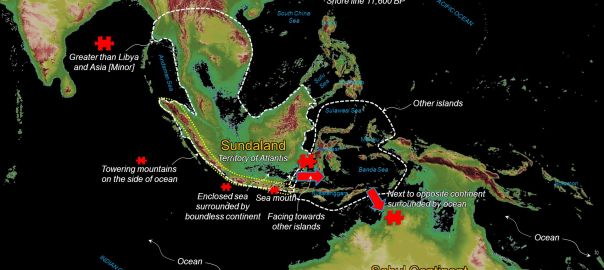
Figure 3.World map at ~11,600 BP with converging markers; Sundaland emphasized. Source: author’s reconstruction.
4.3 Sundaland Envelope: Enclosed Sea, ‘East Mouth,’ Mountains, and Sea Level (~–60 m)
Adopting the East Mouth Model, we focus on Sundaland with sea level near −60 m at ~11,600 BP. First, the macro-properties from 4.2 remain applicable at this scale: (i) a realm larger than Libya and Asia [Minor] (Sunda Shelf extent); (ii) facing towards other islands (archipelagic fields flanking the entrance); and (iii) next to an opposite continent which encompasses the true ocean (the broader oceanic realm beyond the island field).
Second, additional properties emerge at the envelope level: a semi-enclosed sea bounded by a boundless continent on its non-mouth sides; and the necessary existence of a sea mouth providing access from the Outer Sea. Two placements satisfy these conditions: a southern semi-enclosed sea and a northern semi-enclosed sea. The southern candidate—corresponding to the ancient Java Sea—fits the orientation logic of Section 3.4 (plain to the north; canals to the south; capital accessed from the Inner Sea) and is therefore advanced to the next step.
The northern alternative satisfies the sea-mouth requirement and faces other islands (though at greater distance); however, it lacks the critical property of being ‘next to an opposite continent’—that is, adjacency to the true ocean with an opposite continental mass. Consequently, the northern option does not fully meet consilience and is set aside.
Supplementing this envelope analysis, the inner geometry (plain size and orientation, canal spacing, ringed harbours, mountain frame) is preserved without contradiction under the East Mouth Model, and is poised for site-scale evaluation in 4.4.
Figure 4.Sundaland and the ancient Java Sea: enclosed sea, eastern mouths, mountain arc; shoreline ~–60 m. Source: author’s reconstruction.
4.4 Level Plain & Canals (South Kalimantan); Capital-Port and Mouth Placement
Within the southern semi-enclosed sea (ancient Java Sea), the reconstruction reviews prior properties and specifies site-scale elements: (i) a level alluvial plain in South Kalimantan approaching the proportions of “three thousand by two thousand stadia” (Critias 118a–b); (ii) a canalizable surface allowing ~100-stadia (~18.5 km) spacing and southward discharge toward the maritime approach (Critias 118c–d; 113e–114a); (iii) the capital-port city located at or near Gosong Gia reef—a reef-mantled high that communicates with the Inner Sea; and (iv) the sea mouth placed at the Kangean Mouth, supplying the required eastward entrance from a field of islands. These elements strengthen the East Mouth Model by interlocking the plain–canal–capital–mouth geometry into a single coherent frame.
Pilotage Sequence (applied): Vessels approach from the Outer Sea through the Kangean Mouth (east-facing entrance) into the Inner Sea (ancient Java Sea), then proceed along a straight canal to the ringed harbour waters of the capital at Gosong Gia—conforming to the sequence established in Section 3.3: Outer Sea → Mouth → Inner Sea → Straight Canal → Ringed Harbours.
Figure 5.South Kalimantan level plain and canals; placement of the capital-island inside the mouth. Source: author’s reconstruction.
This subsection reviews (not tests) the set of properties related to the capital-port city as described in the narrative. They form the inventory of pieces to be matched against site-scale evidence in 4.6 and integrated by fitness in 4.7:
Rings of water and land (concentric basins).
Fortification elements associated with the rings.
An accessing passage from the sea linking the Inner Sea to the basins.
A bridge system across the rings.
An underpass (sub-ring passage) enabling movement beneath a bridge.
Harbours integrated with the ring basins.
A royal palace complex on the central island.
State officials’ housing arranged in proximity to the palace.
A small hill near the center bearing a Poseidon temple.
A horse race track associated with the ceremonial/urban core.
Figure 6.Conceptual rendering of the ringed capital-island: water/land rings, bridges, and central sanctuary. Source: author’s reconstruction.
4.6 Benchmarks at Gosong Gia (Reef-Mantled High): Bathymetry vs Plato
Bathymetric survey results at Gosong Gia exhibit three properties that map directly onto Plato’s description and thus function as benchmarks (anchoring points) for the assembly of secondary pieces listed in 4.5:
Concentric circular formations aligned with ringed basins.
A small hill close to the center consistent with the temple-bearing eminence.
Sea depth around the coral reef ≈ 55 m, coherent with a reef-mantled high and near-surface obstruction.
These benchmarks anchor the secondary urban-architectural pieces—fortifications, passage, bridges/underpass, harbours, palace, officials’ housing, and race track—within a single coherent geometry. In the puzzle metaphor, the three benchmarks are the corner/edge pieces that fix the frame.
Figure 7.City plan vs. Gosong Gia bathymetry: central knoll, annular trough ~55 – 60 m and three benchmarks. Source: author’s comparison.
4.7 Consilience Tests
Consilience is applied at every step of the reconstruction, with fitness defined as the degree to which a candidate placement of each property (‘puzzle piece’) coheres with the assembled whole. The process explicitly tests and fits possibilities—for example, choosing between the southern vs northern semi-enclosed sea in 4.3, and evaluating the applicability of the East Mouth Model as established in 4.2. The fitness measure here is configuration-specific, asking whether each step improves the interlock of all properties within the Sundaland envelope and the Java Sea focus. The scenario that maximizes joint fitness across 4.1 – 4.6 is retained for synthesis and prediction.
4.8 Testable Predictions
The reconstruction yields concrete, falsifiable expectations at site and regional scales. These predictions operationalize the consilience framework by specifying where and how the configuration should be observable. Priority tests include:
Bathymetric/sonar imaging immediately around Gosong Gia should resolve a nested, near-concentric relief consistent with ringed basins and a small central-adjacent eminence.
Sub-bottom profiling and coring around the reef rim should recover sequences indicative of rapid post-event carbonate mantling and, where preserved, tsunami-grade reworking at depth consistent with ~11,600 BP triggers.
Remote sensing and DEM analysis across South Kalimantan should reveal rectilinear drainage or anthropogenic alignments that express ~100-stadia (~18.5 km) spacing, with a net southward gradient toward the ancient Java Sea.
Along the Kangean Mouth approach, relics of controlled passages (scoured channels, sills, or anthropogenic alignments) should be mappable along plausible fairways leading toward Gosong Gia.
Within the capital footprint, geophysical survey should prioritize loci for fortification traces, bridge abutments/underpass features, harbour aprons, palace/administrative platforms, the temple-bearing hill, and a linear/elliptical race-track embankment.
5. Conclusion
This study has treated Plato’s Timaeus and Critias as a structured repository of signs, extracting Order-2 properties (connotative features) and assembling them into an Order-3 reconstruction that is explicitly tested by consilience. The analytical scaffold distinguishes two narrative timelines (Timeline I, ca. 9,600 BCE; Timeline II, ca. 600 BCE) and two catastrophic phases (Phase I, instant devastation; Phase II, long-term subsidence and shoaling). Within this frame, the maritime system is parsed into five thalassa domains—ringed harbour waters, Inner Sea, Outer Sea, Ocean 1 (ocean-facing mountain margin), and Ocean 2 (true ocean with the opposite continent)—and constrained by a compass-orientation logic that yields three mutually exclusive mouth placements (east, south, west).
Across Sections 4.1–4.4, the reconstruction proceeds stepwise. First, the tropical constraint (~11,600 BP) filters candidates to the low latitudes. Second, global screening of narrative properties (larger than Libya and Asia [Minor]; facing other islands; next to an opposite continent encompassing the true ocean; coconut/elephant/rice distributions) yields a coherent fit in Southeast Asia during the Pleistocene/early Holocene exposure of Sundaland. Third, among the three orientation scenarios, the East Mouth Model best preserves the spatial logic derived in Section 3: a level plain to the north of an Inner Sea, southward canal discharge toward a maritime capital, a mouth that faces a field of islands, and a boundless continental frame elsewhere. At envelope scale (Section 4.3), the southern semi-enclosed sea (ancient Java Sea) satisfies the ‘opposite continent’ adjacency that the northern alternative lacks; thus the southern option advances.
At site scale (Section 4.4), the model interlocks: (i) a level alluvial plain in South Kalimantan approaching Plato’s stated dimensions (three thousand by two thousand stadia); (ii) a canalizable surface with ~100-stadia (~18.5 km) spacing and southward discharge; (iii) the capital-port’s ringed harbour waters positioned at a reef-mantled high at Gosong Gia; and (iv) an eastward entrance at the Kangean Mouth, yielding a pilotage sequence of Outer Sea → Mouth → Inner Sea → Straight Canal → Ringed Harbours. Section 4.5 inventories the capital properties from the dialogue (concentric rings of water and land; fortification; accessing passage; bridges and an underpass; harbours; royal palace; state officials’ housing; a small hill near the center with a Poseidon temple; and a horse race track), while Section 4.6 identifies three bathymetric benchmarks at Gosong Gia—concentric circular formations, a small central-adjacent hill, and ≈55 m surrounding depths—that anchor those secondary pieces in a coherent urban-harbour geometry.
Consilience in this framework is operationalized as fitness at every step: the degree to which each Order-2 property (puzzle piece) improves the interlock of the assembled structure without generating contradiction. The northern semi-enclosed sea option, while satisfying a mouth and facing other islands (at distance), fails the ‘next to an opposite continent’ criterion and therefore does not achieve joint fitness. By contrast, the southern semi-enclosed sea under the East Mouth Model maintains coherence from envelope to site scale and accommodates the Timeline II residue of a persistent obstructor as an Order-2 reef-mantled shoal.
The testable predictions generated by this synthesis are now consolidated in Section 4.8 to remain adjacent to the reconstruction steps they evaluate. The model stands as a map of verifiable expectations—an invitation to test a very old story against the seafloor and the sediments that still remember it.




 Sundaland Research Program