Recent Posts
2. Deglacial Rapid Inundation and Land-Loss Rates of Sundaland
3. Holocene and Deglacial Sea Surface Temperatures in Sundaland
4. Atlantis Parallels: When Myths Echo Plato’s Lost Island
5. A Refined Relative Sea-Level Curve for Sundaland
6. Solon’s Audience Accommodation: A Review of Critias 113a-b
7. Critias 115b: Coconut as a Puzzle Piece of Atlantis
A Consilient Test of Philology, Ecology, and Sundaland Plausibility
8. Three Alternative Compass-Oriented Spatial Models of Atlantis
9. Critias 115a–b & 118e: The Provisioning Complex of Staple and Companion
A Rice-Inclusive Base and Legumes under a Wet/Dry Calendar — A Semiotic–Philological Reading with Consilience-Based Reconstruction
10. Decoding Plato’s Atlantis: A Consilience-Based Reconstruction of the Lost Capital
A Semiotic–Linguistic Case for a Java-Sea Capital in Sundaland
11. Plato’s Two-Phase Catastrophe & the Dual Timeline of Timaeus–Critias
12. Timaeus 25d and the Coral Reef at Gosong Gia (Java Sea)
A semiotic–philological reading with consilience tests: “πηλοῦ κάρτα βραχέος” as a context clue.
13. Aurea Chersonesus Reconsidered: A Bi-Littoral Golden Corridor Centered on Sumatra
A testable synthesis of classical sources, resource geography, monsoon routing, and toponymy.
14. Inside the “Mouth”: Rereading Plato’s Pillars of Heracles as a Navigational Gate
A semiotic, philological and pilotage-based interpretation, with an application to the Kangean Mouth/Java Sea.
15. Decoding Signs of the Past: A Semiotic and Linguistic Framework for Historical Reconstruction
Recent News
Three prominent AI platforms were consulted to do comparative analyses of prominent theories regarding the location of Atlantis: OpenAI/ChatGPT, Google/Gemini and Hangzhou/DeepSeek. The analyses were performed by applying a score to each criterion. These AI platforms all concluded that the Sundaland (Java Sea – Dhani Irwanto) theory ranked highest in terms of the strength of theory construction scores based on their respective criteria.

Comprehensive Research for Human Civilizations
Human civilization has always been shaped by the interplay between memory, myth, and material evidence. Across cultures, ancient narratives preserve echoes of real places, events, and societies that time has otherwise obscured. Yet historians and archaeologists have often regarded myths and legends as unreliable, dismissing them as fiction or metaphor rather than as encoded fragments of memory. This research challenges this dismissal by developing a methodology that treats myths, legends, and symbolic records as structured systems of signs — open to semiotic and linguistic decoding, and capable of yielding historical truths when analyzed systematically.
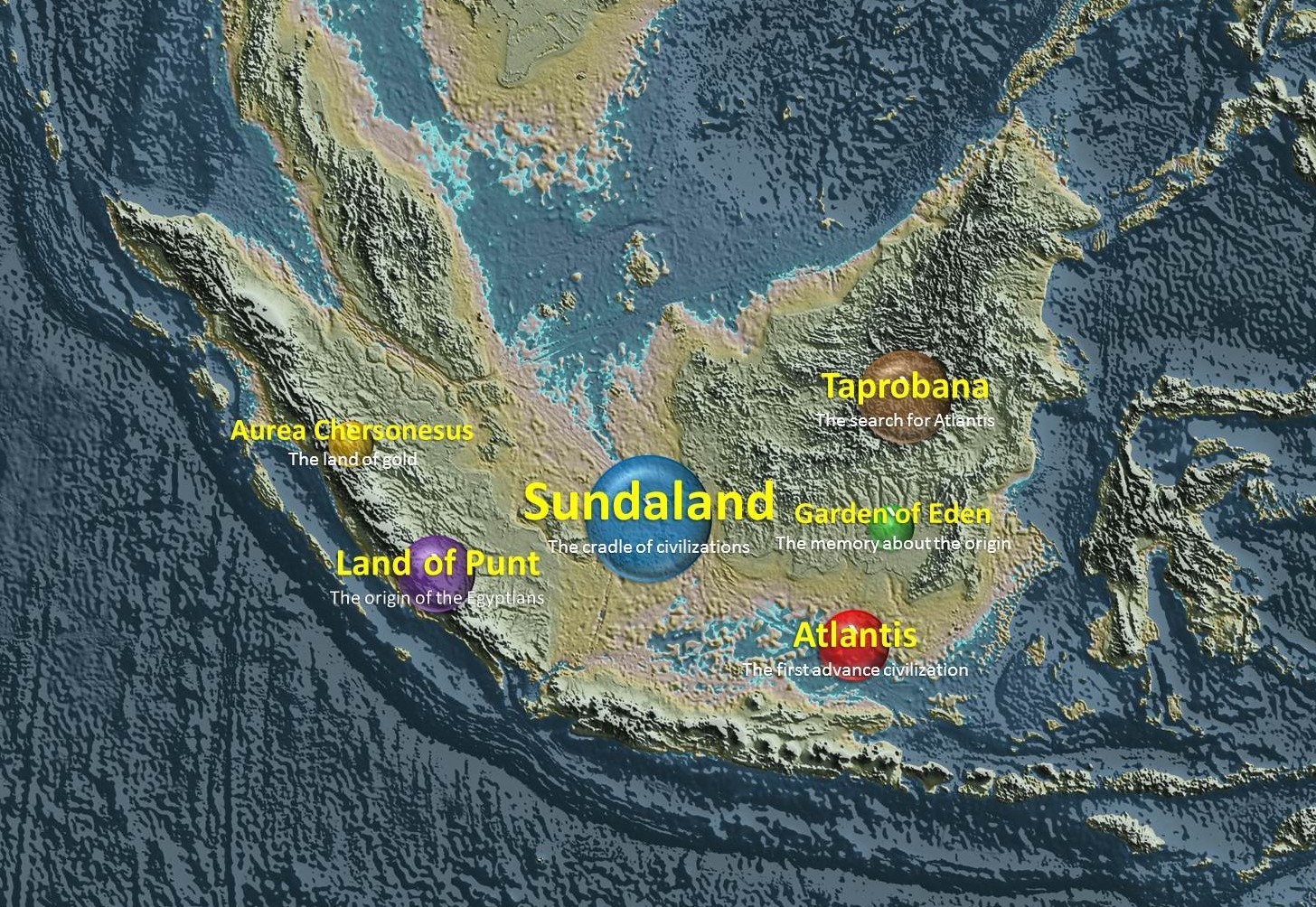
Over the past several decades, the work has centered on reconstructing the forgotten civilizations of Southeast Asia, particularly Sundaland, the now-submerged subcontinent that once connected the islands of Indonesia with the Asian mainland. Drawing on geology, archaeology, linguistics, climatology, and comparative mythology, it proposes that Sundaland was not only a cradle of human civilization, but also the setting for many of the world’s most enduring cultural myths, including Plato’s Atlantis, the Egyptian Land of Punt, the Greco-Roman Taprobana, and the Aurea Chersonesus.
The core of the research is a semiotic and linguistic framework for historical reconstruction. This framework integrates the classic theories of Ferdinand de Saussure, Charles Sanders Peirce, Roman Jakobson, and Roland Barthes with three methodological reconstruction models: Potsherds, Anastylosis, and Puzzle. By decoding signs and narratives across multiple layers of meaning — denotation, connotation, and myth — and reassembling them into structured objects, this method provides a rigorous approach for interpreting symbolic sources.
Crucially, the framework relies on the principle of consilience of evidence: the convergence of independent data from multiple disciplines toward the same conclusion. A single myth or inscription may be ambiguous, but when myths align with geology, when linguistics supports archaeology, and when cartographic traditions echo oral memory, the cumulative weight of evidence becomes compelling. It is this interdisciplinary synthesis that transforms speculative interpretation into robust reconstruction.
Through this approach, the research has advanced several key discoveries:
- Sundaland as the cradle of early civilizations, submerged by rising seas after the last Ice Age.
- Atlantis, as described by Plato, located in the Java Sea.
- The Land of Punt, remembered in Egyptian records, identified with Sumatra.
- Taprobana, long debated in classical geography, reinterpreted as Borneo (Kalimantan).
- The Aurea Chersonesus (“The Cape of Gold”) of Greco-Roman maps, identified as Tanjungemas (‘cape of gold’) in Sumatra.
These findings do not merely propose alternative geographies; they suggest a profound reorientation of world history — one in which Southeast Asia is recognized as a central hub of early human civilization, cultural diffusion, and maritime exchange.
The research is not intended to offer definitive answers, but to provide a replicable framework for decoding the past. By treating myths and legends as meaningful data, and by validating them through consilience across disciplines, the research aims to build bridges between symbolic memory and historical reality. In doing so, the hope is to inspire both scholars and the wider public to look at ancient narratives with renewed curiosity — not as distant fictions, but as coded testimonies of shared human origins.
Irwanto’s research methodology on Sundaland, Atlantis, The Land of Punt, Taprobana and Aurea Chersonesus is multidisciplinary and data-driven, combining geographic information system (GIS) mapping, bathymetry, topography, and paleo-environmental reconstructions. He generates maps of Sundaland during different periods of the Last Glacial Maximum and Younger Dryas by analyzing sea-level changes, river flow patterns, watershed boundaries, sedimentation, and coastal processes. This involves reconstructing ancient landscapes and river systems from elevation data (such as GTOPO30 grids), geological history, and underwater topography.
He also incorporates archaeological, paleontological, and genetic data to trace human migration and the rise of early civilizations in the region. Irwanto uses legends, linguistic studies, and mythology to complement scientific data, decoding cultural archetypes and linking them with physical evidence. His approach includes fieldwork, hydro-engineering principles, and semiotics in analyzing ancient civilizations, integrating both natural phenomena and human history to build a comprehensive picture of Sundaland as the cradle of civilization.
This methodological framework allows Irwanto to propose timelines, reconstruct ancient settlements, and connect geological events with mythological narratives like Atlantis.
Irwanto uses a research methodology that incorporates semiotics, linguistics, orders of signification, and reconstruction models to analyze and decode ancient historical narratives like Atlantis. He employs a multidisciplinary framework that combines historical texts, semiotic analysis, and linguistic studies to interpret signs, symbols, and mythological references embedded in ancient sources.
His approach aims to move beyond literal readings by understanding the layers of meaning (signification) within myths and historical accounts, reconstructing possible realities and cultural contexts behind symbolic expressions. This semiotic and linguistic framework is integrated with geological and archaeological data to create a comprehensive historical reconstruction model.
Irwanto’s recent work explicitly elaborates on this methodology, proposing analytical models that systematically decode the “signs of the past” to reconstruct lost civilizations like that of Atlantis in the Java Sea region.
The core steps in Irwanto’s semiotic methodology for historical texts, as outlined in his recent research, include the following:
- Collection of Primary Sources: Gathering myths, legends, ancient texts, inscriptions, archaeological artifacts, and symbolic records.
- Semiotic Decoding: Applying semiotic models such as Peirce’s triadic model (representamen, object, interpretant), Saussure’s dyadic model (signifier and signified), and Jakobson’s communication functions to decode narratives and symbolic structures.
- Barthesian Orders of Signification: Analyzing texts and symbols on three levels—denotation (literal meaning), connotation (cultural/emotional meaning), and myth (broader ideological meaning)—to uncover layered cultural meanings.
- Cross-validation: Triangulating the semiotic interpretations with archaeological, linguistic, ethnographic, climatological, and geographic evidence to validate findings.
- Reconstruction Models: Using models like Potsherds (fragmentary evidence), Anastylosis (partial restoration), and Puzzle (synthesis of dispersed data) to rebuild coherent historical narratives.
- Iterative Refinement: Continuously refining interpretations based on convergence of multi-disciplinary evidence (principle of consilience) to strengthen the robustness and reliability of the reconstruction.
This framework treats myths and ancient texts as structured sign systems preserving historical memory, using semiotic and linguistic decoding combined with scientific evidence to transform symbolic narratives into plausible historical realities.
Summary table of semiotic frameworks applied:
| Framework | Core Concept | Application |
| Saussure’s Dyadic Model | Signifier + Signified | Decoding textual/linguistic units |
| Peirce’s Triadic Model | Representamen + Object + Interpretant | Interpreting symbolic structures |
| Jakobson’s Functions | Six language functions (referential, emotive, etc.) | Understanding narrative roles |
| Barthes’ Signification | Denotation, Connotation, Myth | Revealing cultural and ideological layers |
This semiotic-linguistic integration allows for a rigorous interdisciplinary approach to decode and reconstruct ancient civilizations such as Atlantis and Sundaland.
Irwanto decides between potsherds, anastylosis, and puzzle models based on the nature and completeness of the available evidence:
- Potsherds model is used when evidence is fragmentary and scattered, like broken pottery shards or isolated archaeological finds. It involves piecing together these small, dispersed clues to infer a larger historical picture.
- Anastylosis model applies when partial but substantial remains exist, allowing partial restoration or reconstruction of a site or artifact, akin to reassembling a monument or structure from its surviving pieces.
- Puzzle model is employed when various types of evidence—archaeological, linguistic, geological, mythological—are dispersed and diverse, requiring synthesis to form a coherent historical narrative.
Irwanto’s choice depends on how direct, complete, and diverse the data sets are. When evidence is highly fragmented, the potsherds approach is appropriate; when remains are more intact, anastylosis fits; and when multiple evidence types must be integrated for holistic reconstruction, the puzzle model is used. This flexible methodology allows him to adapt to different research situations and richness of available data to reconstruct ancient civilizations and histories.
Irwanto handles conflicting evidence between models through a process of cross-validation and iterative refinement, where conflicting data from different models or sources are carefully examined for reliability and context. He weighs the completeness, consistency, and support from multidisciplinary evidence—archaeology, linguistics, geology, mythology—when deciding which model or interpretation has stronger support.
Conflicts are not discarded outright but become opportunities for deeper analysis, prompting reevaluation of assumptions or incorporation of additional data. This process is aligned with the principle of consilience, seeking convergence from independent evidence. When conflicts are significant, Irwanto may use an integrative approach to synthesize different viewpoints or indicate uncertainties rather than forcing a single interpretation.
This methodology ensures transparency and robustness by balancing different lines of evidence, prioritizing triangulated data, and acknowledging ambiguities that need further research or validation. Irwanto handles conflicting evidence between models by carefully weighing the reliability, completeness, and multidisciplinary support of each piece of evidence. Instead of discarding conflicts, he treats them as opportunities for deeper investigation and refinement of hypotheses. He applies cross-validation with data from archaeology, linguistics, geology, mythology, and other fields to seek convergence and consistency (principle of consilience).
When conflicts persist, he may synthesize differing perspectives or explicitly highlight uncertainties rather than forcing a single conclusion. This iterative and integrative approach ensures transparency, robustness, and adaptability in reconstructing historical narratives from incomplete or contradictory evidence.
Contextual stratigraphy is fundamental in Irwanto’s research as it provides the geological framework to correlate sedimentary layers with timelines and environmental changes in Sundaland. It helps him understand the sequence of land formation, sediment deposition, and subsequent flooding events which are essential to reconstructing when and how ancient civilizations thrived and were eventually submerged.
Using stratigraphic data, Irwanto can:
- Situate archaeological sites and cultural layers within a precise temporal context.
- Integrate geological events like tectonic movements and sea-level changes with human history.
- Cross-validate historical reconstructions with sedimentary and fossil evidence.
- Refine his models of Sundaland’s evolution by comparing stratigraphic layers and fossil records across the region.
Thus, contextual stratigraphy guides Irwanto’s choice of reconstruction models and supports his proposals linking geological and cultural developments in Sundaland’s history, ensuring that interpretations remain consistent with the region’s complex geotectonic and sedimentary record.
Recommended Videos
Below are recommended videos to watch related to the research.
1. Sundaland as the cradle of civilizations
2. Atlantis in the Java Sea
3. The Land of Punt
4. Taprobana
Published Books

Books by Dhani Irwanto
Atlantis: The Lost City is in Java Sea (2015)
Amazon, Amazon Kindle, Google Books (sample)
Atlantis: Kota yang Hilang Ada di Laut Jawa (2016)
Tokopedia
Sundaland: Tracing the Cradle of Civilizations (2019)
Amazon, Google Books (free), Google Play (free)
Land of Punt: In Search of the Divine Land of the Egyptians (2019)
Amazon, Google Books (free), Google Play (free)
Taprobana: Classical Knowledge of an Island in the Opposite-Earth (2019)
Amazon, Google Books (free), Google Play (free)
Sundaland | Atlantis | Taprobana | Land of Punt | Garden of Eden
Aurea Chersonesus | Kumari Kandam | Kangdez | Lemuria and Mu
 Sundaland Research Program
I think that is among the such a lot vital information for me.
And i’m happy reading your article. But want to
observation on few normal things, The website style is perfect,
the articles is actually great : D. Excellent task,
cheers
LikeLike
Best reasearches and most matching towards plato’s theory so far
LikeLike
if this all right, what’s benefit or profit can take ?
I settle in area (Garden Eden) in your mention.
I’am geologist
LikeLike
Sudah waktunya untuk muncul di era Melinium sebagai perbandingan technologi dan menjadikan pembelajaran untuk yang tidak dapat dilakukan dimasa sekarang… ☝👍🙏
LikeLike